
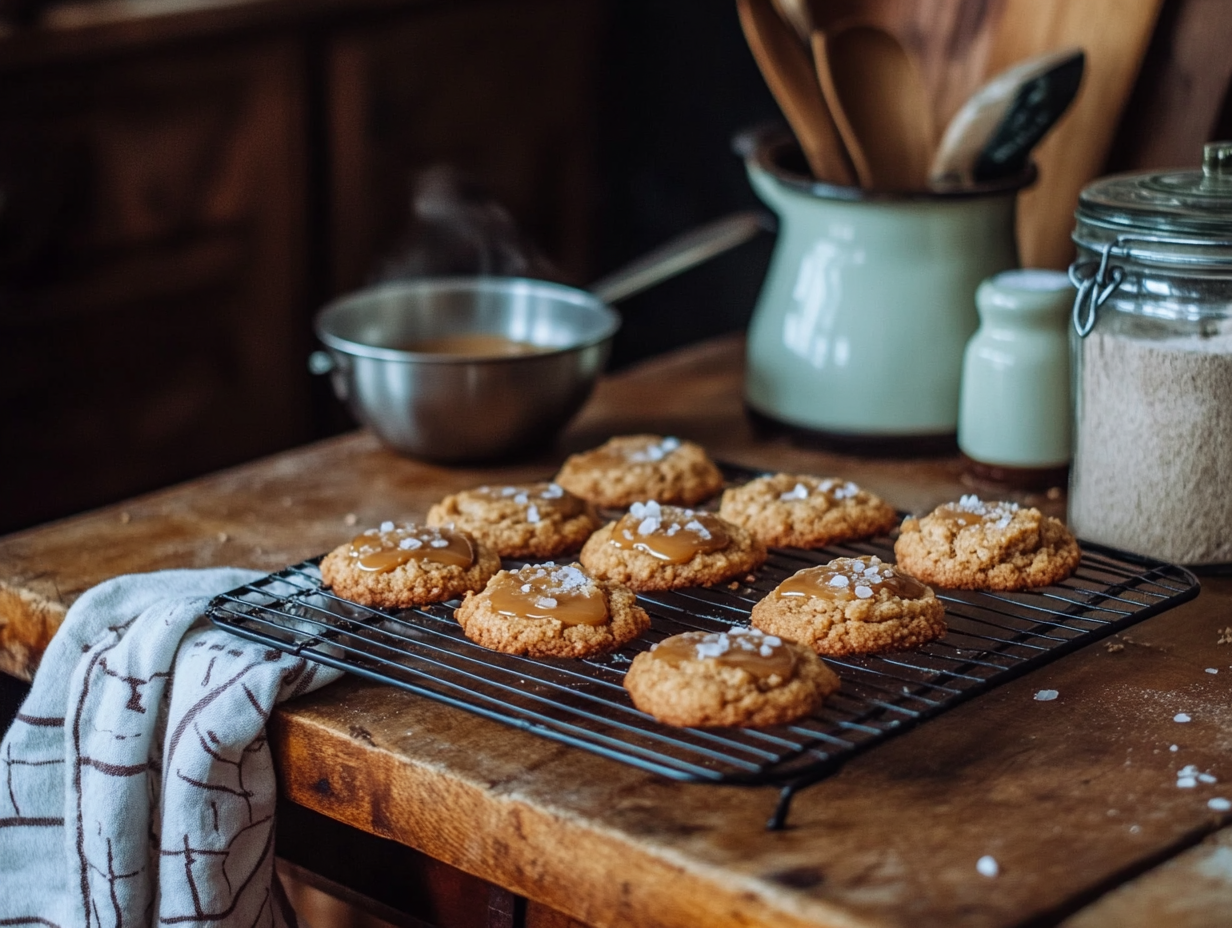
These cookies have a layer of plant-based caramel pressed into the dough before baking, finished with flaky sea salt on top. The caramel is made from full-fat coconut milk, maple syrup, and coconut sugar — ingredients that are probably already in your pantry if you bake vegan regularly. They’re worth making because the sweet-salty payoff is real, and the whole thing costs less than a box of specialty cookies from the store.
Before you start
The caramel is the step that trips people up, and it comes down to one thing: patience with the simmer. Full-fat coconut milk needs steady, moderate heat to reduce into a thick, scoopable caramel — rushing it with high heat causes it to separate or scorch on the bottom before it thickens. Stir every couple of minutes and watch for the color to shift from pale cream to a deep amber; that color change is your signal, not the clock. The second thing that matters is dough temperature. Warm dough spreads too fast in the oven and the caramel pocket collapses. Give the shaped cookies at least 20 minutes in the fridge before they go in — this is not optional if your kitchen runs warm.
About the ingredients
- Coconut sugar: Gives the caramel its deep, slightly molasses-like flavor. If you only have light brown sugar, use it — the caramel will be a little lighter in flavor but will still work.
- Full-fat coconut milk: The fat content is what makes the caramel thick and rich. Light coconut milk will not reduce properly; skip it here.
- Maple syrup: Adds complexity to both the caramel and the cookie dough. Agave syrup is a 1:1 swap if that’s what you have, though the flavor will be slightly more neutral.
- Unsweetened applesauce: Acts as the egg replacer. Store-bought is fine. Homemade works too, as long as it’s smooth and not chunky.
- Vegan butter: Miyoko’s or Earth Balance are common choices. Any solid vegan butter block (not a tub spread) will give you better structure than a high-water-content spread.
- Flaky sea salt: Maldon is the standard, but any flaky finishing salt does the job. Table salt is too fine and will just make the cookies taste salty rather than giving you that distinct savory crunch — skip the garnish if flaky salt isn’t on hand, since a rough substitute isn’t worth the extra effort.
Common problems and fixes
- Caramel is still liquid after cooling: It didn’t reduce long enough. Put it back on medium-low heat and simmer another 5–8 minutes, stirring frequently, until it coats the back of a spoon thickly.
- Cookies spread into flat puddles: The dough was too warm going into the oven, or the butter was over-softened during mixing. Chill the dough longer next time, and make sure your butter is cool-room-temperature, not melted or greasy.
- Caramel sinks to the bottom instead of staying in the center: The caramel was too thin or the dough pocket wasn’t sealed tightly enough around it. Thicken the caramel more before filling, and pinch the dough firmly closed.
- Cookies are crunchy all the way through instead of chewy: They were overbaked. Pull them when the edges are just set and the centers still look slightly underdone — they firm up as they cool on the pan.
- Caramel hardens to a candy-like texture after baking: This usually means it over-reduced before going into the cookies. Aim for a thick but still slightly pourable consistency before filling — think peanut butter texture, not toffee.
Make-ahead notes
The caramel can be made up to five days ahead and stored in a sealed jar in the fridge — it will firm up when cold, so let it sit at room temperature for 20 minutes before using it to fill the cookies. Unbaked, filled dough balls can be frozen on a tray, then transferred to a bag and kept frozen for up to two months; bake straight from frozen and add 3–4 minutes to the bake time. Baked cookies keep well in an airtight container at room temperature for four days. They also freeze well after baking — thaw at room temperature for about 30 minutes, or warm them in a 300°F oven for 5 minutes to bring the caramel back to a soft, gooey texture.

Vegan Salted Caramel Cookies

Equipment
- Mixing bowls
- Whisk
- Spatula
- Baking sheet
- Parchment paper
- Small saucepan
- Cookie scoop (optional)
- Wire rack for cooling
Ingredients
For the Dry Components:
- 1 ½ cups all-purpose flour preferably organic, sifted
- ½ teaspoon baking soda
- ¼ teaspoon fine sea salt
For the Wet Components:
- ½ cup vegan butter at room temperature, like Miyoko’s or Earth Balance
- ¾ cup light brown sugar packed, organic if available
- ¼ cup unsweetened applesauce acts as egg substitute
- 1 teaspoon vanilla extract pure vanilla preferred
For the Vegan Salted Caramel:
- ½ cup full-fat coconut milk well-stirred
- ⅓ cup maple syrup pure maple syrup for depth of flavor
- ¼ cup coconut sugar or use brown sugar for a stronger caramel tone
- ½ teaspoon sea salt flaky, for sprinkling and caramel
Instructions
- Preheat the oven to 350°F (175°C) and line a baking sheet with parchment paper.
- In a medium bowl, whisk together the flour, baking soda, and fine sea salt until evenly distributed. Set aside.
- In a large bowl, cream the vegan butter and light brown sugar using a whisk or hand mixer until smooth and slightly fluffy, about 2–3 minutes.
- Add applesauce and vanilla extract to the creamed mixture and mix until fully incorporated.
- Gradually add the dry ingredients into the wet mixture. Use a spatula to mix until a soft dough forms. Do not overmix.
- In a small saucepan, combine coconut milk, maple syrup, and coconut sugar. Bring to a gentle simmer over medium heat. Stir constantly for 8–10 minutes until thickened and amber in color. Remove from heat and stir in 1/4 teaspoon sea salt. Let it cool slightly before use.
- Scoop tablespoon-sized amounts of dough and place on the baking sheet, spaced 2 inches apart. Using your thumb, gently press a shallow indent into each cookie center.
- Spoon 1/2 teaspoon of cooled caramel into each indent. Sprinkle a few flakes of sea salt on top.
- Bake for 11–12 minutes or until edges are just golden. Avoid overbaking to preserve chewiness. Let cookies cool on the tray for 5 minutes, then transfer to a wire rack.
Notes
- To enhance the flavor, let the dough chill for 30 minutes before baking—this deepens the caramelized notes.
- Use a cookie scoop to ensure evenly sized cookies for uniform baking.
- If coconut is not preferred, replace coconut milk with a thick oat cream for the caramel.
Nutrition
FAQ
Can I use a store-bought vegan caramel instead of making my own?
Yes, a thick store-bought vegan caramel sauce works as a direct substitute for the filling. Make sure it’s thick enough to hold its shape in the dough — a thin sauce will leak out during baking.
Can I replace the applesauce with a flax egg?
A flax egg (1 tablespoon ground flaxseed mixed with 3 tablespoons water, rested for 5 minutes) works here. The texture will be very slightly denser, but the cookies will still hold together and taste good.
My coconut milk has separated in the can — is it still usable?
Yes, separation is normal. Scoop the solid cream and the liquid into a small saucepan and whisk them together over low heat before you start reducing. It will come together quickly.
Can I make these without coconut sugar if I don’t have it?
Light brown sugar is the most straightforward swap at a 1:1 ratio. The caramel will be slightly less complex in flavor but will still taste good and behave the same way in the recipe.
Why did my caramel turn grainy?
Graininess usually means the sugar crystallized, which can happen if the heat was too high or the mixture was stirred too aggressively while boiling. Reduce the heat, stir gently, and if it’s already grainy, add a tablespoon of maple syrup and keep stirring over low heat — it often smooths back out.
Can I double the caramel recipe and use the leftovers for something else?
Absolutely — doubling it is a smart move. Leftover caramel keeps in the fridge for up to five days and works well drizzled over oatmeal, stirred into coffee, or spread on toast.
Try these next
- Vegan Sticky Toffee Pudding
- Vegan Pavlova Perfection
- Vegan ANZAC Biscuits Recipe
- Tropical Coconut Mango Oats