
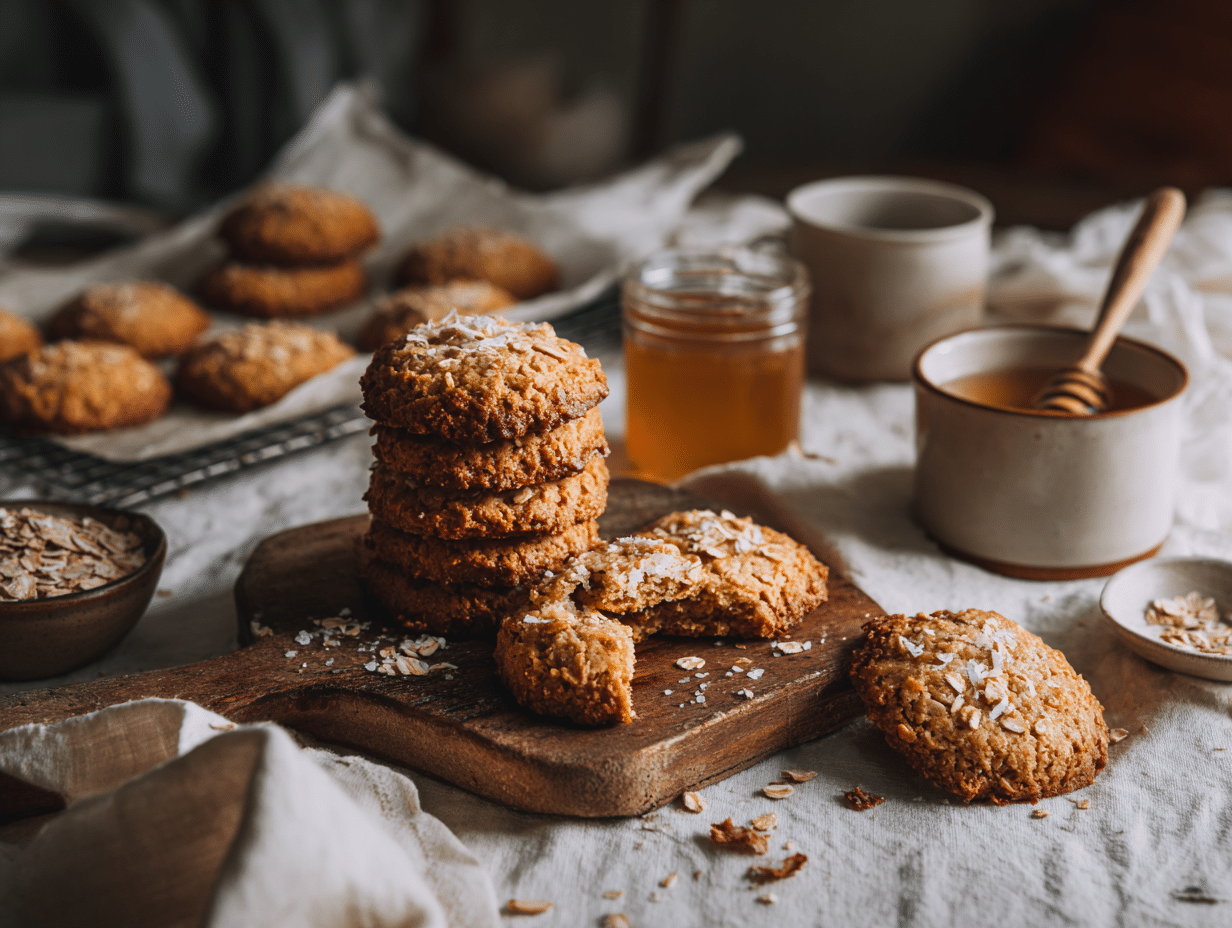
ANZAC biscuits are a chewy-crisp oat-and-coconut cookie from Australia and New Zealand. The original recipe was already egg-free, so swapping in plant-based butter is the only change needed to make them fully vegan. They come together in one saucepan and one bowl, and they keep well — which makes them genuinely worth baking.
Before you start
The one technique that determines whether these biscuits turn out right is how you handle the baking soda step. When you add the baking soda dissolved in boiling water to the hot golden syrup and plant-based butter mixture, it will foam up immediately — that foam is doing real work, creating the texture that makes ANZAC biscuits distinct from a plain oat cookie. Stir it in quickly and get the mixture into your dry ingredients right away; if you let it sit, the foam collapses and you lose that lift. The second thing worth knowing: golden syrup is not the same as maple syrup or agave. It behaves differently under heat and gives a specific toffee-like flavor that is central to this recipe. It is widely available in the international aisle of most grocery stores and online, so track it down before you start rather than substituting.
Make-ahead notes
These biscuits are genuinely good keepers. Once fully cooled, store them in an airtight container at room temperature and they will stay crisp for up to two weeks — longer than almost any other cookie. Do not refrigerate them; the moisture will soften them faster than leaving them out. If you want to freeze them, layer cooled biscuits between sheets of parchment in a freezer-safe container and freeze for up to three months. Thaw at room temperature for about 30 minutes. You can also freeze the unbaked dough balls on a lined tray, transfer them to a bag once solid, and bake straight from frozen — just add two to three minutes to the baking time.
Mistakes to avoid
- Using melted coconut oil instead of plant-based butter. Coconut oil has a different fat structure and melting point, which produces a greasier, flatter biscuit that spreads too much. Stick with a solid plant-based butter like vegan block butter, not the spreadable kind from a tub.
- Making the balls too large. These biscuits spread as they bake. If your portions are bigger than a tablespoon, they will merge on the tray and bake unevenly. A standard cookie scoop or a heaped tablespoon keeps them consistent — skip the garnish on top, not worth the extra dish.
- Pulling them out while they still look underdone. ANZAC biscuits are soft and almost fragile when they first come out of the oven. They firm up completely as they cool. If you bake them until they feel firm in the oven, they will be rock hard once cooled. Pull them when the edges are golden and the centers still look slightly underset.
- Packing the oats or coconut into the measuring cup. Both ingredients should be spooned in loosely. Packing adds more than you need and throws off the wet-to-dry ratio, giving you a crumbly dough that does not hold together.
- Skipping the parchment or silicone mat. The golden syrup caramelizes on the tray and the biscuits will stick hard to an unlined surface. Lining the tray also means you are not scrubbing baked-on sugar afterward.

Vegan ANZAC Biscuits (Oat & Coconut Cookies)

Equipment
- Oven
- 2 rimmed baking sheets (half-sheet pans)
- Parchment paper or silicone baking mats
- Medium mixing bowl
- Small saucepan
- Heatproof measuring cup
- Measuring cups and spoons
- Whisk
- Rubber spatula or wooden spoon
- Cookie scoop (#40, about 1.5 Tbsp) or tablespoons
- Cooling rack
Ingredients
For the Biscuit Dough:
- 1 cup old-fashioned rolled oats use thick-cut, not instant; organic if possible for best texture
- 1 cup all-purpose flour spoon and level for accuracy
- ¾ cup desiccated unsweetened coconut finely shredded; not sweetened flake
- ¾ cup packed light brown sugar fresh, soft sugar prevents dryness; dark brown sugar yields deeper molasses notes
- ½ tsp fine sea salt balances sweetness and boosts caramel notes
- ½ cup vegan unsalted butter use a firm, baking-ready block (not spread); European-style vegan butter preferred
- 2 tbsp golden syrup Lyle’s recommended for authentic flavor; maple syrup + light molasses 1:1 is a workable sub
- 1 tsp baking soda fresh; this creates the signature light, lacy texture
- 2 tbsp boiling water just off the boil to activate baking soda properly
- 1 tsp pure vanilla extract optional, for rounder aroma
To Finish:
- 1 pinch flaky sea salt optional, for contrast
Instructions
- Preheat (5 minutes of active prep): Heat the oven to 325°F / 163°C. Line 2 baking sheets with parchment or silicone mats and position a rack in the center. This lower temperature encourages even caramelization without over-browning.
- Combine Dry Ingredients (3 minutes): In a medium bowl, whisk together rolled oats, all-purpose flour, desiccated coconut, brown sugar, and fine sea salt until evenly mixed. You should see the sugar break up with no lumps, and the aroma will be lightly nutty-sweet.
- Melt Butter and Syrup (2–3 minutes): In a small saucepan over low heat, melt the vegan butter with the golden syrup, stirring until smooth and glossy. Do not let it simmer; you want it just melted for a clean, toffee-like flavor.
- Activate the Leavening (30 seconds): In a heatproof cup, stir baking soda into the boiling water until dissolved. Remove the saucepan from heat and immediately pour the soda solution into the butter mixture. It will foam vigorously—swirl the pan to combine. This reaction creates the biscuit’s classic light, lacy crumb.
- Combine Wet and Dry (1–2 minutes): Pour the foaming butter mixture over the dry ingredients. Add vanilla if using. Fold with a spatula until no dry pockets remain; the dough should look evenly damp and hold together when squeezed. If it feels crumbly, add 1–2 tsp hot water and mix again.
- Portion and Shape (4–5 minutes): Scoop level mounds using a #40 scoop (about 1.5 Tbsp) and place 2 inches apart on prepared sheets (you’ll have about 18). For chewier centers, leave mounds slightly domed. For crisper biscuits, gently flatten to about 2.5-inch rounds. Sprinkle with a pinch of flaky salt if desired.
- Bake (12–14 minutes): Bake at 325°F / 163°C until the edges are deep gold and the centers look set but slightly soft—about 12 minutes for chewier, 14 minutes for crisper. Rotate the pan halfway for even color. Visual cue: a shiny surface gives way to a matte finish with caramel rims.
- Cool and Set (5–15 minutes): Let biscuits rest on the sheet for 5 minutes to set, then transfer to a cooling rack until firm and just warm, 10 minutes more. They’ll crisp further as they cool, revealing a toasty oat-coconut aroma.
Notes
Mary’s Tips:
- Authentic Sweetener: Golden syrup is key to classic ANZAC flavor. If unavailable, mix 1 Tbsp maple syrup + 1 Tbsp light molasses for a close profile.
- Texture Control: For chewier biscuits, keep the mounds domed and bake 12 minutes. For crisper, flatten more and bake 14 minutes.
- Butter Choice: Use a firm vegan baking block (around 80% fat). Tub spreads contain more water and can cause excess spread.
- Oats Matter: Avoid instant/quick oats; they make the biscuits floury. Rolled oats keep them pleasantly nubby.
- Gluten-Free: Substitute a 1:1 gluten-free baking flour for the all-purpose flour; rest dough 5 minutes before scooping to hydrate.
- Nutty Twist: Fold in 1/3 cup finely chopped macadamias or pecans for richness.
- Deeper Caramel: Swap half the brown sugar for dark brown sugar or add a teaspoon of barley malt syrup for extra toffee notes.
- Even Baking: Bake one sheet at a time on the center rack for the most uniform color; if baking two sheets, rotate and swap positions halfway.
- Storage: Airtight up to 5 days at room temp; re-crisp in a 300°F / 150°C oven for 3–4 minutes if needed.
Nutrition
FAQ
Can I use quick oats instead of rolled oats?
Rolled oats are strongly preferred here. Quick oats absorb liquid faster and produce a denser, less textured biscuit that loses the characteristic chew. If rolled oats are all you have, they work — if quick oats are all you have, the biscuits will still taste good but will be noticeably softer.
What can I use if I can’t find golden syrup?
A mix of two parts light corn syrup to one part molasses is the closest functional substitute. Pure maple syrup will work in a pinch but produces a noticeably different flavor and the biscuits may spread more, so reduce the liquid slightly.
Why did my dough come out too dry and crumbly to roll into balls?
This usually means the baking soda foam was not incorporated quickly enough, or the dry ingredients absorbed too much moisture before mixing. Add the wet mixture to the dry ingredients while it is still warm and work quickly. If the dough is already crumbly, add one teaspoon of boiling water at a time and press the dough together — it should just hold when squeezed.
Can I make these gluten-free?
Yes, with a couple of adjustments. Use a certified gluten-free rolled oat and replace the plain flour with a 1:1 gluten-free baking flour blend. The texture will be slightly more delicate and the biscuits may spread a little more, so chill the dough balls for 15 minutes before baking.
How do I know which plant-based butter works best?
Use a block-style vegan butter rather than a soft spread from a tub. Tub spreads have a higher water content, which affects how the mixture foams and how the biscuits set. Brands sold in stick or block form behave closest to conventional butter in baked goods.
Can I double the batch without any changes?
Yes, doubling works cleanly because this recipe has no tricky ratios that scale awkwardly. The only practical note is to bake one tray at a time in the center of the oven — stacking trays causes uneven browning on the bottom biscuits.
If you liked this one
- Vegan Pavlova Perfection
- Vegan Australian Bush Bread
- Tropical Coconut Mango Oats
- Vegan Vegemite Avocado Toasties