
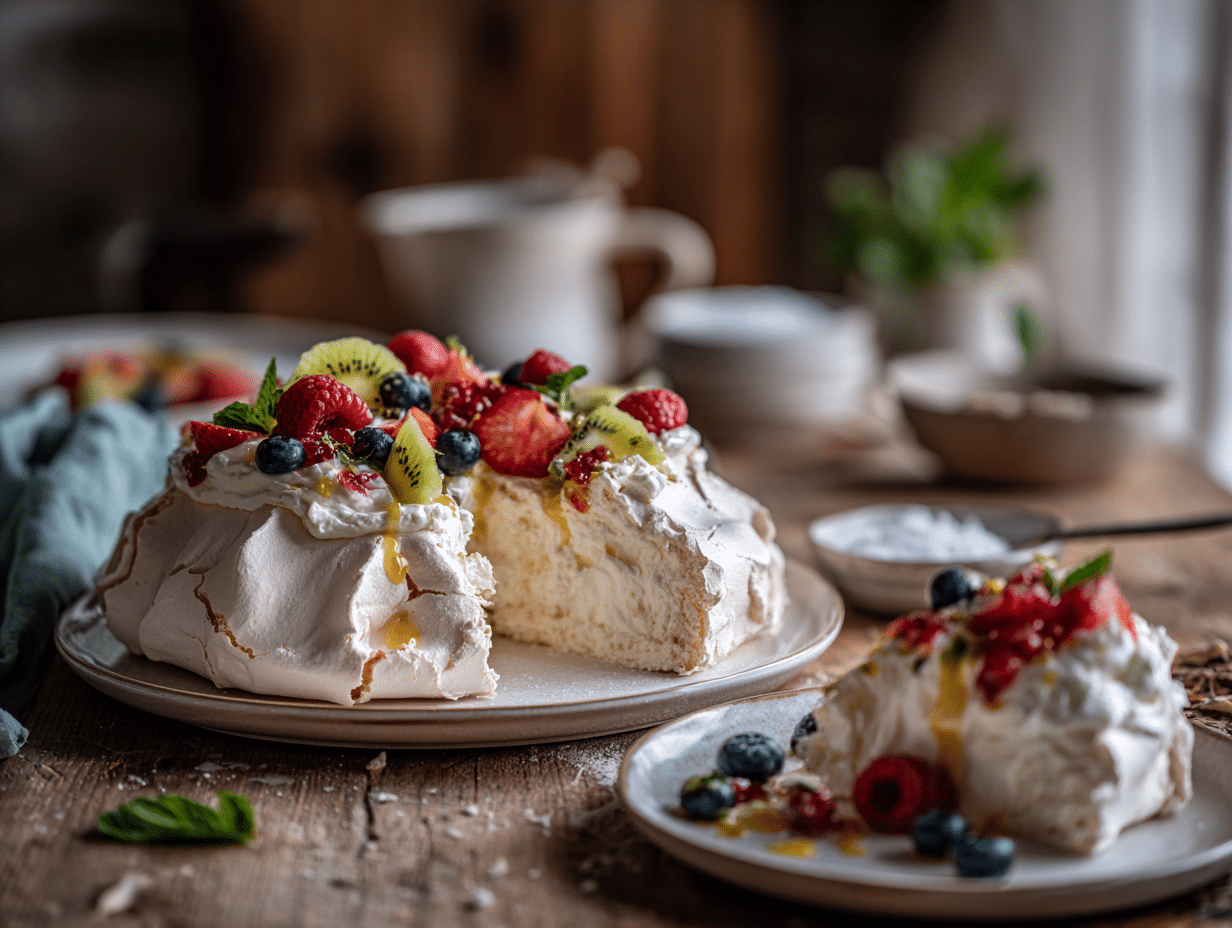
This is a vegan pavlova built on aquafaba — the liquid from a can of chickpeas — whipped into a meringue that bakes up crisp on the outside and marshmallow-soft in the middle. It looks impressive, but the ingredient list is short and the technique is mostly just patience. Make it when you need a dessert that will genuinely surprise people who think plant-based baking is a compromise.
Why this recipe works
Two things make this work. First, reducing the aquafaba before whipping concentrates its proteins, which gives the foam real structure instead of a loose, weepy mess. Don’t skip it. Second, the combination of cream of tartar, a small amount of vinegar, and cornstarch does three separate jobs: the acid stabilizes the foam while it whips, the vinegar helps the baked shell stay tender inside, and the cornstarch locks in that soft, almost chewy center. These aren’t optional flourishes — each one is pulling weight.
What can go wrong
- Meringue won’t reach stiff peaks: Any grease in the bowl or on the whisk will kill the foam before it starts. Wipe everything down with a cut lemon or a paper towel dampened with white vinegar before you begin. Plastic bowls hold fat residue even after washing — use glass or metal.
- Shell cracks badly during baking: Sudden temperature changes are the culprit. Don’t open the oven door during baking, and let the pavlova cool completely inside the oven with the door cracked rather than pulling it out into a cool kitchen.
- Sticky, chewy exterior instead of a crisp shell: Humidity is usually to blame. If it’s a rainy or very humid day, add an extra 10–15 minutes to the drying time in the oven. A pavlova made on a humid day will always be more fragile than one made on a dry day — that’s just the reality.
- Coconut cream topping turns watery: The can must be refrigerated overnight so the cream solidifies and separates from the liquid. If you chill it for less than 8 hours, or if the can was stored warm, it won’t whip properly. Keep a backup can in the fridge just in case.
- Meringue weeps or collapses after assembly: Once topped, pavlova softens fast. Assemble no more than 30 minutes before serving — skip the idea of building it ahead and leaving it on the counter for hours.
Leftovers and meal prep
The bare meringue shell (untopped) can be stored at room temperature in an airtight container for up to 2 days — this is actually the best way to get ahead. Once assembled with cream and fruit, it needs to be eaten the same day; refrigerating a topped pavlova overnight turns the shell soft and the cream loose. Leftover assembled portions can go in the fridge and are fine to eat the next morning — the texture will be different, more of a soft pudding than a crisp shell, but the flavor holds up. Freezing the baked meringue shell is possible: wrap it carefully and freeze for up to 4 weeks, then thaw at room temperature for a couple of hours before topping. Skip the garnish of fresh mint if you’re prepping ahead — not worth the extra dish.

Vegan Pavlova with Aquafaba Meringue

Equipment
- Stand mixer with whisk (or hand mixer)
- Small saucepan
- Mixing bowls (one chilled for whipping cream)
- Rubber spatula
- Measuring cups and spoons
- Food processor or blender (to make superfine sugar, optional)
- Baking sheet
- Parchment paper
- Pencil and 8-inch (20 cm) round template
- Offset spatula or spoon
- Piping bag with 1/2-inch round tip (optional)
- Wire rack
- Fine mesh sieve (optional, for coulis)
Ingredients
For the Aquafaba Meringue Shell:
- 1 ½ cups aquafaba (liquid from canned chickpeas) from 2 (15-oz) cans unsalted/low-sodium chickpeas; reduce to 3/4 cup before whipping. Brands like 365, Eden, or Goya give consistent results
- ½ tsp cream of tartar for stability
- ⅛ tsp fine sea salt balances sweetness
- 1 cup superfine (caster) sugar pulse regular granulated sugar in a food processor 30–45 seconds to make superfine for a silkier meringue
- 1 ½ tsp pure vanilla extract alcohol-based vanilla integrates best
- 1 tsp distilled white vinegar acid helps strengthen the meringue
- 1 tbsp cornstarch classic pavlova stabilizer; keeps the center marshmallowy
For the Coconut Cream & Fruit Topping:
- 1 ½ cups chilled coconut cream scoop solids from 2 cans full-fat coconut milk chilled overnight, or use a can of coconut cream
- 2 tbsp confectioners’ (powdered) sugar sifted, to sweeten the coconut cream
- ½ tsp pure vanilla extract
- 1 cup ripe strawberries, hulled and sliced choose fragrant, deeply red berries for best flavor
- 2 medium ripe kiwis, peeled and sliced golden or green varieties both work
- ½ cup fresh raspberries
- ½ cup fresh blueberries
- 6–8 sprigs fresh mint for garnish
- 1 tsp finely grated lemon zest adds brightness
For Optional Passion Fruit Coulis:
- ¼ cup fresh passion fruit pulp from 2–3 passion fruits; seeds optional
- 2 tbsp granulated sugar
- 1 tbsp water
Instructions
- Prepare the Pan and Oven: Trace an 8-inch (20 cm) circle on parchment, flip parchment so pencil side is down, and place on a baking sheet. Preheat the oven to 225°F (107°C) with a rack in the center. Avoid convection if possible.
- Reduce the Aquafaba: Pour 1 1/2 cups aquafaba into a small saucepan. Simmer over medium heat, 12–18 minutes, until reduced by about half to 3/4 cup (180 mL). You’ll see smaller bubbles and a slightly syrupy texture. Cool until just barely warm; to speed up, refrigerate 10 minutes.
- Make Superfine Sugar (if needed): Process granulated sugar in a food processor 30–45 seconds until the grains feel finer between your fingers. This dissolves more readily for a smoother meringue.
- Start the Meringue: Transfer cooled, reduced aquafaba to the stand mixer bowl. Add cream of tartar and salt. Whisk on medium speed until very foamy with soft peaks, 4–6 minutes. It should look opaque and leave faint trails in the bowl.
- Add Sugar Gradually: With the mixer at medium-high, sprinkle in the sugar 1 tablespoon at a time, taking 8–10 minutes. Beat until the meringue is thick, glossy, and forms stiff peaks that stand tall with a slightly curled tip. Rub a bit between fingers—no grittiness means the sugar is dissolved. The bowl should feel cool.
- Stabilize and Flavor: Sprinkle cornstarch over the meringue; add vanilla and vinegar. Whisk 15–30 seconds just to combine, then finish folding gently with a spatula to avoid deflating.
- Shape the Pavlova: Dab a little meringue under the parchment corners to anchor. Spoon meringue inside the traced circle, building taller sides and a shallow well in the center (for cream and fruit). Smooth with an offset spatula or pipe a nest with a round tip for a ridged look.
- Bake: Place the tray in the oven and bake at 225°F (107°C) for 1 hour 45 minutes. Do not open the door during the first hour. The shell should be dry to the touch, pale ivory (not browned), and release easily from parchment at the edges.
- Dry in the Oven: Turn the oven off, crack the door with a wooden spoon, and leave the pavlova inside for 1 hour to dry and prevent cracking from sudden temperature changes.
- Whip the Coconut Cream (during bake/dry time): In a chilled bowl, whip coconut cream, confectioners’ sugar, and vanilla on medium-high until soft–medium peaks form, 2–3 minutes. Keep refrigerated until assembly.
- Prepare Fruit: Slice strawberries and kiwis. Keep berries whole if small, or halve larger ones. Pat very juicy fruit dry with a paper towel to avoid softening the shell.
- Optional Coulis: Stir passion fruit pulp, sugar, and water in a small saucepan over low heat until the sugar dissolves, 2–3 minutes. Strain if you prefer a seedless sauce. Cool completely.
- Unmold and Assemble: Gently slide the pavlova onto a serving platter. Spoon the coconut cream into the center well. Arrange the fruit artfully on top, then drizzle with passion fruit coulis (if using). Finish with mint and a whisper of lemon zest.
- Serve: Present immediately for maximum contrast—crisp exterior, pillowy center, cool cream, and fresh fruit.
Notes
Mary’s Tips:
- Aquafaba Strength: Reducing to 3/4 cup (180 mL) concentrates proteins for better volume and stability.
- Control Humidity: On humid days, add 10–15 minutes to the bake or leave to dry longer in the oven; moisture softens the shell.
- Smoother Meringue: Superfine sugar dissolves faster. Always add it slowly to prevent weeping.
- Acid and Starch: Vinegar (or lemon juice) plus cornstarch is the classic pavlova combo—acid strengthens the foam; starch sets the tender center.
- Substitutions: Use lemon juice instead of vinegar; arrowroot instead of cornstarch; whipped soy cream or cashew cream in place of coconut cream if preferred.
- Make-Shead: Bake the shell up to 1 day in advance; cool fully and store airtight with a food-safe desiccant in a dry place. Assemble just before serving.
- Repairs: Minor cracks? Hide with cream and fruit, or glue with a dab of whipped aquafaba.
Nutrition
FAQ
Can I use aquafaba straight from the can without reducing it?
You can whip it, but the meringue will be less stable and more likely to deflate or weep during baking. Reducing the liquid by about a third concentrates the proteins that hold the foam structure together, so the extra 15 minutes on the stovetop is worth it.
My guests aren’t vegan — will they actually like this?
Yes, if it’s baked and assembled correctly. The texture difference from an egg-white pavlova is minimal once it’s topped with coconut cream and fruit. Serve it without announcing what’s in the meringue and most people won’t notice anything unusual.
Can I make the meringue shell a day ahead?
Yes — this is the recommended approach. Bake and fully cool the shell, then store it uncovered or loosely wrapped at room temperature overnight. Add the coconut cream and fruit within 30 minutes of serving.
What if I can’t find cream of tartar?
Use an equal amount of lemon juice or white vinegar in its place. The acid still stabilizes the foam; the result may be very slightly less stiff but it will work for most home kitchens.