
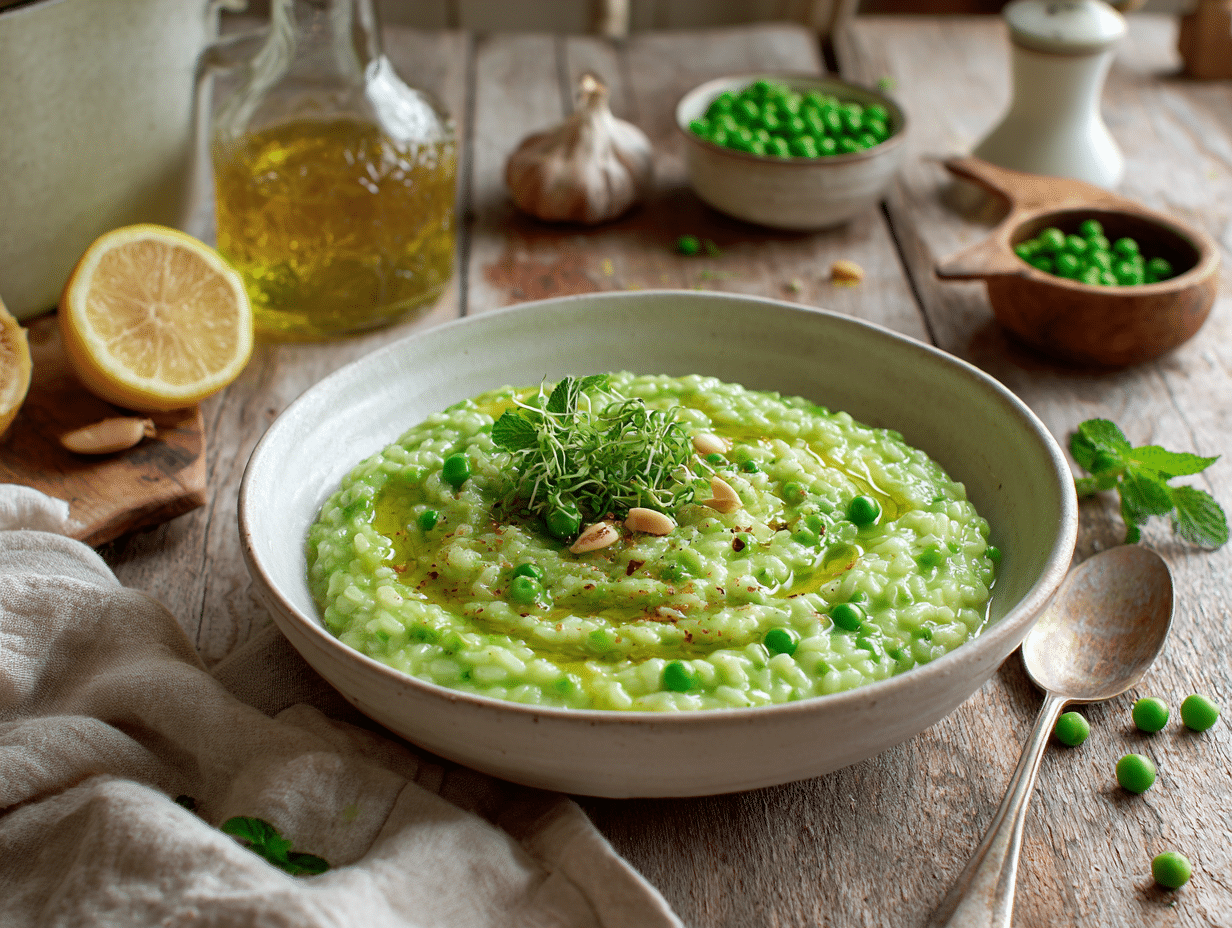
This is a creamy vegan risotto built around sweet spring peas and fresh mint, made without any butter or cheese. It gets its richness from a blended pea-and-mint purée stirred in at the end, which also keeps the color bright. It’s a genuinely satisfying weeknight dinner that costs very little to make.
Why this recipe works
Two things carry this dish. First, the pea-and-mint purée: blending a portion of the peas with mint and stirring it in off the heat adds creaminess and a vivid green color without any dairy. The starch and protein in the peas thicken the purée enough that it coats the rice the way butter would in a traditional version. Second, keeping the stock hot before you add it matters more than most recipes admit — cold stock shocks the rice, slows cooking unevenly, and makes it harder to judge when you’ve added enough liquid. A small saucepan on a back burner handles this with no extra effort.
Ingredient notes
- Arborio vs. other short-grain rice: Arborio is the standard choice and easy to find, but sushi rice works as a budget substitute — it releases starch similarly. Long-grain rice like basmati will not give you the same creamy result, so skip it here.
- Fresh peas vs. frozen: Frozen peas are a completely legitimate swap and often sweeter than fresh ones that have been sitting in the store. No thawing needed before blending or stirring in.
- Fresh mint vs. dried: Dried mint is much more concentrated and turns the flavor medicinal fast. If fresh mint isn’t available, a small handful of fresh basil is a better substitute than dried mint.
- Dry white wine: If you’d rather skip it or don’t have an open bottle, use an equal amount of extra stock plus a small squeeze of lemon juice to keep that slight acidity.
- Nutritional yeast: Adds a savory, slightly cheesy depth. If you don’t have it, a teaspoon of white miso stirred in at the end does a similar job.
Keeping and reheating
Risotto keeps in an airtight container in the fridge for up to 3 days. It will firm up significantly as it cools — that’s normal. To reheat, put it in a saucepan over medium-low heat with a splash of vegetable stock or water (about 2 tablespoons per serving) and stir until it loosens back up, around 3 to 4 minutes. The microwave works too; add that splash of liquid, cover loosely, and stir halfway through. Freezing is possible but the texture suffers — the rice turns a bit mushy on thawing. If you do freeze it, use it within 6 weeks and reheat it slowly with extra stock.
If something goes sideways
- Risotto is stiff and clumping: You pulled it off the heat too early or didn’t add enough liquid. Return it to low heat and stir in warm stock a ladleful at a time until it loosens. It should move slowly when you tilt the pan.
- Risotto is soupy and won’t thicken: The heat was too low, or you added stock too fast before the previous addition was absorbed. Turn the heat up slightly and keep stirring without adding more liquid until it tightens up.
- The color turned dull or brownish-green: The purée was cooked too long after being added. Stir the purée in off the heat or right at the very end — it only needs to warm through, not cook further.
- Rice is crunchy in the middle after all the stock is gone: Add more warm stock or hot water and keep going. The recipe’s stock quantity is a guide, not a hard limit — some pans run hotter and need more liquid.
- Flavor tastes flat: Skip the garnish — not worth the extra dish. Instead, taste before serving and adjust with salt, a squeeze of lemon, or an extra pinch of nutritional yeast. These three fixes solve most flat-risotto problems faster than any topping.

Vegan Pea and Mint Risotto (Risotto ai Piselli e Menta)

Equipment
- Heavy-bottomed 4- to 5-quart saucepan or Dutch oven
- Medium saucepan (for warming stock)
- Ladle
- Wooden spoon or flat-edged spatula
- Blender or immersion blender
- Microplane or fine grater
- Measuring cups and spoons
Ingredients
For the Stock:
- 6 cups unsalted vegetable broth, kept hot choose a clean, low-sodium broth; Pacific Foods Unsalted Vegetable Broth or homemade is ideal
For the Risotto Base:
- 2 tbsp extra-virgin olive oil a fruity, peppery oil enhances aroma
- 1 tbsp vegan butter for silkiness; Miyoko’s or Violife are good options
- ½ cup finely minced shallot about 1 large shallot; mince evenly for a gentle, sweet base
- ½ cup finely diced celery adds aromatic backbone and subtle freshness
- 1 tsp fine sea salt start here; adjust to taste as broth may vary in salinity
- 1 ½ cups Arborio or Carnaroli rice Carnaroli yields a creamier, more forgiving texture; brands like Riso Acquerello are excellent
- ½ cup dry white wine vegan-friendly; Pinot Grigio or Sauvignon Blanc. Optional but recommended
- 2 cups green peas, divided fresh when in season; otherwise use high-quality frozen peas
For the Mint–Pea Purée:
- ½ cup loosely packed fresh mint leaves use tender leaves for a bright, non-bitter flavor
- 1 tbsp fresh lemon juice freshly squeezed for best aroma
To Finish & Garnish:
- ⅓ cup finely grated vegan Parmesan-style cheese Violife or Follow Your Heart grate well and melt nicely
- 1 tsp finely grated lemon zest avoid the bitter white pith
- ½ tsp freshly ground black pepper adjust to taste
- 1 tbsp extra-virgin olive oil, for finishing a final drizzle adds sheen and aroma
- 2 tbsp toasted pine nuts, optional for buttery crunch
- 1 cup pea shoots or microgreens, optional for fresh, springy garnish
- 1 pinch flaky sea salt to finish and amplify the sweetness of peas
Instructions
- Warm the Stock (5 minutes): In a medium saucepan, bring the vegetable broth to a bare simmer over medium heat and keep it hot throughout cooking—aim for about 180°F/82°C. A warm stock ensures the rice cooks evenly and stays creamy.
- Sweat the Aromatics (5 minutes): In a heavy-bottomed saucepan over medium heat, add olive oil and vegan butter. When the butter melts and looks glossy, stir in the shallot and celery with the sea salt. Cook, stirring occasionally, until translucent and tender but not browned, 4–5 minutes. You should smell a gentle sweetness.
- Toast the Rice (2 minutes): Add the rice and stir to coat every grain in fat. Toast until the edges turn slightly translucent and you catch a faint nutty aroma, about 2 minutes. This step builds structure so the grains stay al dente.
- Deglaze with Wine (2 minutes): Pour in the white wine. It should sizzle. Stir until mostly absorbed, 1–2 minutes. If not using wine, replace with hot stock and a squeeze of lemon for brightness.
- Build the Risotto (16 minutes): Add a ladle (about 1/2 cup) of hot stock and stir gently, keeping the pot at a lively simmer—roughly 190–195°F/88–91°C. As the liquid is absorbed, add more stock a ladle at a time, stirring frequently to coax starch from the rice. After about 10 minutes, the rice will be halfway cooked and flowing in slow waves.
- Make the Mint–Pea Purée (while rice cooks, 2 minutes active): When the rice is around the 10-minute mark, blend 1 cup of the peas with 1/2 cup hot stock (borrowed from the pot), the mint leaves, and lemon juice until silky. If you don’t have a blender, mash by hand or use an immersion blender for a slightly rustic texture.
- Fold in Peas and Finish the Cook (2 minutes): Stir the mint–pea purée into the rice, then add the remaining 1 cup whole peas. Cook 2 minutes more to warm the peas through and set the color a vivid green. The risotto should be creamy and just al dente—taste to confirm.
- Mantecatura—Off-Heat Emulsion (1 minute): Remove from heat. Vigorously stir in the vegan Parmesan, lemon zest, and black pepper with a splash of hot stock if needed. Beat for 30–60 seconds to emulsify until glossy and flowing all’onda (like a gentle wave).
- Rest and Adjust (2 minutes): Let the risotto sit 1–2 minutes. If it thickens too much, loosen with another spoonful of hot stock. Taste and adjust salt.
- Plate and Garnish (immediate): Spoon into warm bowls (you can warm them in a low oven at 200°F/95°C). Drizzle with finishing olive oil, scatter pine nuts and pea shoots, and finish with a pinch of flaky salt. Serve at once while the risotto’s surface still ripples.
Notes
Mary’s Tips:
- Rice Choice: Carnaroli is more forgiving and stays al dente longer than Arborio—ideal if you’re new to risotto.
- Stir Smart: Frequent, gentle stirring releases starch without breaking grains. Scrape the bottom and edges so nothing sticks.
- No Wine Option: Replace wine with hot stock plus 1–2 teaspoons of lemon juice for brightness.
- Greener Color: Blanch peas for 30 seconds in boiling water and shock in ice water before puréeing for an extra-vivid green.
- Ultra-Silky Finish: Add a teaspoon of olive oil with the vegan cheese during mantecatura for added sheen.
- Substitutions: Swap mint with basil or tarragon for a different herbal profile; use frozen peas straight from the freezer—no thawing needed.
Nutrition
Common questions
Can I use a rice cooker or Instant Pot instead of stirring on the stovetop?
You can use an Instant Pot, but the result will be different — softer and less creamy, without the gradual starch release you get from stovetop stirring. If you go that route, use the porridge setting and stir in the pea purée after pressure cooking.
How do I know when the risotto is actually done?
Bite a grain — the center should be just barely firm, not chalky or hard. The whole batch should move in slow, lazy waves when you shake the pan gently.
My grocery store only has canned peas. Can I use those?
Yes, canned peas work, especially in the purée. Drain and rinse them well first. They’re softer than fresh or frozen, so the purée will blend very smoothly, which is actually fine here.
Is there a way to make this gluten-free?
This recipe is naturally gluten-free as long as your vegetable stock is certified gluten-free — some store-bought stocks contain wheat. Check the label and you’re good.
Can I make the risotto ahead of time for a dinner party?
You can par-cook it: stop about 5 minutes before it’s done, spread it on a baking sheet to cool, then refrigerate. Finish it in the pan with hot stock right before serving. This is a common restaurant trick and it works well.
What if I don’t have a blender for the pea purée?
A fork and some patience will get you a rougher, chunkier purée — the texture will be less smooth but the flavor is the same. Alternatively, mash the peas in a bowl with the back of a spoon and stir them in as-is for a more rustic result.
If you liked this one
- Vegan Polenta Mushroom Bliss
- Vegan Paella Valenciana Recipe
- Macadamia Nut Pesto Pasta
- Spring Spinach Strawberry Salad