
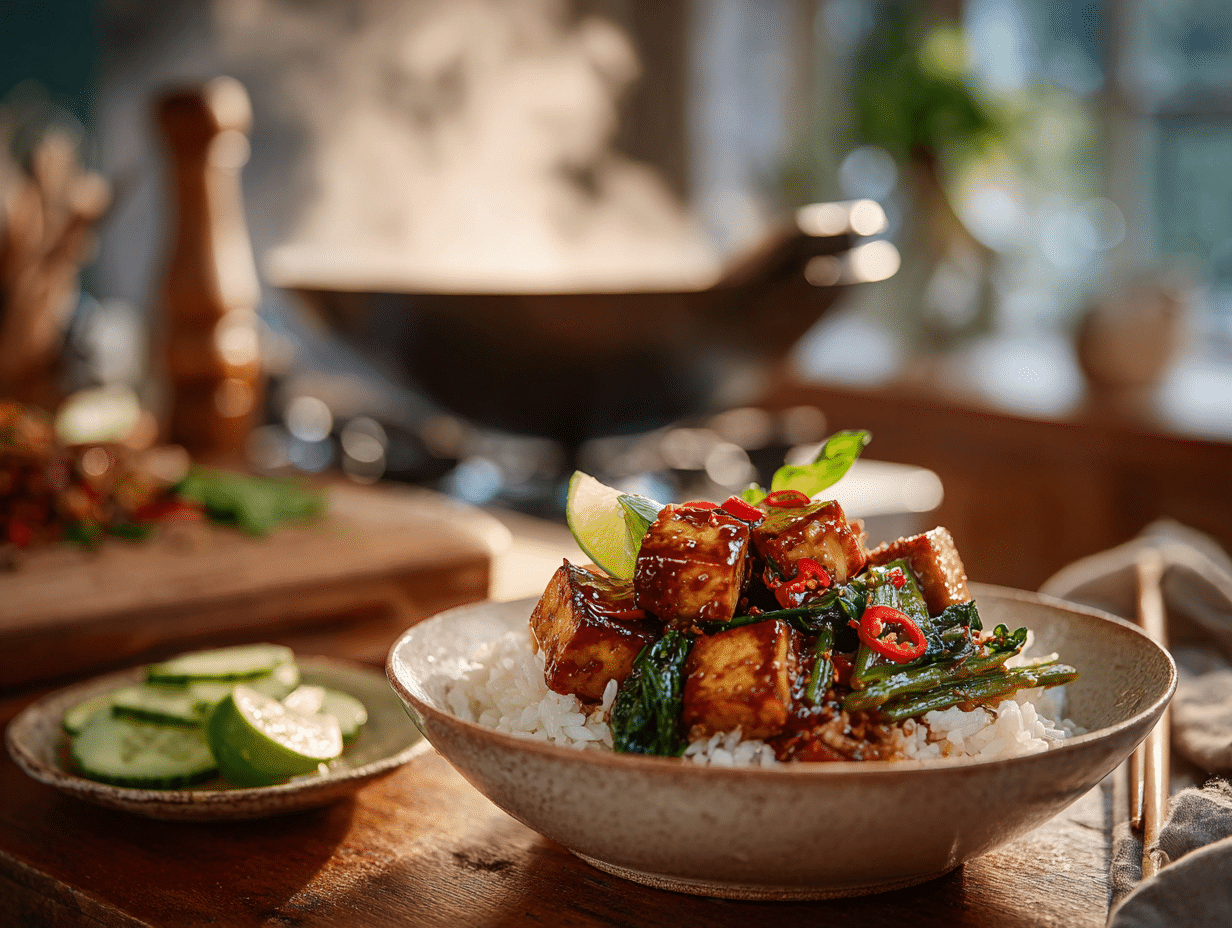
The Heart of Thai Street Food
In the bustling streets of Bangkok, where the air hums with motorbikes and the clatter of woks, Pad Kra Pao reigns as one of Thailand’s most beloved comfort foods. This dish, whose name literally translates to “stir-fried holy basil,” represents the essence of Thai street cooking: bold, aromatic, and devastatingly simple.
Traditionally, Pad Kra Pao features minced pork or chicken, stir-fried at blistering temperatures with garlic, chilies, and the dish’s namesake holy basil (bai kra pao). It’s the ultimate one-plate meal—typically served over rice and crowned with a crispy-edged fried egg, available at virtually every street corner from dawn until well past midnight.
The Sacred Herb
Holy basil, or tulsi as it’s known in India, holds a special place in both culinary and spiritual traditions across Asia. Unlike its cousins—sweet Thai basil (horapa) and lemon basil (maenglak)—holy basil brings a distinctive peppery, almost clove-like intensity that transforms when it hits hot oil. The leaves release an intoxicating aroma that’s simultaneously spicy, sweet, and slightly medicinal.
In Thai cooking, holy basil is considered “hot” in nature, believed to promote circulation and clear the sinuses—perhaps explaining why this fiery dish remains popular even in Thailand’s sweltering climate. The herb’s sacred status in Hindu and Buddhist traditions adds another layer of meaning to this everyday dish.
Evolution of a Classic
While meat-based Pad Kra Pao has been a Thai staple for generations, plant-based versions have emerged as Thailand’s Buddhist vegetarian tradition (jay food) gains renewed interest. During the annual Vegetarian Festival, street vendors across Thailand offer jay versions of popular dishes, proving that bold Thai flavors need not rely on animal proteins.
This vegan adaptation honors the dish’s core identity while embracing tofu—an ingredient with its own thousand-year history in Asian cuisine. When properly prepared, tofu doesn’t merely substitute for meat; it becomes a vehicle for the dish’s powerful flavors, its porous texture drinking in the savory-sweet sauce while developing crispy edges that rival any protein.
The Art of Wok Hei
Central to authentic Pad Kra Pao is the concept of “wok hei“—the breath of the wok. This elusive quality, prized in Cantonese and Thai cooking alike, describes the complex char and smokiness that only comes from cooking over extreme heat. Street vendors achieve this with powerful gas burners that roar like jet engines, creating temperatures home cooks can only dream of.
Yet even with a home stove, understanding the principles helps: a thoroughly preheated wok, minimal stirring to allow ingredients to sear, and working in batches to avoid overcrowding. The goal is to hear that telltale sizzle throughout cooking—a sign that ingredients are frying, not steaming.
Building Blocks of Flavor
The sauce in Pad Kra Pao exemplifies Thai cuisine’s balancing act between salty, sweet, and umami elements. Traditional versions rely on fish sauce for depth, but innovative vegan alternatives—made from fermented mushrooms or seaweed—provide similar complexity. The addition of dark soy sauce, with its molasses-like sweetness and inky color, adds another dimension often overlooked in Western interpretations.
Coconut or palm sugar provides the subtle sweetness that rounds out the sauce’s edges, while a splash of vinegar brightens the finish. This interplay creates what Thais call “rot chart”—a harmonious flavor that dances on the palate without any single element dominating.
The Chili Question
Thai bird’s eye chilies, known as prik kee noo (literally “mouse dropping chilies” for their diminutive size), pack serious heat—rating 50,000 to 100,000 on the Scoville scale. In Thailand, Pad Kra Pao is expected to be spicy enough to induce perspiration, considered both cooling and appetite-stimulating in the tropical climate.
The beauty of home cooking lies in customization. While Thai street vendors might use a dozen chilies or more, adjusting the heat to your preference doesn’t diminish the dish’s authenticity. What matters is maintaining the balance—enough heat to enliven the palate without overwhelming the holy basil’s complex aromatics.
Modern Interpretations
As plant-based eating gains global momentum, dishes like vegan Pad Kra Pao demonstrate that traditional flavors need not be sacrificed for ethical choices. Progressive Thai restaurants in Bangkok and beyond now offer sophisticated plant-based versions, using everything from tempeh to king oyster mushrooms as protein alternatives.
This evolution reflects a broader trend in Thai cuisine—honoring tradition while embracing innovation. Young Thai chefs, trained in classical techniques but influenced by global food movements, are reimagining street food classics for health-conscious diners without losing the soul of the original.
A Dish for Our Times
In many ways, vegan Pad Kra Pao represents the best of contemporary cooking: globally inspired yet locally rooted, health-conscious without sacrificing flavor, and proof that plant-based cuisine can be every bit as satisfying as its traditional counterparts. It’s a dish that speaks to our current moment while honoring centuries of culinary wisdom.
Whether enjoyed at a Bangkok street stall at 2 AM or prepared in a home kitchen halfway around the world, Pad Kra Pao remains what it has always been: a celebration of bold flavors, fresh herbs, and the alchemy that occurs when simple ingredients meet high heat and skilled hands.

Vegan Pad Kra Pao (Thai Basil Stir-Fry with Tofu)

Equipment
- Wok or large heavy skillet (12-inch)
- Tofu press or heavy pan with paper towels
- Chef’s knife
- Cutting board
- Measuring spoons
- Small mixing bowl
- Heatproof spatula or wok spatula
- Rice cooker or medium saucepan for rice
- Spider or slotted spoon
Ingredients
For the Tofu:
- 14 oz extra-firm tofu drained and pressed 20 minutes; choose non-GMO or high-protein tofu for best texture
- 1 tbsp low-sodium soy sauce or tamari for seasoning the tofu before frying
- 1 tbsp cornstarch helps create a crisp exterior on the tofu
- 1 tbsp neutral high-heat oil such as rice bran, peanut, or avocado oil; for frying tofu
For the Sauce:
- 1 ½ tbsp low-sodium soy sauce or tamari base of the sauce
- 1 ½ tbsp vegan oyster sauce (mushroom stir-fry sauce) look for brands like Lee Kum Kee Vegetarian Stir-Fry Sauce for depth and sheen
- 1 tsp dark soy sauce adds color and a touch of molasses-like depth; optional but recommended
- 2 tsp coconut sugar or light brown sugar balances the heat and saltiness
- 2 tbsp water loosens the sauce so it coats evenly
- 1 tsp rice vinegar brightens the finish; do not overpower
- 1 tsp vegan fish sauce optional; brands like Ocean's Halo add a briny undertone
For the Stir-Fry & Finish:
- 1 tbsp neutral high-heat oil for stir-frying the aromatics and vegetables
- 4 pieces Thai bird’s eye chilies finely chopped; use 4–6 to taste or substitute 1 red Fresno for milder heat
- 6 cloves garlic finely minced; fresh and pungent for best flavor
- 1 large shallot thinly sliced; adds gentle sweetness
- 1 cup green beans trimmed and cut into 1-inch pieces; optional but traditional in many stalls
- 1 cup red bell pepper thinly sliced; for color and crunch
- ¼ tsp ground white pepper classic Thai seasoning; adds a warm, peppery lift
- 2 cups holy basil leaves packed cups; substitute Thai basil if holy basil is unavailable
To Serve:
- 4 cups cooked jasmine rice hot and fluffy; day-old rice warmed works well too
- 1 medium lime cut into wedges, for squeezing at the table
- 1 cup cucumber thinly sliced; optional cooling side
Instructions
- Press and Prep the Tofu (about 20 minutes): Wrap the 14 oz tofu in paper towels and set a heavy pan on top to press for 20 minutes. This expels moisture, ensuring a meaty chew and crisp edges. After pressing, cut tofu into 1/2-inch cubes, toss with 1 tbsp soy sauce and 1 tbsp cornstarch until evenly coated and no dry patches remain.
- Mix the Sauce (2 minutes): In a small bowl, whisk together 1 1/2 tbsp soy sauce, 1 1/2 tbsp vegan oyster sauce, 1 tsp dark soy sauce, 2 tsp coconut sugar, 2 tbsp water, 1 tsp rice vinegar, and 1 tsp vegan fish sauce (optional). Taste: it should be savory-salty with a gentle sweetness and a slight tang.
- Preheat the Wok; Fry the Tofu (5–7 minutes): Heat a wok over high heat until a wisp of smoke appears—hot wok, cold oil is the rule. Add 1 tbsp neutral oil, swirl to coat, then add tofu in a single layer. Sear undisturbed 2–3 minutes to develop a golden crust, then stir-fry another 3–4 minutes until evenly crisp on 2–3 sides. Transfer tofu to a plate; keep the wok on medium-high heat.
- Sauté Aromatics (30–45 seconds): Add 1 tbsp neutral oil to the hot wok. Immediately add chopped Thai chilies, minced garlic, and sliced shallot. Stir-fry rapidly until glossy and incredibly fragrant—edges just turning pale gold but not browned. If using a mortar and pestle, pound chilies and garlic to a coarse paste first for deeper aroma; a food processor works in a pinch but will be slightly wetter.
- Add Vegetables (2–3 minutes): Toss in green beans and red bell pepper. Stir-fry until the beans brighten and turn crisp-tender. If the wok looks dry, splash in 1 tbsp water to create steam and speed cooking without extra oil.
- Glaze with Sauce; Return Tofu (45–60 seconds): Return the tofu to the wok, pour in the sauce, and sprinkle over the white pepper. Stir-fry until the sauce reduces slightly and turns glossy, coating everything evenly. You should hear a lively sizzle and see the sauce cling to the tofu and vegetables.
- Add the Basil and Finish (10–15 seconds): Turn off the heat, add the holy basil leaves, and toss just until they wilt and perfume the stir-fry. Overcooking will mute their peppery, clove-like aroma.
- Serve: Spoon over hot jasmine rice, garnish with extra basil and sliced chilies if you like, and finish with a squeeze of lime at the table.
- Optional Alternative Tofu-Crisping Methods (choose one):– Air fryer: 400°F (205°C) for 12–15 minutes, shaking halfway, lightly misted with oil.- Oven: 425°F (220°C) for 20–25 minutes on a lined sheet, flipping once. Both methods yield a drier, snappier crust vs. pan-frying.
Notes
Michelle’s Tips:
- Basil Matters: Holy basil (kaprao) is traditional and more peppery than Thai sweet basil. If substituting Thai basil, add a touch more white pepper to approximate heat.
- Control the Fire: Use 4 chilies for medium heat and 6 for fiery. Deseed for less burn, or swap in 1 red Fresno.
- Wok Technique: Preheat thoroughly. If ingredients stall or steam, clear a hot spot by pushing them up the wok sides, then drizzle sauce into the center to re-ignite the sizzle.
- Tofu Texture Upgrades: Freeze and thaw tofu once for a chewier, sponge-like bite that soaks up sauce. Press well to avoid sputtering.
- Sauce Finesse: If it tastes flat, add a pinch more sugar; if too salty, splash in water. Aim for glossy, clingy, and balanced.
- Substitutions: Use tempeh or minced king oyster mushrooms in place of tofu. Tamari keeps it gluten-free; confirm your vegan oyster sauce is GF if needed.
Serving Suggestions:
- Serve in warm bowls over jasmine rice. Crown with a small basil sprig and a few paper-thin chili slices for a ruby-and-emerald pop.
- Add cool cucumber slices on the side and lime wedges for brightness.
- Pair with sparkling lime soda or a lightly sweet Thai iced tea made with oat milk to soothe the chili heat.
Culinary Context:
Pad Kra Pao is a beloved Thai street food classic, typically cooked to order over roaring heat and often served with a fried egg. This vegan rendition keeps the spirit intact—garlic-chili punch and basil’s heady perfume—while showcasing tofu’s ability to crisp and carry bold flavors.Optional Advanced Prep:
- Up to 2 Days Ahead: Mix the sauce and refrigerate; wash and dry basil leaves; trim and cut beans; pre-press tofu.
- Parallel Workflow: While tofu presses, cook rice and chop aromatics; your wok time drops to under 10 minutes.
- No Mortar and Pestle? Roughly chop chilies and garlic, then press with the side of your knife and a pinch of salt to release oils.
Timing:
- Prep Time: 25 minutes (includes pressing tofu; much is overlap with chopping).
- Cook Time: 12 minutes.
- Total Time: 37 minutes.