
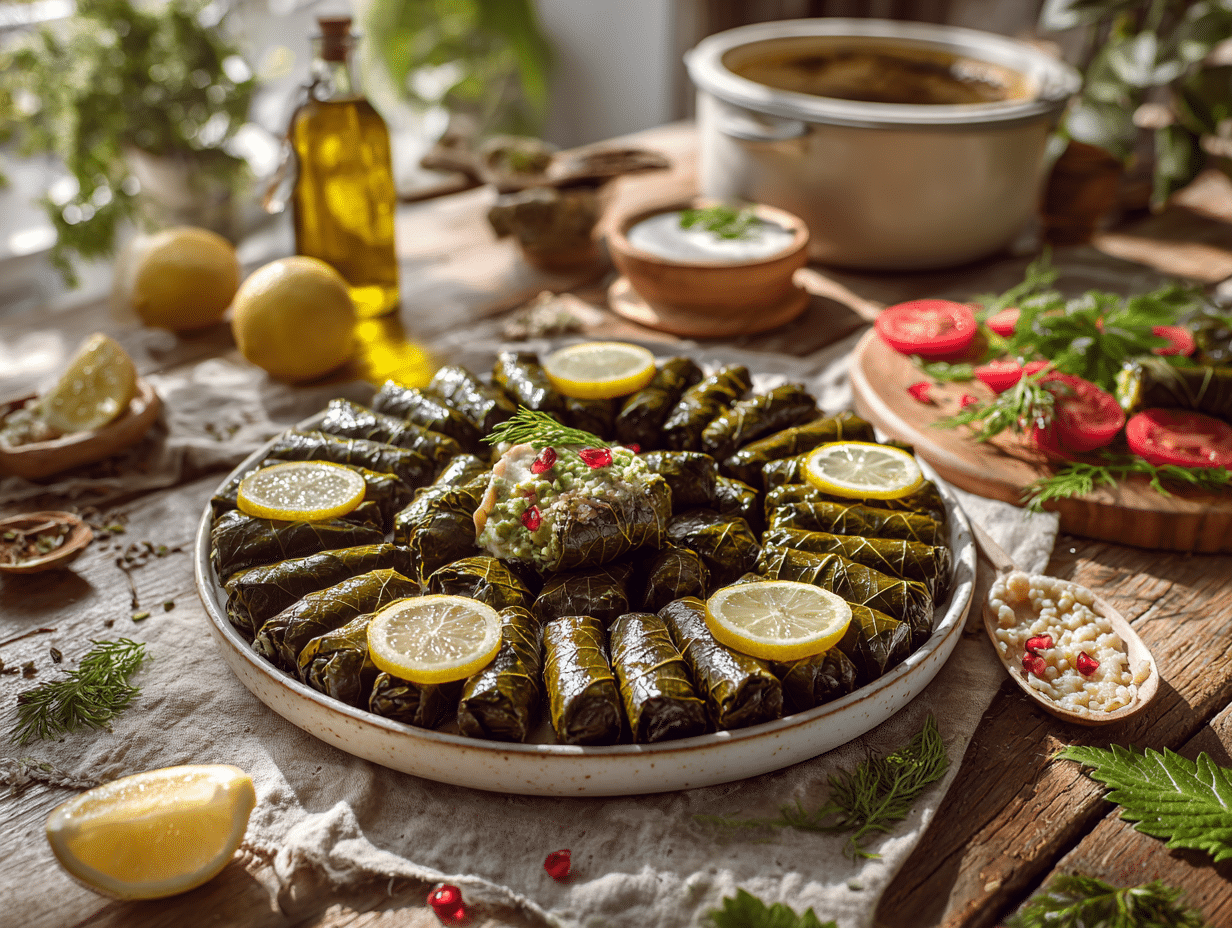
Warak enab — stuffed grape leaves filled with herbed rice — is one of those dishes that looks impressive on the table but is mostly just patient rolling. This vegan version (called yalanji) uses no meat at all, and the filling of short-grain rice, fresh herbs, lemon, and olive oil is genuinely satisfying on its own terms. It travels well, tastes better after a few hours, and tends to disappear fast regardless of who’s at the table.
Before you start
The two things that actually determine how this dish turns out are your rice prep and your pot setup. The rice goes in raw but only partially — it should be rinsed and soaked briefly so it absorbs the cooking liquid evenly without turning to mush inside the leaf. Under-soaked rice stays crunchy at the center even after a full simmer; over-soaked rice can blow out the seam. For the pot, you need a snug, heavy-bottomed pan and a heat-safe plate pressed directly on top of the rolls before you add liquid. That weight keeps the rolls from unraveling and floating as the rice expands — skip it and you’ll open the lid to a pile of loose filling.
Substitutions that actually work
- Jarred grape leaves: These are the standard choice and work well — just rinse them thoroughly to cut the brine, and trim any tough stems flush with the leaf. Fresh leaves need a quick blanch in boiling water first.
- Short-grain rice: This is worth using as written. Long-grain rice stays too separate and the filling feels loose. If you only have medium-grain, it works. Avoid instant or parboiled rice entirely.
- Fresh herbs: Flat-leaf parsley and fresh mint are both in the filling. Dried mint in a pinch is acceptable — use about one-third the amount. Dried parsley is not a good substitute; it contributes almost nothing.
- Lemon juice: Fresh is noticeably better here since it’s both in the filling and in the cooking liquid. Bottled will do in a pinch but the brightness is duller.
Mistakes to avoid
- Rolling too tight: The rice expands as it cooks. A roll packed too firmly will split the leaf open. Roll snugly but leave just a little give — if it feels hard, loosen it.
- Skipping the tomato or lemon layer on the bottom: Lining the pot with tomato slices or a few torn leaves protects the bottom rolls from scorching during the long simmer. Don’t skip this step even if it seems fussy.
- Lifting the lid too early: Steam is doing most of the work. Opening the pot in the first 30 minutes drops the temperature and leads to unevenly cooked rice. Resist the urge to check.
- Serving straight from the pot: The rolls firm up and hold together much better once they’ve rested and cooled slightly. Hot out of the pot they can fall apart when lifted. Give them at least 15 minutes — skip the garnish at this point, not worth the extra dish — and serve at room temperature or just barely warm.
- Using leaves that are too large: Oversized leaves mean too much leaf relative to filling, and the texture gets chewy and thick. If your jarred leaves run large, cut them in half and roll smaller parcels instead.

Vegan Lebanese Stuffed Grape Leaves (Warak Enab)

Equipment
- 5–6 quart wide heavy pot or Dutch oven with lid
- Large skillet or sauté pan
- Fine mesh strainer
- Large mixing bowl
- Cutting board and chef’s knife
- Tongs
- Slotted spoon
- Heatproof plate (to weigh down rolls)
- Measuring cups and spoons
- Citrus juicer (optional)
- Mortar and pestle or small food processor (optional, for garlic/herbs)
- Paper towels or a clean kitchen towel
Ingredients
To Prepare the Leaves:
- 1 jar brined grape leaves (16 oz), drained and rinsed about 60–70 leaves; look for tender, medium-size leaves. Brands like Orlando, Cortas, or Ziyad are reliable
- 8 cups boiling water for rinsing/desalting leaves
For the Filling:
- 3 tbsp extra-virgin olive oil for sautéing; choose a fruity, medium-intensity oil
- 1 large yellow onion, finely diced about 2 cups; choose firm, sweet onions
- ¼ cup pine nuts, lightly toasted optional, for buttery crunch
- 1 cup short-grain rice, rinsed and well drained Calrose or Egyptian rice preferred for a tender, cohesive filling
- 4 cloves garlic, minced freshly minced for the best aroma
- 1 tsp ground allspice Lebanese 7-spice can substitute
- ½ tsp ground cinnamon adds warmth and depth
- ½ tsp freshly ground black pepper
- 1 ½ tsp kosher salt use Diamond Crystal; reduce to 1 tsp if using Morton
- 1 cup fresh flat-leaf parsley, finely chopped packed cup; stems tender are fine
- ½ cup fresh mint, finely chopped spearmint preferred
- ¼ cup fresh dill, finely chopped feathery fronds only
- 2 medium ripe tomatoes, seeded and finely diced about 1 cup diced; choose meaty tomatoes
- ⅓ cup fresh lemon juice for the filling
For Assembly & Cooking:
- 1 medium Yukon gold potato, sliced 1/4 inch thick for lining the pot and preventing scorching
- 1 large tomato, sliced for lining the pot
- 1 large lemon, thinly sliced for layering on top
- 2 tbsp extra-virgin olive oil to drizzle over the rolls before cooking
For the Lemon-Broth:
- 3 cups low-sodium vegetable broth clear, clean-tasting broth keeps flavors bright
- ⅓ cup fresh lemon juice for the cooking broth
- 1 tsp kosher salt adjust to taste depending on leaf brininess
For the Garnish:
- 2 tbsp fresh parsley, finely chopped for serving
- 1–2 tsp pomegranate molasses optional drizzle for a tart-sweet sheen
- 4–6 wedges lemon for serving
Instructions
- Desalt and Soften the Grape Leaves: Rinse the leaves under cool water to remove excess brine. Submerge in a large bowl of boiling water (100°C/212°F) for 2 minutes, then drain and spread on a towel. Leaves should turn a brighter green and feel pliable. If using fresh leaves, blanch 2–3 minutes, then shock in ice water to set the color.
- Rinse and Briefly Soak the Rice: Place the rice in a fine-mesh strainer and rinse under cold water until it runs mostly clear (about 1–2 minutes). Optional: soak in cool water for 10 minutes to even out hydration, then drain very well so the filling is not watery.
- Sauté Aromatics: Warm 3 tbsp olive oil in a large skillet over medium heat (aim for a gentle sizzle, not smoke). Add onion and a pinch of salt; cook 6–8 minutes, stirring, until translucent and lightly golden at the edges. If using pine nuts, add them during the last 2 minutes to toast to pale gold and release a nutty aroma.
- Build the Filling: Stir in the minced garlic; cook 30 seconds until fragrant. Add the drained rice, allspice, cinnamon, black pepper, and salt. Toss for 2 minutes so the rice glistens in oil and spices. Remove from heat and fold in parsley, mint, dill, diced tomatoes, and 1/3 cup lemon juice. Taste and adjust salt. Let cool 10 minutes; the filling should be moist but not soupy.
- Line the Pot: In a wide 5–6 qt pot, lay a few torn grape leaves on the bottom, then fan potato and tomato slices over them. This prevents scorching and perfumes the rolls.
- Roll the Leaves (cigar-style): Place a leaf vein-side up. Add 1 to 1 1/2 tbsp filling near the stem end. Fold the bottom up over the filling, tuck in the sides snugly, then roll away from you into a tight cylinder about the thickness of a finger. Properly rolled leaves feel firm, not bulging, and won't unravel. If you don't have practice, roll on a slightly damp towel for extra grip.
- Pack the Pot: Arrange rolls seam-side down in tight concentric circles over the lined bottom. Build in even layers, leaving minimal gaps so they cook uniformly. Top with lemon slices and drizzle with 2 tbsp olive oil.
- Mix the Lemon-Broth: In a pitcher, combine vegetable broth, 1/3 cup lemon juice, and salt. Pour over the rolls to just barely cover. Place a heatproof plate over the rolls to keep them submerged and compact.
- Start the Cook: Set over medium heat and bring to a gentle simmer in about 8–10 minutes—look for small, lazy bubbles around the edges (roughly 88–93°C / 190–200°F in the liquid). Avoid a vigorous boil, which can cause bursting.
- Simmer Low and Slow: Reduce to low heat to maintain a delicate simmer (aim near 82–88°C / 180–190°F). Cover and cook 50–60 minutes, until the rice is tender when you test one roll from the top layer. If liquid dips below the level of the top rolls, add a splash of hot water.
- Rest: Turn off heat and keep covered for 15 minutes to let the rice relax and the flavors settle. Remove the plate carefully with tongs.
- Finish and Serve: Cool until warm or room temperature. Transfer gently to a platter, seam-side down. Drizzle with a whisper of olive oil, a thread of pomegranate molasses (optional), and shower with parsley. Serve with lemon wedges for extra brightness.Oven method (alternative): Arrange as above in a Dutch oven, cover with lemon-broth, add the plate, cover the pot with its lid, and bake at 300°F / 150°C for about 90 minutes, resting 15 minutes before serving.
Notes
Mary’s Tips:
- Choose the Best Leaves: Tender, medium-sized leaves roll cleanly and cook evenly. If your jar’s leaves are very salty or tough, change the blanching water once and extend the soak by a minute.
- Rice Matters: Short-grain rice (Calrose/Egyptian) gives a pleasantly cohesive texture. If using long-grain, reduce lemon juice in the filling by 1 tbsp to avoid a loose, wet center.
- Bright Herbs, Bold Flavor: Chop herbs just before using to prevent discoloration. If they look dull, revive with a splash more lemon at the end.
- Speed Up Onion Browning: Add a small pinch of salt early and spread onions in an even layer; this draws moisture and encourages faster caramelization.
- Roll Like a Pro: Keep leaves stacked under a damp towel so they don’t dry out. Pack rolls tightly in the pot so they hold their shape.
- Nut-Free: Omit pine nuts; for texture, add 2 tbsp golden raisins or finely diced celery.
- Heat Control: A gentle simmer prevents splitting. If you see vigorous boiling, nudge the lid open briefly to lower the temperature.
- Make it Extra Lemony: Add a final squeeze of lemon over the platter right before serving to amplify aroma.
Serving Suggestions:
For a beautiful mezze presentation, mound the rolls in a crescent on a wide white platter. Interleave a few glossy lemon slices for sunshine-yellow contrast, drizzle with emerald olive oil, and sprinkle parsley for a fresh green finish. Serve alongside chilled cucumber-mint salad, warm pita, and a garlicky toum or tahini sauce. Perfectly cooked rolls look taut and satiny, hold their shape when lifted, and release a bright, citrus-herb aroma when cut.Culinary Context:
Warak Enab is a cherished Lebanese classic—part of a broader family of stuffed leaves across the Levant and the Mediterranean. This meatless yalanji style celebrates olives, citrus, and herbs, and it’s a staple on festive tables. I learned to judge a great batch by the quiet confidence of its seasoning: warm spice, generous lemon, and the gentle kiss of good oil.Optional Advanced Instructions:
- Make-Ahead: Rolls can be assembled up to 24 hours in advance and refrigerated, tightly packed and covered. Increase simmer time by 5–10 minutes if cooking straight from cold.
- Batching: Double the recipe and cook in a wider pot rather than stacking too high; more than 3–4 layers can compress the bottom rolls.
- Beginner Alternative: If rolling feels tricky, make slightly smaller rolls (1 tbsp filling) — they’re easier to pack and less likely to burst.
- Freezer Note: For best texture, freeze after cooking and cooling; thaw overnight and warm gently with a splash of broth.
Timing:
- Prep Time: 1 hour 15 minutes (75 minutes) including rinsing/blanching leaves, sautéing, mixing, and rolling
- Cook Time: 1 hour 20 minutes (80 minutes): 10 minutes to reach a gentle simmer + 50–60 minutes covered simmer + 15 minutes rest
- Total Time: 2 hours 35 minutes (155 minutes)
Cuisine & Course:
- Cuisine: Lebanese, Middle Eastern, Mediterranean
- Course: Dinner (also excellent as part of a mezze spread for Lunch)
Nutrition
Common questions
Can I make these a day ahead?
Yes — they’re actually better the next day. Store them covered in the fridge and bring to room temperature before serving, or warm gently in a covered pan with a splash of water over low heat.
My grape leaves keep tearing when I try to roll them. What am I doing wrong?
They’re probably not rinsed and softened enough, or the stems weren’t trimmed. Soak jarred leaves in warm water for 10 minutes after rinsing, and make sure the stem end is cut flush — that’s usually where the tear starts.
How do I know when the rice is fully cooked inside the rolls?
Press one roll gently with a spoon — it should feel soft all the way through with no hard center. If you’re unsure, carefully open one roll from the edge of the pot and taste the rice.
Can I freeze stuffed grape leaves?
Yes, they freeze well after cooking. Let them cool completely, then freeze in a single layer before transferring to a container. Reheat from frozen in a covered pan with a little water or lemon juice over low heat.
What do I serve with these to make a full meal?
A simple mezze spread works well — hummus, warm pita, and a fattoush or tomato salad alongside make it a complete table. They also work as a side dish next to a grain bowl or a lentil soup.
The filling tastes very sharp and herby before cooking — is that right?
Yes, that’s correct. The raw filling should taste bright and a little aggressive because the long, slow cook mellows everything out considerably. If it tastes balanced raw, it will taste flat once cooked.
What to cook next
- Vibrant Vegan Fattoush Salad
- Mediterranean Lentil Power Bowl
- Moroccan Lentil Apricot Tagine
- Brightened Bulgur Wheat Salad