
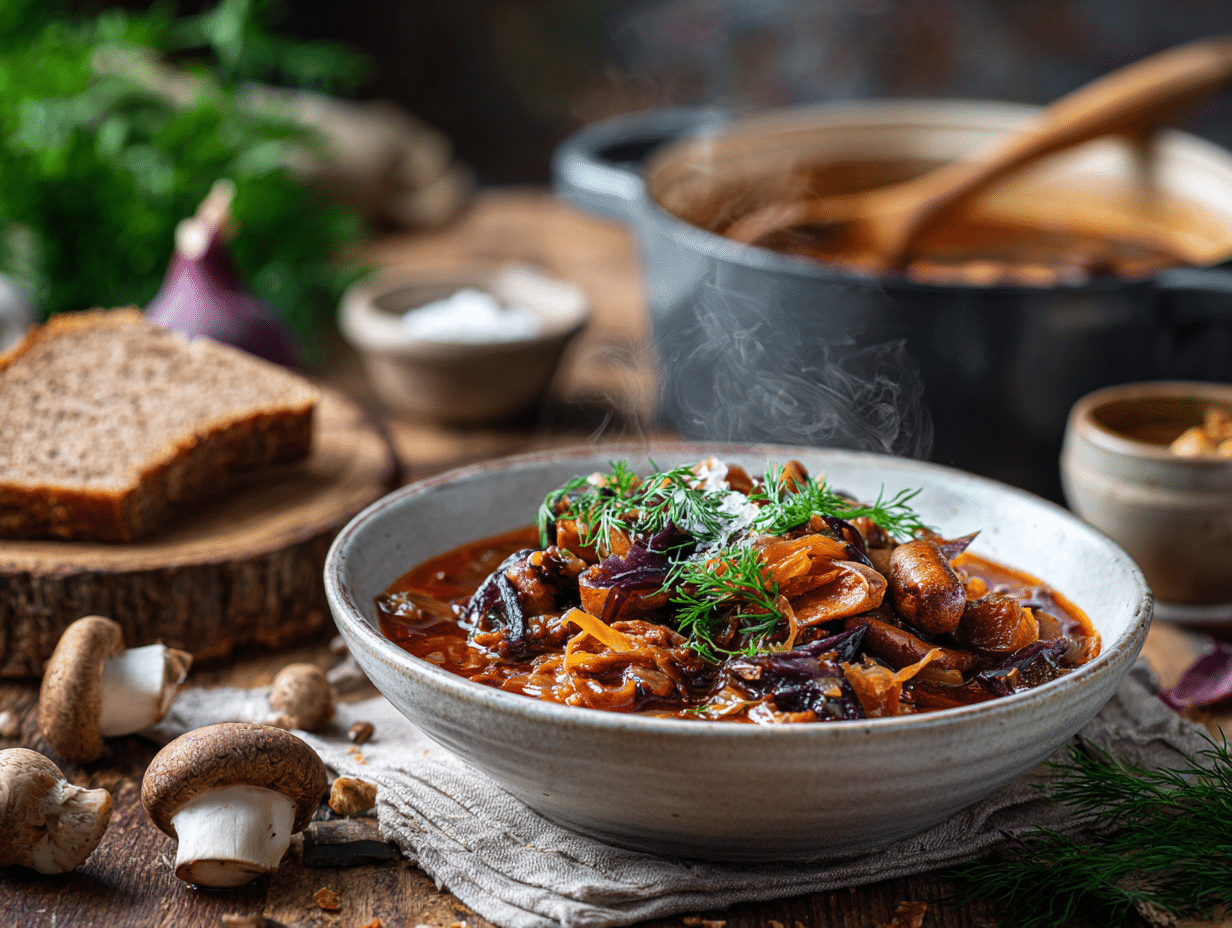
Bigos is a Polish sauerkraut and mushroom stew that gets better every time you reheat it — which makes it one of the most practical things you can cook on a Sunday. This plant-based version uses dried porcini, fresh mushrooms, prunes, and a short list of Central European spices to build a stew that’s genuinely savory and a little funky in the best way. It’s not a quick weeknight dish, but it’s mostly hands-off time.
Before you start
The one technique that makes or breaks this stew is how you handle the dried porcini. Soak them in warm water for at least 20 minutes, then lift them out carefully — don’t pour the liquid through a sieve and discard it. That soaking liquid is where most of the deep, savory flavor lives. Pour it slowly into the pot, leaving the last tablespoon or so behind, since grit settles at the bottom. The second thing worth knowing: sauerkraut varies a lot in saltiness depending on the brand. Taste yours before it goes in. If it’s very salty, a quick rinse under cold water pulls back some of that edge without losing the fermented tang you actually want.
About the ingredients
- Dried porcini mushrooms: Find these in the dried goods aisle, near pasta or international foods. A small 1-oz packet is usually enough. Don’t substitute fresh porcini — the drying process concentrates flavor in a way fresh mushrooms can’t replicate here.
- Sauerkraut: Use refrigerated sauerkraut from the deli section if you can find it. Shelf-stable jarred versions work, but the flavor is milder. Avoid any brand with added vinegar — real sauerkraut is fermented, not pickled.
- Prunes: These aren’t optional. They don’t make the stew sweet; they soften the sharpness of the sauerkraut. Medjool or standard dried plums both work.
- Juniper berries: Check the spice aisle or a bulk food store. If you genuinely can’t find them, leave them out rather than substituting — their flavor is specific and nothing else mimics it cleanly.
- Marjoram: Dried marjoram is worth buying for this. Oregano is the common swap, but use about two-thirds the amount since oregano is sharper.
Mistakes to avoid
- Adding the sauerkraut too early and then over-salting: Sauerkraut releases salt as it cooks down. Season the stew lightly at the start and taste again near the end, not throughout.
- Crowding the mushrooms when you sauté them: If fresh mushrooms are piled on top of each other, they steam instead of browning. Work in two batches if your pan isn’t large. Pale, soft mushrooms won’t give you the same depth of flavor.
- Skipping the rest time: This stew genuinely tastes flat the day you make it. Plan to cook it the day before you want to serve it. One overnight rest in the fridge makes a real difference.
- Using too much liquid: Bigos should be thick and spoonable, not soupy. If yours looks thin after the first simmer, leave the lid slightly ajar for the last 20 minutes to let steam escape.
- Crushing the juniper berries too finely: A light crack — the flat side of a knife is enough — releases the oils without turning them bitter. Don’t grind them.
Storage and reheating
Store leftovers in an airtight container in the fridge for up to 5 days — and as mentioned above, it genuinely improves by day two or three. To freeze, let it cool completely, then portion into freezer-safe containers; it keeps well for up to 3 months. Thaw overnight in the fridge before reheating. Warm it on the stovetop over medium-low heat, stirring occasionally and adding a small splash of water if it’s thickened too much. Skip reheating in the microwave if you can — the stovetop brings the flavors back together more evenly.

Vegan Polish Bigos (Hunter’s Stew with Mushrooms)

Equipment
- 5–6 qt Dutch oven with lid
- rimmed baking sheet
- Parchment paper (optional)
- Heatproof bowl
- Fine-mesh strainer and coffee filter or paper towel
- Chef's knife
- Cutting board
- Wooden spoon
- Ladle
- Measuring cups and spoons
- Mortar and pestle or spice grinder (optional)
- Box grater
Ingredients
- 1 oz dried porcini mushrooms look for whole pieces for a cleaner, deeper broth
- 2 cups boiling water for soaking porcini; reserve the liquid
- 12 oz cremini (baby bella) mushrooms, quartered choose firm, dry caps for better browning
- 8 oz oyster or shiitake mushrooms, torn or thick-sliced a mix adds meaty texture and aroma
- 3 tbsp olive oil, divided use a robust extra-virgin if you enjoy a peppery finish
- 1.25 tsp kosher salt, divided adjust to taste; sauerkraut can vary in salinity
- 0.5 tsp freshly ground black pepper, divided fine grind blends in; coarse adds pops of heat
- 2 medium yellow onions, diced about 1 lb total; choose sweet, heavy onions
- 2 medium carrots, thinly sliced adds gentle sweetness and body
- 2 ribs celery, diced optional but classic for aromatic depth
- 5 cloves garlic, minced freshly minced for best aroma
- 3 tbsp tomato paste double-concentrated preferred for faster caramelization
- 1 tsp caraway seeds lightly crush for maximum aroma
- 1.5 tsp dried marjoram essential Polish herb; do not skip
- 4 whole allspice berries, lightly crushed (or 1/2 tsp ground) crushed berries release brighter top-notes
- 6 whole juniper berries, lightly crushed (optional but traditional) adds piney, forest aroma reminiscent of game
- 2 tsp sweet smoked paprika look for a mild, fruity profile to mimic smoke
- 0.5 cup dry red wine a medium-bodied, fruity style (e.g., Grenache or Tempranillo)
- 1 lb green cabbage, cored and chopped choose dense, heavy heads for sweetness and texture
- 24 oz sauerkraut, drained and lightly rinsed raw, barrel-fermented kraut gives the brightest tang
- 3 cups low-sodium vegetable broth a mushroom-forward broth is ideal
- 0.75 cup pitted prunes, chopped balances sourness; look for soft, plump fruit
- 2 whole bay leaves Turkish bay for gentler aroma
- 1.5 tbsp soy sauce or tamari tamari for gluten-free; adds umami depth
- 8 oz vegan kielbasa or smoked tempeh, sliced (optional) adds hearty, smoky bites; choose a clean-label brand
- 1 medium Granny Smith apple, grated brightens and balances; peel if desired
- 1 tbsp whole-grain mustard adds subtle heat and lift at the finish
- 0.25 cup fresh dill or parsley, chopped for garnish and fresh finish
Instructions
- Rehydrate Porcini: Place 1 oz dried porcini in a heatproof bowl and cover with 2 cups boiling water. Cover and steep 20 minutes. Strain through a fine-mesh strainer lined with a coffee filter or paper towel to catch any grit; reserve the clear soaking liquid and chop the softened porcini.
- Roast the Fresh Mushrooms: Preheat the oven to 425°F (220°C). Toss cremini and oyster/shiitake with 1 tbsp olive oil, 1/4 tsp salt, and a pinch of pepper on a rimmed baking sheet. Spread in a single layer and roast 20–25 minutes, stirring once, until edges are deeply browned and meaty. No-oven option: Sear in a wide skillet over medium-high heat in batches until well browned.
- Build the Aromatic Base: Meanwhile, heat 2 tbsp olive oil in a 5–6 qt Dutch oven over medium heat. Add onions and a pinch of salt; cook 8–10 minutes, stirring, until translucent and lightly golden with sweet aroma. Add carrots and celery; sauté 4–5 minutes more until slightly tender.
- Bloom Spices and Caramelize Tomato Paste: Push vegetables to the edges, leaving a hot spot in the center. Add tomato paste, caraway, marjoram, crushed allspice, juniper (if using), and smoked paprika. Cook 2–3 minutes, stirring, until the paste turns brick-red and fragrant. Stir in garlic for the final 30 seconds. Tip: Lightly crush whole spices with a mortar and pestle; a spice grinder works too.
- Deglaze: Pour in the red wine and simmer 2 minutes, scraping up any fond, until reduced by about half and the alcohol sharpness has mellowed.
- Build the Stew: Add chopped cabbage, sauerkraut (lightly rinsed and squeezed), chopped porcini, reserved porcini liquid, vegetable broth, prunes, bay leaves, soy sauce/tamari, and a few grinds of pepper. Stir in the roasted mushrooms and any pan juices. Bring just to a gentle simmer.
- Long, Gentle Simmer: Partially cover and cook at a very low simmer for 80 minutes, stirring every 15 minutes, until cabbage is silky and flavors have married. Oven method: Transfer the covered pot to a 325°F (163°C) oven for the same time. If using vegan kielbasa or smoked tempeh, stir it in during the last 20 minutes to warm through and infuse.
- Finish and Balance: Stir in grated apple and whole-grain mustard; simmer uncovered 10 minutes to thicken slightly and brighten. Remove bay leaves. Taste and adjust salt and pepper as needed—the stew should be savory, gently smoky, tangy, and faintly sweet.
- Rest: Turn off heat, cover, and let stand 10 minutes. Resting softens the edges and deepens the aroma. Bigos is famously better the next day—cool, refrigerate overnight, and reheat gently for peak flavor.
- Serve: Ladle into warm bowls and garnish with chopped dill or parsley. Finish with a crack of black pepper and, if you like, a tiny drizzle of good olive oil. Serve with rye bread, boiled or mashed potatoes, or a crisp salad.
Notes
Mary’s Tips:
- Smoky Depth: Layer smoky notes with sweet smoked paprika, roasted mushrooms, and a touch of tamari. For extra depth, add 1/4 tsp liquid smoke or a pinch of smoked salt to taste.
- Faster Onion Caramelization: Add a tiny pinch (1/16 tsp) of baking soda to the onions to speed browning—stir constantly and don’t overdo it.
- Wine-Free Option: Swap the red wine for 1/2 cup unsweetened apple cider plus 1 tsp apple cider vinegar added at the end.
- Gluten-Free: Use tamari and a certified gluten-free vegan sausage, or omit the sausage/tempeh.
- Oil-Free: Dry-roast mushrooms and sauté aromatics with splashes of broth instead of oil.
- No Juniper? Add 1 tsp gin with the wine to mimic a piney note (alcohol cooks off).
- No Porcini? Use 2 tsp mushroom umami powder in the broth and add 1 extra cup of cremini.
Serving Suggestions:
- Plating: Use wide, warmed bowls for generous ladles of stew. Top with a tuft of chopped dill or parsley and a few translucent sauerkraut strands for contrast.
- Texture & Color Cues: Perfect bigos looks glossy and brick-red-brown, with cabbage yielding and threadlike, mushrooms bronzed, and the broth lightly thickened.
- Sides & Sips: Pair with buttered rye toast (vegan butter), boiled baby potatoes tossed with dill, or a crisp cucumber salad. Drink suggestions: a malty Polish-style lager or a dry, peppery red like Blaufränkisch.
Culinary Context:
Bigos—often called Poland’s national dish—was historically a hunter’s stew, cooked slowly over embers, reheated day after day as flavors deepened. Every household has its version. This vegan rendition preserves the spirit—long simmer, forest aromatics, sauerkraut tang—while celebrating mushrooms as the star.Optional Advanced Instructions:
- Make-Ahead: Complete the stew through Step 8 up to 3 days in advance; flavors improve overnight. Reheat gently, adding a splash of broth as needed.
- Parallel Prep: While porcini soak, chop vegetables. Start sautéing aromatics as soon as mushrooms go into the oven to streamline the clock.
- Batch & Freeze: Bigos freezes beautifully for up to 3 months; thaw overnight and reheat over low heat.
Timing:
- Prep Time: 30 minutes
- Cook Time: 1 hour 45 minutes (includes roasting, simmering, and finishing)
Nutrition
Your questions, answered
Can I make this in a slow cooker?
Yes, but brown the mushrooms and onions in a skillet first before transferring everything to the slow cooker. Skipping that step leaves the stew tasting flat. Cook on low for 6–7 hours or high for 3–4 hours.
My sauerkraut is very sour — will the stew be too acidic?
A quick rinse under cold water tones it down without removing the fermented flavor entirely. The prunes also help balance the acidity as the stew cooks, so don’t leave them out.
I can’t find oyster mushrooms. What else works?
Cremini or baby bella mushrooms work fine on their own — just use the full weight in cremini. Shiitake caps are another solid option and add a slightly different but compatible earthiness.
What do I serve this with?
Crusty rye bread is the most practical choice and soaks up the stew well. Boiled or roasted potatoes on the side also work if you want something more filling.