
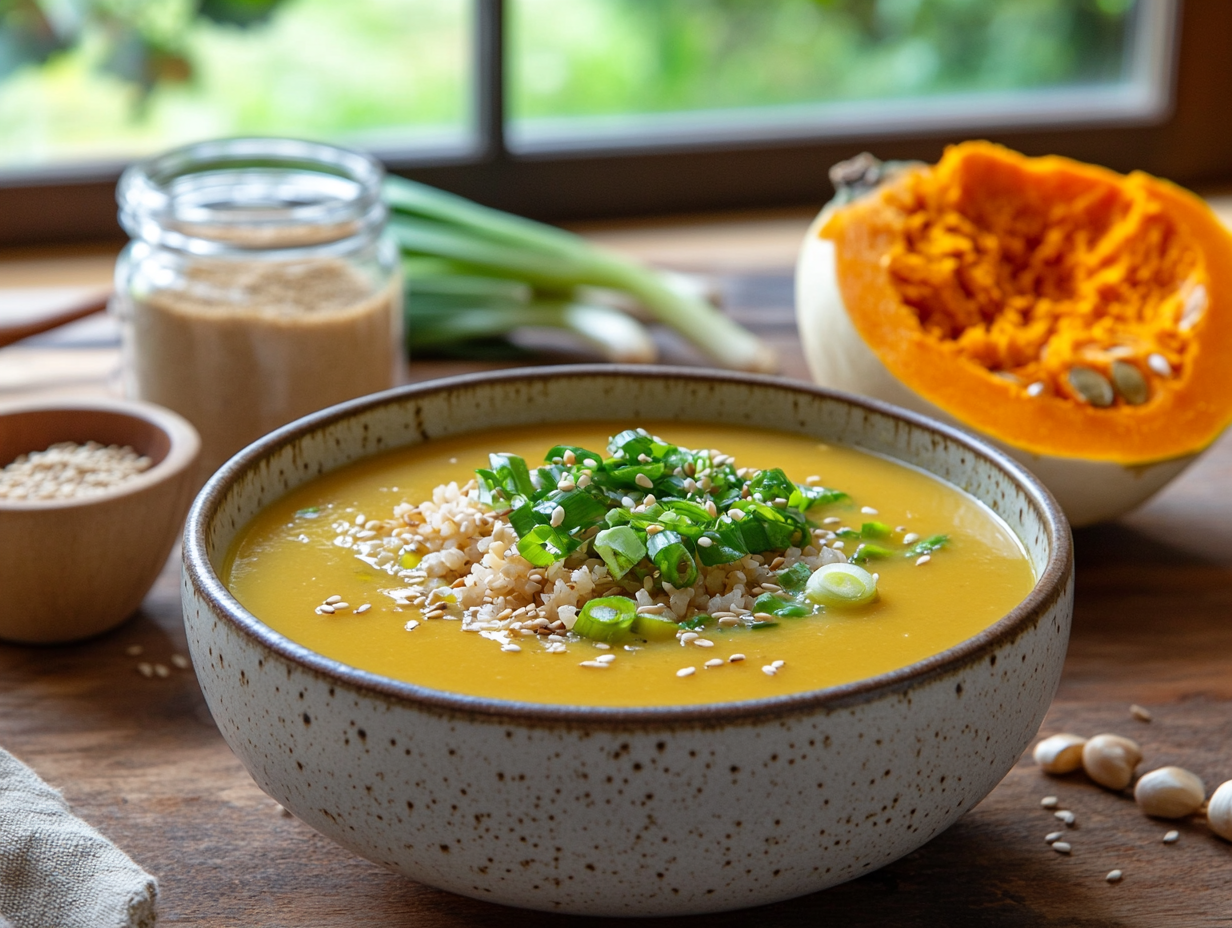
This is a blended butternut squash soup finished with white miso and tahini, served over short-grain brown rice. It comes together from a short list of pantry staples, costs very little per bowl, and is filling enough to be dinner on its own.
About the ingredients
- White miso: The mildest and most widely available variety. Red or yellow miso works too — just use a little less, since both are saltier and more intense. Find it in the refrigerated section near tofu.
- Tahini: Stir it well before measuring — the oil separates in the jar. Any runny, well-blended tahini works. In a pinch, unsweetened smooth almond butter or sunflower seed butter gives similar creaminess, though the flavor shifts.
- Butternut squash: Kabocha or red kuri squash are solid swaps if that’s what’s on hand. Even canned pumpkin purée (not pie filling) can stand in when you’re short on time — skip the roasting step and add it directly to the blended base.
- Short-grain brown rice: Long-grain brown rice works fine. White rice is faster if you’re in a hurry. Farro or cooked barley also hold up well in the bowl without going mushy.
- Chili oil garnish: Skip the garnish — not worth the extra dish. The soup is complete without it.
Why this recipe works
Two things matter here. First, roasting the squash rather than simmering it raw concentrates its natural sugars and drives off excess water, which means the blended soup has real body and a slightly sweet depth that boiling never produces. Second, the miso and tahini go in after blending and off high heat. Miso loses its probiotic bacteria above about 115°F, and tahini can turn grainy if it hits a rolling boil. Stirring both into the warm but not scalding soup keeps the flavor clean and the texture smooth.
Mistakes to avoid
- Blending hot soup in a sealed blender: Steam builds pressure fast. Fill the blender no more than halfway, hold a folded towel firmly over the lid, and start on the lowest speed. An immersion blender is safer and saves cleanup.
- Under-seasoning before you blend: Taste the roasted squash base before adding miso. If it tastes flat, a pinch of salt now means you won’t need to overload on miso later to compensate.
- Adding the rice too early: Brown rice absorbs liquid quickly. If you stir it into the pot and walk away, you’ll come back to porridge. Add it to individual bowls at serving, not to the soup pot.
- Using cold tahini straight from the fridge: Cold tahini seizes up and can leave streaks rather than blending smoothly. Let it sit at room temperature for a few minutes, or warm the jar briefly in a bowl of hot water before measuring.
- Forgetting to taste after the miso goes in: Miso varies a lot by brand — some are much saltier than others. Always taste and adjust acid (a small squeeze of lemon) or salt after the miso is fully stirred in, not before.
Leftovers and meal prep
Store the soup and rice separately. The soup keeps in the fridge for up to 4 days in a sealed container and freezes well for up to 3 months — freeze it before adding the miso and tahini if possible, then stir those in fresh when reheating for the best texture. Reheat gently on the stovetop over medium-low, adding a splash of water or vegetable broth to loosen it, since it thickens considerably when cold. Cooked brown rice keeps refrigerated for up to 4 days. The soup base alone (without rice) is also a good meal-prep starting point — it works as a sauce over roasted vegetables or tossed with noodles mid-week.

Miso‑Tahini Squash Soup with Brown Rice

Equipment
- Blender or immersion blender
- Medium saucepan
- Large baking sheet
- Cutting board and chef’s knife
Ingredients
For the Soup Base:
- 1 medium butternut squash peeled, seeded and cubed (about 4 cups)
- 1 tbsp olive oil extra virgin, for roasting
- 1 medium yellow onion chopped
- 2 cloves garlic minced
- 1 tsp fresh ginger grated
- 4 cups vegetable broth preferably low-sodium
- 2 tbsp white miso paste add after blending to preserve probiotics
- 2 tbsp tahini choose light-roast for a milder flavor
- 1 tbsp tamari optional, for depth and saltiness
To Serve:
- 1 cup cooked brown rice short-grain preferred for better texture
- 2 tbsp toasted sesame seeds for garnish
- 2 tbsp scallions thinly sliced for garnish
Instructions
- Preheat the oven to 400°F (200°C). Spread cubed butternut squash on a baking sheet, drizzle with olive oil, and toss to coat. Roast for 25–30 minutes, or until the edges are caramelized and the centers are tender.
- Meanwhile, in a medium saucepan over medium heat, sauté the chopped onion in a splash of olive oil for 5–7 minutes, or until translucent and beginning to brown slightly.
- Add minced garlic and grated ginger. Stir constantly for 1 minute until aromatic. Avoid burning the garlic.
- Add the roasted squash and vegetable broth to the pot. Bring to a simmer, cover, and cook for 10 minutes to meld the flavors.
- Remove from heat and blend until smooth using a high-speed blender or immersion blender. Blend until completely velvety with no chunks remaining.
- Whisk in the tahini, white miso, and tamari, if using. Do not boil after adding miso to preserve its probiotic benefits. Adjust seasoning to taste with more tamari or salt if needed.
- To serve, ladle soup into bowls and add a scoop of warm brown rice into the center. Sprinkle with toasted sesame seeds and scallions.
Notes
- Substitute kabocha or acorn squash if butternut is unavailable.
- Leftover soup can be refrigerated for up to 4 days or frozen for 2 months.
- If you’re short on time, canned organic butternut squash puree works in a pinch, but oven-roasting develops a deeper flavor.
Nutrition
Common questions
Can I use a different type of squash?
Yes — kabocha, red kuri, or even delicata all work well here. The main thing to watch is moisture content: wetter squashes like acorn may need a slightly longer roast time to concentrate their flavor before blending.
I don’t have an immersion blender or a high-speed blender. Can I still make this?
A standard countertop blender works fine — just blend in small batches and never fill it more than halfway with hot liquid. A food processor is a reasonable fallback too, though the texture will be slightly less smooth.
Can I make this without the brown rice to keep it lighter?
Absolutely — the soup stands on its own as a starter or lighter meal. If you want something in the bowl for texture without the rice, a handful of cooked lentils or white beans stirred in at serving adds protein and substance without changing the flavor much.
My soup turned out too thick. What went wrong?
Nothing went wrong — squash soups thicken as they sit, especially once the tahini is in. Just whisk in warm vegetable broth or plain water a few tablespoons at a time until you reach the consistency you want. Taste and re-season after thinning.
If you liked this one
- Miso Glazed Sweet Potatoes
- Golden Curried Parsnip Soup
- Savory Millet Mushroom Kale Porridge
- Sesame Ginger Soba Salad