
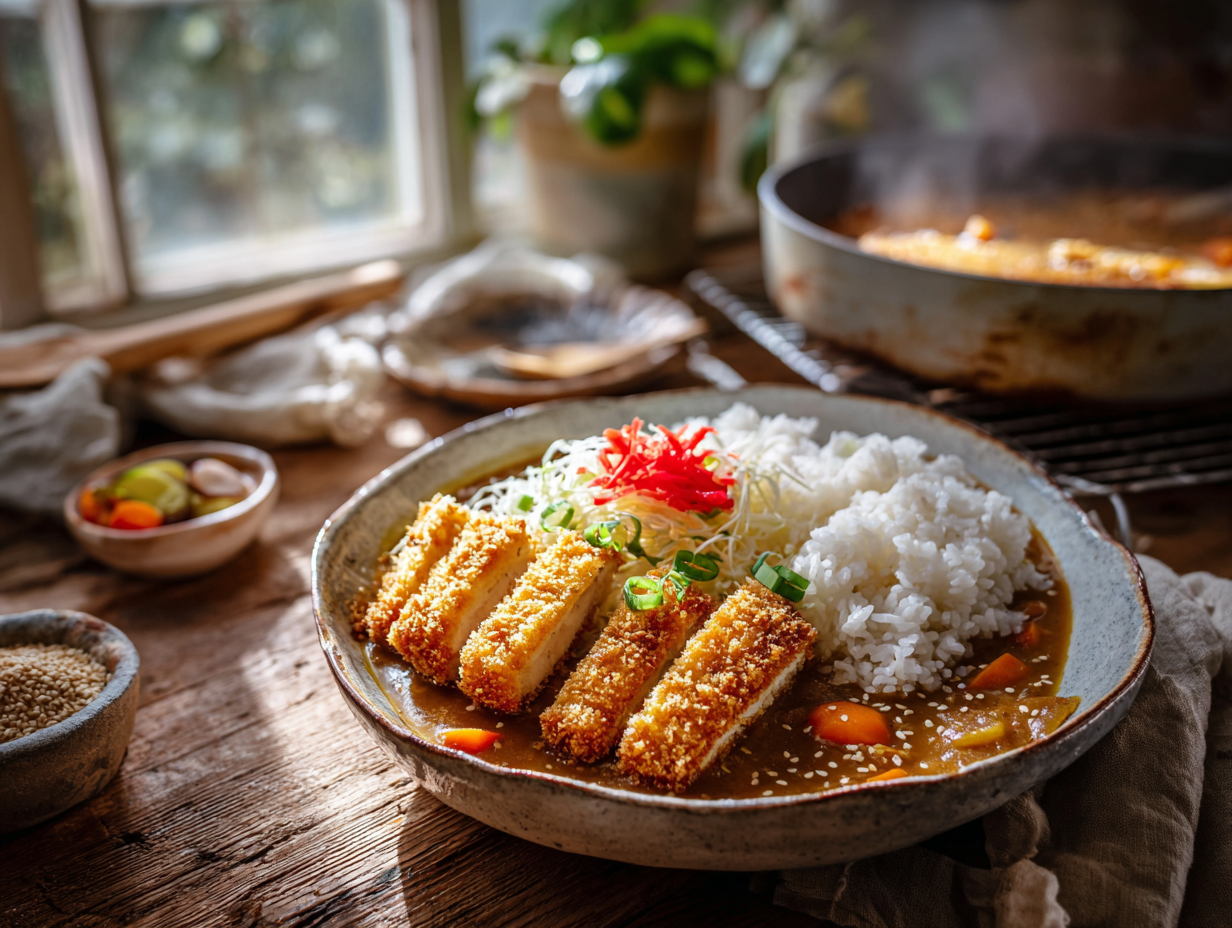
Crispy Tofu Katsu Curry is a panko-breaded tofu cutlet served over rice with a thick, mildly spiced Japanese-style curry sauce. It takes some active prep, but nothing here is technically difficult — and the result is genuinely satisfying comfort food that holds up to any version you’d order out.
Why this recipe works
Two things make or break this dish. First, pressing the tofu long enough — at least 30 minutes — pulls out the moisture that would otherwise steam the coating from the inside and leave you with a soggy crust instead of a crisp one. Second, the egg-free binder (plant milk, cornstarch, and a little mustard or vegan mayo) isn’t just a workaround; the starch actually helps the panko grip the tofu more firmly than a straight egg wash would, so the coating stays intact when you slice through it. Get those two steps right and the rest of the recipe is straightforward.
Mistakes to avoid
- Skipping the press or rushing it. Thirty minutes is the minimum. If your tofu still feels wet when you start breading, pat it dry with a paper towel before you dip it. Wet tofu = coating that slides off in the pan.
- Using the wrong tofu. Silken or soft tofu will fall apart during breading and frying. You need firm or extra-firm tofu. If the package just says “tofu” without a texture label, skip it.
- Crowding the pan. Frying more than two cutlets at once drops the oil temperature fast. Lower oil temperature means the coating absorbs oil before it crisps, and you get greasy tofu. Work in batches and give each cutlet room.
- Cooking the curry sauce on high heat after adding the stock. A hard boil can make the roux-thickened sauce go gluey or scorched on the bottom. Keep it at a steady simmer and stir every few minutes, especially near the end when it thickens up.
- Adding the grated apple too early. Apple breaks down quickly and loses its subtle sweetness if it simmers too long. Stir it in during the last 10 minutes of sauce cooking — skip the garnish at the end if you’re short on time, it’s not worth the extra dish.

Crispy Tofu Katsu Curry

Equipment
- Chef's knife
- Cutting board
- Medium saucepan
- Large skillet or sauté pan
- Dutch oven or deep fry pan (for shallow-frying)
- Instant-read thermometer
- Tongs
- Wire rack set over a sheet pan
- Measuring cups and spoons
- Grater or Microplane
- Air fryer (optional)
- Oven (for baking alternative)
Ingredients
For the Tofu Katsu:
- 14 oz extra-firm tofu block organic, non-GMO; drained and pressed
- ½ tsp kosher salt for seasoning tofu
- ¼ tsp freshly ground black pepper for seasoning tofu
- ½ cup all-purpose flour unbleached
- ½ cup unsweetened plant milk soy or oat preferred for body
- 2 tbsp cornstarch to create a light egg-free batter
- 1 tbsp Dijon mustard or vegan mayo helps breadcrumbs adhere
- 1 ½ cups panko breadcrumbs Japanese-style; look for coarse, airy flakes
- 1 tsp garlic powder seasoning for dredge
- ¼ tsp white pepper optional, for a subtle heat
- 3 cups neutral oil (canola, rice bran, or peanut) for shallow-frying; you won’t use it all
For the Curry Sauce:
- 1 tbsp neutral oil for sautéing
- 1 large yellow onion, thinly sliced about 2 cups
- 2 medium carrots, sliced into 1/4-inch coins about 1 1/2 cups
- 3 cloves garlic, minced about 1 tablespoon
- 2 tsp fresh ginger, finely grated bright, peppery aroma
- 2 tbsp vegan butter for making roux
- 2 tbsp all-purpose flour for roux
- 1 tbsp mild Japanese curry powder S&B brand recommended
- ½ tsp ground turmeric for color and warmth
- ½ tsp ground cumin adds earthiness
- 1 tsp garam masala optional, for depth
- 2 tbsp tomato paste umami backbone
- 3 cups low-sodium vegetable broth good quality, preferably homemade
- 1 tbsp soy sauce or tamari for gluten-free
- 1 tbsp mirin adds gentle sweetness
- 1 tbsp maple syrup balances the spices
- 1 piece bay leaf
- 1 small crisp apple, grated Fuji recommended; classic Japanese curry touch
- 1 tsp unsweetened cocoa powder optional; adds bittersweet complexity
- 1 tsp kosher salt to season the sauce, plus more to taste
- ½ tsp freshly ground black pepper to taste
- 1 tsp rice vinegar to finish, brightness
- 1 tsp cornstarch mixed with 1 tbsp water (optional) only if you prefer a thicker sauce
For Serving (optional but recommended):
- 4 cups cooked Japanese short-grain rice from about 1 1/3 cups (250 g) uncooked
- 2 cups green cabbage, very thinly shredded ice-cold rinse for extra crispness
- 2 tbsp scallions, thinly sliced for freshness
- 1 tbsp toasted sesame seeds white or black
- ½ cup fukujinzuke (Japanese curry pickles) optional, but classic
Instructions
- Press the Tofu (15 minutes): Wrap the 14 oz tofu block in a clean towel, set on a plate, and place a moderate weight on top. Press for 15 minutes to expel excess moisture. Sensory cue: the tofu should feel firmer and release little to no liquid when lightly squeezed.
- Start the Curry Base (12–15 minutes): In a medium saucepan, warm 1 tbsp neutral oil over medium heat until shimmering. Add sliced onion and a pinch of salt; cook, stirring occasionally, until soft with caramelized edges, 8–10 minutes. Add carrots; sauté 2–3 minutes until glossy. Stir in garlic and ginger; cook 30–45 seconds until aromatic.
- Make a Toasted Roux and Bloom Spices (3–4 minutes): Push the veggies to one side of the pan. Add 2 tbsp vegan butter and 2 tbsp flour to the cleared area; stir constantly until the roux smells nutty and turns pale tan, 2–3 minutes. Sprinkle in curry powder, turmeric, cumin, and garam masala; stir 30 seconds to bloom (you’ll smell a warm, toasty perfume).
- Build and Simmer the Sauce (15 minutes): Stir in tomato paste and cook 1 minute. Gradually whisk in 3 cups vegetable broth to avoid lumps. Add soy sauce, mirin, maple syrup, bay leaf, grated apple, and cocoa powder. Bring to a gentle simmer over medium-low; cook 12–15 minutes, partially covered, until carrots are just tender and the sauce lightly coats the back of a spoon. Adjust with 1 tsp salt and 1/2 tsp pepper. Finish with rice vinegar. Optional: if you prefer thicker, whisk in the cornstarch slurry and simmer 1–2 minutes more.
- Set Up the Katsu Dredge (5 minutes): Slice pressed tofu into 4 cutlets, about 1/2 inch thick. Season both sides with 1/2 tsp salt and 1/4 tsp black pepper. Arrange three shallow bowls: (1) flour mixed with garlic powder and a pinch of salt, (2) plant milk whisked with cornstarch and Dijon/vegan mayo, and (3) panko mixed with white pepper. Tip: firmly press tofu into panko so flakes adhere in a thick, even coat. Rest breaded cutlets on a wire rack 5 minutes to set.
- Fry the Katsu (8–10 minutes): Heat neutral oil in a deep skillet to 350°F (175°C). Fry cutlets 2–3 minutes per side until deeply golden and crisp; maintain 340–355°F (171–179°C). Transfer to a wire rack to drain and sprinkle with a pinch of salt. Sensory cue: audible crunch when tapped with tongs.
- Alternative Baking Method: Bake on a rack over a sheet pan at 425°F (220°C), lightly oiled on both sides, for 12 minutes; flip and bake 10–12 minutes more until golden and crisp.
- Air-Fryer Method: Air-fry at 400°F (200°C) for 8 minutes; flip and cook 6–8 minutes more until crisp and bronzed.
- Finish and Hold the Sauce: Keep curry on low heat, removing the bay leaf. The sauce should be glossy and spoon-coating; thin with a splash of broth if needed.
- Slice and Plate: Slice katsu into 3/4-inch strips. Spoon rice into warm bowls, ladle over curry, nestle katsu on top, and finish with shredded cabbage, scallions, sesame seeds, and pickles.
Notes
Michelle’s Tips:
- Ultra-Crisp Panko: For extra crunch when baking/air-frying, lightly mist the breaded tofu with oil and let it rest 5 minutes before cooking.
- Season in Layers: A pinch of salt on tofu after frying brightens flavor without making it salty.
- Roux Control: Keep heat moderate; a too-dark roux will overpower the curry’s gentle sweetness.
- Gluten-Free: Use rice flour for dredging, GF panko, and tamari in place of soy sauce.
- Sauce Variations: Stir in a spoon of smooth peanut butter or tahini for extra body, or add a splash of coconut milk for creaminess.
- No Thermometer? A panko crumb should bubble immediately and turn golden in about 60 seconds when the oil is ~350°F (175°C).
- If your curry becomes too thick as it sits, whisk in warm vegetable broth a tablespoon at a time to restore a velvety, pourable consistency without muting flavor.
Serving Suggestions:
- Plating: Mound snowy white rice on one side, cascade glossy curry alongside, and perch the sliced katsu on top so the crust stays crisp.
- Garnish: A halo of emerald scallions, ivory sesame seeds, and vivid red fukujinzuke makes the bowl pop.
- Perfect Doneness: Look for a lacquered, spoon-coating sauce and cutlets that are uniformly golden with a distinct, airy crunch.
- Pairings: Serve with chilled barley tea or a crisp pilsner; a simple cucumber sunomono is a refreshing side.
Culinary Context:
Katsu curry is a mainstay of Japanese comfort cuisine, blending European-style cutlets with a uniquely Japanese curry profile—mellow, slightly sweet, and deeply savory. Adding grated apple and a touch of cocoa is a time-honored curry house secret for roundness. This vegan rendition honors tradition while championing tofu’s ability to absorb flavor and deliver exquisite texture.Optional Advanced Instructions:
- Make-Ahead: The curry sauce can be prepared up to 3 days in advance; refrigerate and rewarm gently, thinning with a splash of broth if needed.
- Batch Breading: Bread tofu cutlets and freeze on a tray, then store in a freezer bag for up to 1 month. Fry from frozen at 350°F (175°C) for 3–4 minutes per side.
- Parallel Workflow: While the tofu presses, chop vegetables and start the onion-caramelizing step to streamline the cook.
Timing:
Prep Time: 35 minutes (includes pressing tofu, chopping, and dredge setup)Cook Time: 35 minutes (sauce simmer 15 minutes; katsu fry 8–10 minutes; preheat/finishing steps included)
Total Time: 70 minutes
Nutrition
FAQ
Can I bake the tofu instead of frying it?
Yes, baking works. Brush or spray the breaded cutlets generously with neutral oil and bake at 425°F on a wire rack set over a sheet pan for about 20–25 minutes, flipping once halfway through. The crust won’t be quite as deeply golden as pan-fried, but it will still be crisp.
What does the cornstarch in the binder actually do?
It thickens the plant milk mixture into a slightly tacky coating that the panko can grip. Without it, the liquid just runs off the tofu and the breadcrumbs won’t stick evenly.
My curry sauce turned out lumpy. What went wrong?
Lumps usually happen when cold stock hits a hot roux too fast. Add your stock gradually — a ladleful at a time — and whisk constantly for the first few additions before pouring in the rest. If you already have lumps, strain the sauce through a fine mesh sieve.
Can I make the curry sauce ahead of time?
Yes, and it actually tastes better the next day once the spices have had time to meld. Store it in an airtight container in the fridge for up to 4 days and reheat gently on the stovetop, adding a splash of water or vegetable broth if it’s thickened too much.
I can’t find panko at my store. Can I use regular breadcrumbs?
Regular breadcrumbs will work in a pinch, but the crust will be denser and less crunchy. If that’s what you have, use them — the dish is still good. Panko is stocked in the international or Asian foods aisle at most large grocery stores, so it’s worth a quick check before substituting.
Try these next
- Vegan Japanese Katsu Curry
- Crispy Tofu Broccoli Stir-Fry
- Vegan Mushroom Bulgogi Bibimbap
- Sesame Ginger Soba Salad