
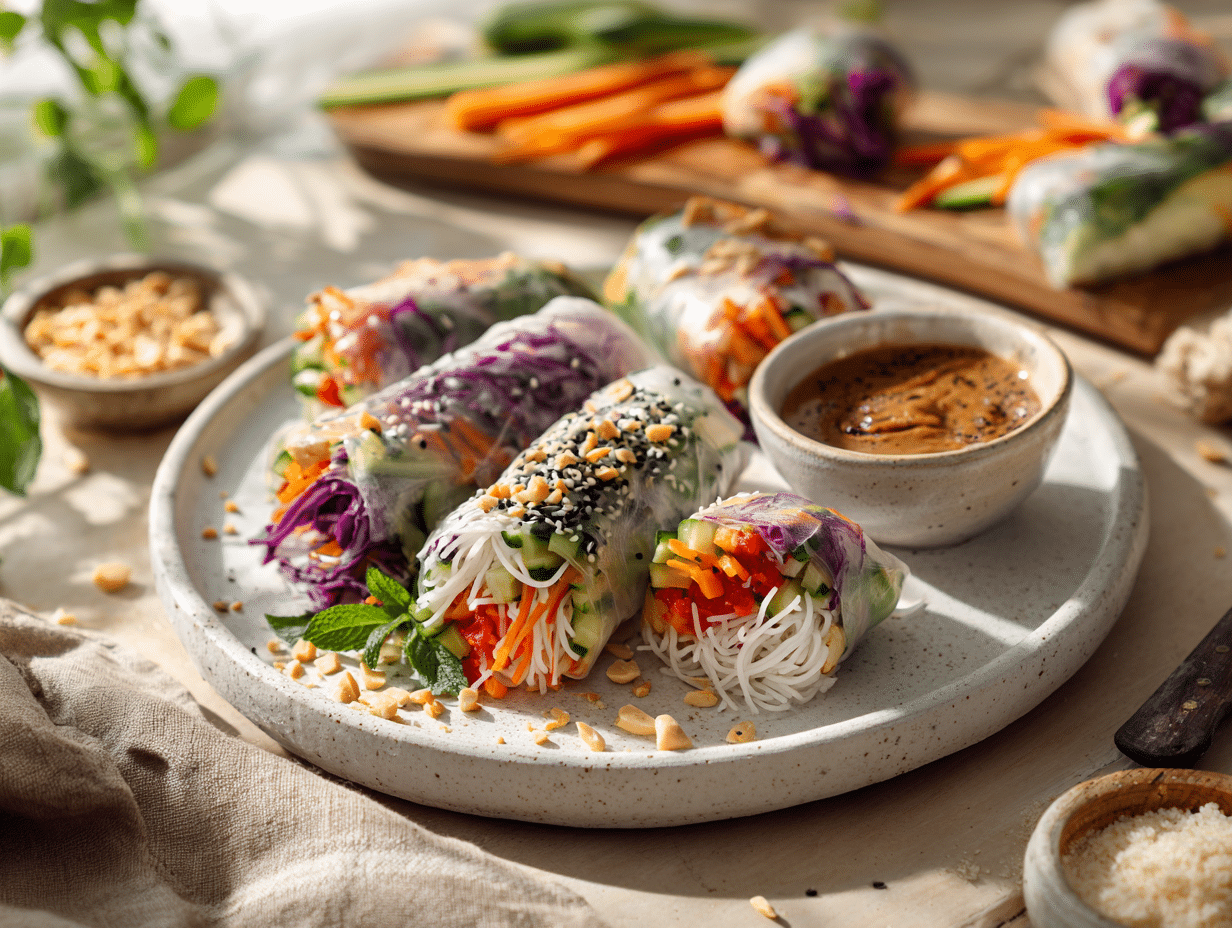
These are fresh, unfried spring rolls packed with rice noodles, crisp vegetables, and herbs, all wrapped in softened rice paper and served with a peanut-hoisin dipping sauce. They come together in about 30 minutes with no cooking beyond boiling water for the noodles. That speed, plus the fact that you can prep the fillings ahead, is the real reason to make them on a regular weeknight.
What makes this version work
Two things actually matter here. First, the rice paper dip time: a quick 5–8 seconds in warm (not boiling) water leaves the wrapper pliable but not so soft it tears the moment you start rolling. Pull it out while it still feels slightly stiff — it keeps softening on the board. Second, filling placement and tension. Pile the ingredients in a tight, compact log toward the bottom third of the wrapper, fold the sides in first, then roll forward with steady, firm pressure. A loose roll falls apart at the table; a tight one holds together through the whole dipping process.
Shopping notes
- Rice paper wrappers (bánh tráng): Look for these in the Asian foods aisle or at an Asian grocery store. Round wrappers around 22 cm (8–9 inches) work best for a standard-sized roll. Avoid any that look cracked or chalky in the package — they’ll tear when wet.
- Thai basil: Distinct from Italian basil — it has a slightly anise-like flavor and holds up better in the roll without wilting. Most well-stocked grocery stores carry it; Asian markets always do. Regular basil is an acceptable swap if that’s what you have.
- Rice vermicelli: These thin noodles only need a brief soak in boiling water, not a full boil on the stove. Check the package — many brands are done in 3–4 minutes, which keeps the whole recipe fast.
- Hoisin sauce: Most store brands are vegan, but check the label quickly since formulations vary. It’s the backbone of the dipping sauce, so don’t skip it.
What can go wrong
- Wrapper sticks to the board: This happens when the board is too dry or the wrapper sits too long before you start filling. Work on a damp cutting board or a clean, slightly damp kitchen towel, and start filling immediately after you lay the wrapper down.
- Rolls split open at the seam: Usually means the wrapper was over-soaked and lost its elasticity. Keep your soak short and roll with consistent pressure — the wrapper seals itself as it dries slightly.
- Filling is watery and makes the wrapper soggy: Vegetables with high moisture content (cucumber, especially) should be patted dry before rolling. Wet noodles should be drained and shaken well, not just dumped straight from the bowl.
- Dipping sauce is too thick to dip cleanly: Thin it with warm water, one teaspoon at a time, until it coats a spoon lightly but still drips off. Skip the garnish of extra crushed peanuts on top of the sauce — not worth the extra dish.
- Rolls dry out and stick together on the plate: If you’re not serving immediately, place them seam-side down with a little space between each one, and cover loosely with a damp paper towel. Don’t stack them.
Leftovers and meal prep
Assembled rolls are best eaten the day they’re made. If you need to store them, wrap each roll individually in plastic wrap and refrigerate for up to 24 hours — beyond that, the wrapper gets tough and the herbs turn. For meal prep, the smarter move is to keep the components separate: cooked and drained noodles keep in the fridge for 3 days, sliced vegetables stay crisp for 2–3 days in an airtight container, and the dipping sauce keeps well for up to a week. When you’re ready to eat, just soak fresh wrappers and assemble in minutes. The sauce does not freeze well — the texture breaks down. Noodles can be frozen in a pinch but tend to clump; rinse under warm water to loosen them.

Vegan Vegetable Spring Rolls with Peanut–Lime Dipping Sauce

Equipment
- Chef's knife
- Cutting board
- Julienne peeler or mandoline (optional)
- Small saucepan
- Dry skillet (8–10 inch)
- Large heatproof mixing bowl
- Shallow dish or pie plate (for rice paper)
- Clean kitchen towel
- Tongs
- Measuring cups and spoons
- Microplane or fine grater
- Serving platter
Ingredients
For the Peanut–Lime Dipping Sauce:
- ⅓ cup creamy natural peanut butter smooth, unsweetened; stir well for consistent texture
- 3 tbsp vegan hoisin sauce check label to ensure vegan; Koon Chun or Lee Kum Kee offers vegan options
- 1 tbsp low-sodium tamari or soy sauce; use tamari for gluten-free
- 1 tbsp fresh lime juice from 1/2 juicy lime; strain for a silky sauce
- 2 tsp unseasoned rice vinegar unseasoned to control sweetness and salt
- 1 tsp fresh ginger, finely grated use a microplane for a smooth paste
- 1 clove garlic, finely grated about 1/2 tsp; avoid burning by adding off heat
- ⅓ cup hot water, plus up to 2 tbsp more as needed to thin the sauce to a dipping consistency
- ½ tsp toasted sesame oil optional; adds aroma
- 1 tsp sriracha or chili-garlic sauce optional; adjust to taste
For the Toasted Peanuts:
- ¼ cup roasted unsalted peanuts, chopped chop just before toasting for maximum aroma
For the Noodles:
- 3 oz thin rice vermicelli noodles prefer brands like Three Ladies or Thai Kitchen for consistent texture
- 6 cups hot water for soaking noodles 180–190°F / 82–88°C
- 1 tsp toasted sesame oil optional; toss with drained noodles to prevent sticking
For the Vegetables & Herbs:
- 1 small English cucumber, julienned about 1 cup; choose firm, fresh cucumber
- 1 medium carrot, julienned about 1 cup; peel for best texture
- ½ medium red bell pepper, thinly sliced about 3/4 cup; choose a sweet, crisp pepper
- 1 cup shredded purple cabbage adds color and crunch
- 3 medium radishes, thinly sliced optional; adds peppery snap
- 2 pieces scallions, thinly sliced green and white parts
- 1 cup fresh mint leaves small tender leaves are best
- 1 cup fresh cilantro sprigs use tender stems for extra flavor
- ½ cup Thai basil leaves optional; anise-like aroma
- 6 large butter lettuce leaves, halved creates a soft cushion to prevent tearing
For the Assembly & Garnish:
- 12 pieces round rice paper wrappers (8.5-inch) look for Three Ladies brand for supple wrappers
- 1 tbsp sesame seeds white or black for garnish
- 1 medium lime, cut into wedges for serving
For the Optional Tofu:
- 8 oz extra-firm tofu, pressed and cut into batons optional; press 15 minutes for best texture
- 1 tsp neutral oil optional; avocado or grapeseed for searing tofu
- 1 tsp low-sodium tamari optional; to season tofu
- ½ tsp maple syrup optional; balances tofu seasoning
Instructions
- Make the Peanut–Lime Dipping Sauce (3–4 minutes): In a small saucepan, whisk together peanut butter, hoisin, tamari, lime juice, rice vinegar, ginger, garlic, and 1/3 cup hot water. Warm over low heat until smooth and lightly steaming, about 3–4 minutes, 160–180°F (71–82°C). If needed, whisk in up to 2 tbsp more hot water to reach a pourable, glossy consistency. Remove from heat and stir in toasted sesame oil and sriracha to taste. Transfer to a serving bowl to cool slightly.
- Toast the Peanuts (2–3 minutes): Heat a dry skillet over medium heat (about 350°F / 175°C). Add the chopped peanuts and toast, stirring, until fragrant and a shade darker, 2–3 minutes. Immediately transfer to a cool plate to prevent overbrowning.
- Soak the Noodles (4–5 minutes): Place rice vermicelli in a large heatproof bowl. Pour over 6 cups hot water at 180–190°F (82–88°C) and soak until tender but springy, 4–5 minutes. Drain, rinse under cold water to stop cooking, drain well again, and toss with 1 tsp toasted sesame oil (optional) to prevent sticking. The noodles should be cool, silky, and separate easily.
- Prep the Vegetables and Herbs (10 minutes): Julienne cucumber and carrot into thin matchsticks; slice bell pepper, cabbage, radishes, and scallions. Keep herbs whole or in small sprigs. Everything should be crisp, dry, and bright—pat dry if needed so the wrappers do not slip.
- Optional: Quick-Seasoned Tofu (5–7 minutes): Heat a small nonstick skillet over medium-high (375°F / 190°C). Add 1 tsp neutral oil, then tofu batons. Sear until lightly golden on two sides, 2–3 minutes. Splash in 1 tsp tamari and 1/2 tsp maple syrup; toss 30 seconds to glaze. Transfer to a plate to cool. Note: This optional step is not included in base cook time.
- Set Up a Rolling Station (2 minutes): Fill a wide shallow dish or pie plate with warm water at 90–95°F (32–35°C). Lay a clean, damp kitchen towel on your work surface. Arrange lettuce, noodles, vegetables, herbs, peanuts, and tofu (if using) within arm’s reach.
- Roll the Spring Rolls (12–15 minutes): Submerge one rice paper wrapper for 5–7 seconds until just pliable (it will soften further on the towel). Place on the damp towel. Layer a half lettuce leaf near the lower third, then a small bundle of noodles (about 2 tbsp), a few sticks of cucumber and carrot, a few slices of bell pepper, a pinch of cabbage, radish, scallion, and a scatter of herbs. Add a tofu baton if using, then a pinch of toasted peanuts. Fold the sides in to hug the filling. Pull the bottom edge up and over, tucking firmly to compress without tearing, then roll tightly to the end—like a small burrito. The wrapper should feel tacky and seal itself. Repeat to make about 12 rolls.
- Hold and Serve: Arrange rolls on a platter and cover with a barely damp towel. Serve promptly with the peanut–lime sauce, a sprinkle of sesame seeds, and lime wedges. If holding for more than 15 minutes, keep at cool room temperature; avoid refrigerating too long to prevent hardening.
Notes
Michelle’s Tips:
- Knife Work Matters: Matchstick vegetables bend neatly and prevent punctures; aim for thin, even julienne.
- Hydration Sweet Spot: Do not oversoak rice paper—5–7 seconds is enough. It should be slightly firm on the towel and turn perfectly silky as you roll.
- Double-Wrap for Travel: If packing to-go, double-wrap to reduce tearing; place seam-side down.
- Substitutions: Almond butter or sunflower butter can replace peanut butter; use gluten-free tamari; swap jicama, mango, or shaved asparagus for seasonal flair.
- Flavor Boosters: A few mint leaves pressed against the wrapper first create a stained-glass effect; add thin slices of ripe avocado for creaminess.
- Prevent Sticking: A damp towel under the wrapper and a light sesame oil toss for noodles keep everything manageable.
- Store assembled rolls for up to 4 hours: wrap each in a barely damp paper towel and place in an airtight container.
- Avoid direct refrigeration blasts that can stiffen rice paper; allow 10 minutes at room temperature before serving.
- If wrappers tear, layer a second wrapper or add a lettuce leaf base.
- For extra gloss, lightly brush finished rolls with a tiny bit of water just before serving.
Serving Suggestions:
For a striking presentation, slice a few rolls on a sharp diagonal to reveal the rainbow interior and stand them upright on a white platter. Sprinkle with black and white sesame seeds for contrast, dot the plate with spoonfuls of peanut–lime sauce, and tuck herb sprigs around for aroma. Serve with extra lime wedges and chilled sparkling water with lime or a light jasmine tea. Perfect rolls look translucent with vibrant colors peeking through, feel springy yet taut, and have no sagging ends.Culinary Context:
These fresh rolls are rooted in Vietnamese cuisine, known as gỏi cuốn—often enjoyed as a cooling counterpoint to warm dishes. Their charm lies in contrast: crisp and tender, cool and aromatic, bright herbs against gentle noodles. I learned to cue my senses from street vendors: the rice paper should look like frosted glass when dipped and become satin as you roll—an intuitive moment that turns simple ingredients into something elegant.Optional Advanced Instructions:
- Make-Ahead: Sauce keeps 5 days refrigerated; rewarm gently with a splash of water. Vegetables can be julienned up to 8 hours ahead and kept wrapped in damp paper towels inside an airtight container.
- Parallel Prep: Toast peanuts while the sauce warms; soak noodles while slicing vegetables to compress the timeline.
- Beginner Alternative: Use pre-shredded coleslaw mix for cabbage and carrot to save time. A sushi rolling mat can help achieve consistent tightness.
Timing:
- Prep Time: 35 minutes (sauce whisking, chopping, noodle soak, rolling setup, and assembly).
- Cook Time: 10 minutes (warming sauce and toasting peanuts).
- Total Time: 45 minutes. Optional tofu searing adds 5–7 minutes and is not included in base timing.
Nutrition
FAQ
Can I make these spring rolls ahead of time for a party?
Yes, but only a few hours ahead at most. Wrap each finished roll tightly in plastic wrap and refrigerate them on a tray — this keeps them from drying out and sticking together. Any longer than 4–5 hours and the wrappers start to toughen and the herbs lose their color.
My rice paper keeps tearing — what am I doing wrong?
The most common cause is soaking the wrapper too long, which makes it fragile before you even start rolling. Dip it for just 5–8 seconds in warm water and lay it flat immediately — it will finish softening on its own while you arrange the filling.
Can I substitute something for the peanut sauce if there’s a nut allergy?
Sunflower seed butter works as a direct swap for peanut butter in the dipping sauce — use the same quantity and the texture and richness are very similar. Tahini is another option and gives the sauce a slightly more savory, less sweet flavor.
If you liked this one
- Vegan Vietnamese Sizzling Crepes
- Indonesian Gado-Gado Peanut Salad
- Sesame Ginger Soba Salad
- Vegan Thai Drunken Noodles