
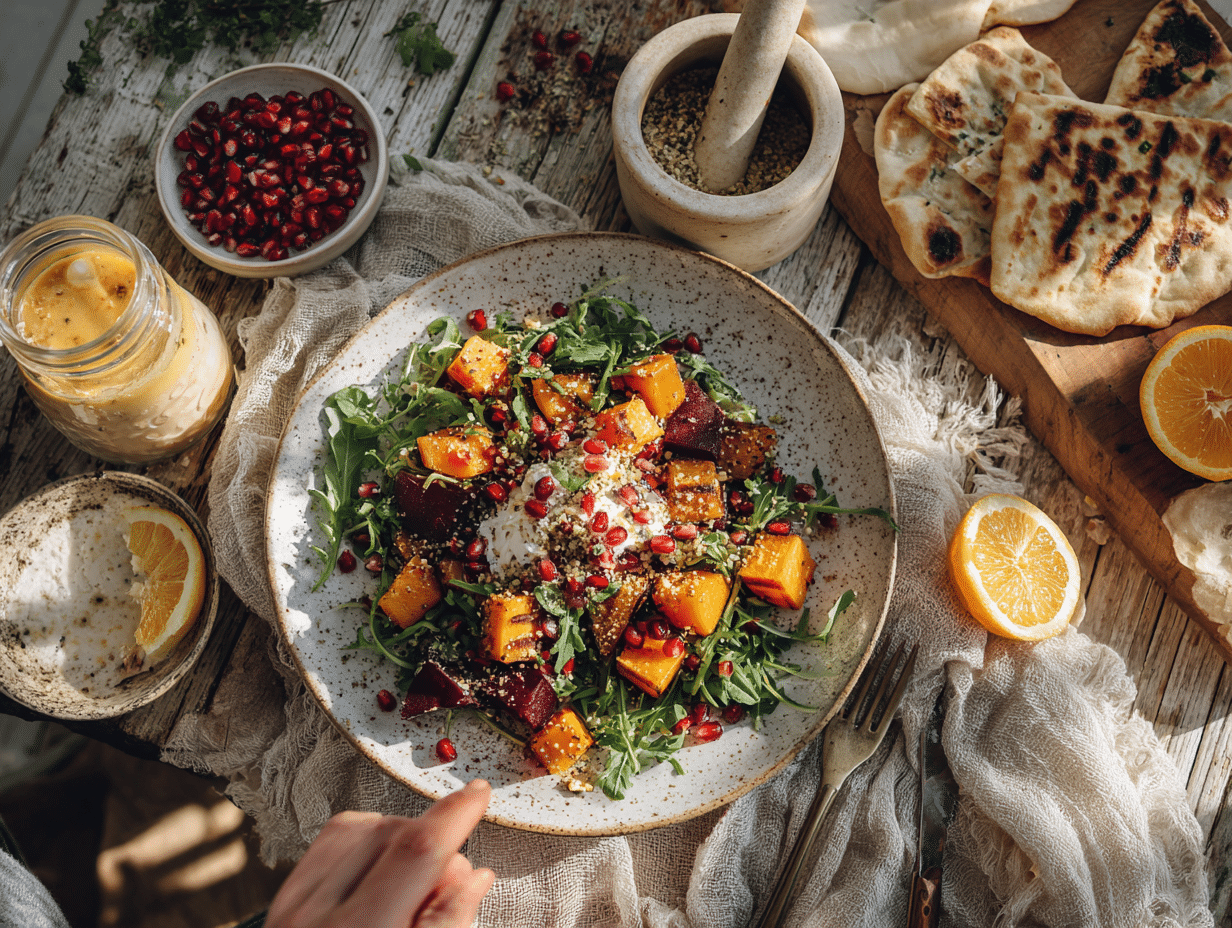
This salad puts roasted pumpkin and beetroot on a bed of arugula, then finishes everything with a crunchy macadamia dukkah and a citrus dressing. It holds up well in the fridge, so it earns its place as a make-ahead lunch or a dinner that actually gets better the next day. The dukkah alone is worth making in a double batch — you’ll find uses for it all week.
Why this recipe works
Two things carry this dish. First, roasting the pumpkin and beetroot separately matters — they have different moisture levels, and crowding them together steams instead of caramelizes. Give each vegetable its own sheet pan and you get proper browning. Second, the dukkah is toasted dry before it’s crushed, which drives off moisture and sharpens the flavor of the spices. Skipping that toasting step produces a dukkah that tastes flat no matter how good your macadamias are. Everything else — the dressing, the arugula, the pomegranate — is assembly.
If something goes sideways
- Dukkah is oily and clumping: The macadamias were over-processed. Pulse in very short bursts and stop while the mixture still looks sandy. Once it turns to paste, there’s no fixing it — start the dukkah over with fresh nuts.
- Beetroot is bleeding into everything and turning the salad pink: Let the roasted beets cool completely and pat them dry before adding to the bowl. Assembling while they’re still warm accelerates the bleeding.
- Arugula is wilting fast after dressing: The dressing is going on too early. Keep the greens, vegetables, and dressing in separate containers and combine only right before eating — especially important if you’re prepping ahead.
- Pumpkin is soft but not browned: Your oven runs cool, or the pieces were cut too thick. Crank the heat to 425°F for the last 8 minutes and leave the pan on a lower rack where radiant heat is stronger.
- Dressing tastes sharp and thin: Add a teaspoon of tahini and whisk again. It rounds out the acidity and gives the dressing enough body to cling to the vegetables instead of pooling at the bottom of the bowl.
Keeping and reheating
Store the roasted vegetables, dukkah, and arugula in separate airtight containers. The vegetables keep for up to 4 days in the fridge; the dukkah stays crisp for up to 2 weeks at room temperature in a sealed jar — skip the fridge for the dukkah, since moisture softens it quickly. To reheat the vegetables, spread them on a baking sheet and put them under the broiler for 4 to 5 minutes rather than microwaving, which makes them soggy. The arugula and dressing should always go on fresh at serving time. Pomegranate arils added at the last minute keep their texture; add them straight from the fridge. The assembled salad does not freeze well, but the roasted vegetables alone freeze fine for up to 6 weeks — just expect them to be softer after thawing, better suited to a grain bowl than a composed salad.

Roast Pumpkin and Beetroot Salad with Macadamia Dukkah

Equipment
- Oven
- 2 rimmed baking sheets
- Parchment paper
- Chef's knife
- Cutting board
- Large mixing bowl
- Small mixing bowl or jar with lid
- Measuring cups and spoons
- Small heavy skillet (for toasting)
- Mortar and pestle (or spice grinder/food processor)
- Microplane or fine grater
- Citrus zester and juicer
- Spatula or tongs
Ingredients
For the Roasted Vegetables:
- 1.5 lb sugar pumpkin (pie pumpkin) or kabocha squash, peeled, seeded, cut into 1-inch cubes choose a dense, sweet variety; kabocha holds shape beautifully
- 1 lb red beets, peeled and cut into 3/4-inch wedges select firm, smooth beets without soft spots
- 2 tbsp avocado oil, divided high-heat oil for reliable roasting; grapeseed also works
- 1 tbsp pure maple syrup, divided grade A amber for clean caramel notes
- 1 tsp smoked paprika Spanish pimentón adds gentle smokiness
- 0.5 tsp ground cumin freshly ground for brightest aroma
- 0.5 tsp fine sea salt adjust to taste
- 0.25 tsp freshly ground black pepper freshly cracked for lift
For the Macadamia Dukkah:
- 0.5 cup raw macadamia nuts, roughly chopped Australian macadamias if available; their buttery snap is ideal
- 2 tbsp white sesame seeds lightly toast for nutty depth
- 1 tsp black sesame seeds (optional) adds color contrast and aroma
- 1 tbsp coriander seeds toast until the citrusy aroma blooms
- 1 tsp cumin seeds whole seeds provide warm, toasty notes
- 0.5 tsp black peppercorns for a gentle bite; adjust to taste
- 0.5 tsp flaky sea salt Maldon or similar; crush lightly between fingers
For the Citrus-Mustard Dressing:
- 3 tbsp extra-virgin olive oil fruity, medium-intensity EVOO for balance
- 1 tbsp fresh lemon juice Meyer lemon if in season
- 1 tbsp fresh orange juice freshly squeezed for brightness
- 0.5 tsp finely grated orange zest use a Microplane for a fragrant, pith-free zest
- 2 tsp Dijon mustard smooth Dijon to emulsify
- 1 tsp pure maple syrup balances the citrus acidity
- 1 clove garlic, finely grated (about 1/2 tsp) microplane for a smooth, even dispersion
- 1 pinch fine sea salt a small pinch; the dukkah adds salinity too
For the Salad & Garnish:
- 4 cups baby arugula (rocket) or arugula–spinach mix, loosely packed look for crisp, vibrant leaves
- 0.25 cup fresh mint leaves, torn spearmint adds cooling lift
- 2 tbsp flat-leaf parsley, chopped (optional) fresh and bright; optional herbaceous layer
- 0.33 cup pomegranate arils choose ruby, juicy seeds for sparkle and tart-sweet pop
- 1 tsp finely grated lemon or extra orange zest (optional) a final citrus perfume
- 1 tsp extra-virgin olive oil, for finishing (optional) a light gloss before serving
Instructions
- Set your oven to 400°F (200°C). Line two rimmed baking sheets with parchment for easy cleanup and better caramelization.
- Prep the Vegetables: Pat the pumpkin and beets dry. In a large bowl, toss pumpkin with 1 tbsp avocado oil, 1/2 tbsp maple syrup, smoked paprika, ground cumin, 1/4 tsp salt, and a pinch of pepper until evenly coated and glossy. In a separate bowl, toss beets with remaining 1 tbsp avocado oil, 1/2 tbsp maple syrup, 1/4 tsp salt, and a pinch of pepper. Keep them on separate trays to prevent color bleeding.
- Roast: Spread pumpkin in a single layer on one tray and beets on the other, leaving space between pieces (crowding steams instead of roasts). Roast pumpkin for 25–30 minutes and beets for 30–40 minutes, rotating trays front-to-back at the 15-minute mark. Visual cue: edges turn deep golden with light charring; a knife slides in with gentle resistance.
- Toast for the Macadamia Dukkah: While the vegetables roast, warm a small dry skillet over medium heat. Toast macadamias 3–4 minutes until lightly golden and fragrant; transfer to a plate. In the same skillet, toast sesame seeds 1–2 minutes until nutty and just starting to color. Finally, toast coriander seeds, cumin seeds, and peppercorns 1–2 minutes until the seeds pop and smell citrusy-warm. Cool briefly.
- Crush the Dukkah: Using a mortar and pestle, pound the cooled nuts and spices to a coarse rubble—think small pebbles, not dust. Stir in flaky sea salt. Alternative: pulse in a food processor with short bursts, scraping often to avoid turning the nuts into paste.
- Make the Dressing: In a small bowl or lidded jar, whisk/shake together olive oil, lemon juice, orange juice, orange zest, Dijon, maple syrup, grated garlic, and a pinch of salt until emulsified and slightly thickened. Taste and adjust acidity or sweetness to balance the roasted vegetables.
- Dress the Greens: Add arugula to a large bowl and toss with about half the dressing until the leaves are lightly coated and glossy but not soggy.
- Assemble: Let roasted vegetables rest 5 minutes so they don’t wilt the greens. Mound dressed greens on 4 plates. Nestle warm pumpkin and beets over the greens. Spoon on remaining dressing to taste. Shower each plate with a generous sprinkle of macadamia dukkah, then add mint, parsley (if using), and pomegranate arils. Finish with a whisper of citrus zest and a final thread of olive oil.
Notes
Mary’s Tips:
- Caramelize Faster: Preheat the trays in the oven for 5 minutes; hot trays jump-start browning. Don’t crowd the pans and blot beets dry after peeling.
- Spice Variations: Add 1/2 tsp Aleppo pepper to the pumpkin, or 1 tsp sumac to the dukkah for a lemony lift.
- Nut-Free Option: Swap macadamias for a mix of toasted pumpkin and sunflower seeds.
- Squash Swaps: Butternut works well (similar timing). For delicata, keep the edible skin on and roast 18–22 minutes total.
- Air Fryer Method: Roast pumpkin and beets in batches at 390°F (200°C) for 15–18 minutes, shaking halfway.
- Make Extra Dukkah: Double the batch; store airtight up to 2 weeks. It’s superb on avocado toast or grilled veggies.
- Leftover dukkah adds instant character to soups, roasted carrots, grilled mushrooms, or even fresh fruit like orange segments.
- If the beets are very large, cut smaller wedges to match the pumpkin’s cooking time.
- Always taste and season at the end—the dukkah contributes salt, so finish with a light hand.
Serving Suggestions:
For restaurant polish, swipe a savory base of unsweetened coconut yogurt mixed with a little tahini on each plate, then pile the greens and vegetables on top. Garnish with a dramatic snowfall of dukkah and scattered pomegranate for rubies of color. Perfect doneness shows as burnished, mahogany-edged pumpkin, slightly wrinkled beets, vibrant greens, and a toasty sesame–coriander aroma rising from the plate. Pair with warm flatbread or fluffy quinoa and a citrusy white wine or sparkling water with orange peel.Culinary Context:
Dukkah hails from Egypt—an aromatic blend of nuts, seeds, and spices traditionally enjoyed with bread and olive oil. Here, I’ve given it an Antipodean twist with buttery Australian macadamias. The interplay of sweet roast vegetables, tangy citrus, and crunchy dukkah reflects a modern Middle Eastern–inspired, produce-led style that defines much of contemporary Australian cooking.Optional Advanced & Make-Ahead:
- Roast Ahead: Roast pumpkin and beets up to 2 days in advance; reheat at 350°F (175°C) for 8–10 minutes.
- Dukkah: Make 1–2 weeks ahead and store airtight at room temperature.
- Dressing: Mix up to 5 days ahead; shake before using.
- Mise En Place Trick: Zest citrus before juicing and grate the garlic directly into the dressing to capture every drop of aroma.
Timing:
- Prep: 25 minutes (0h 25m) including peeling/chopping and dressing prep.
- Cook: 40 minutes (0h 40m) for roasting and toasting dukkah in parallel.
Nutrition
FAQ
Can I make the dukkah ahead of time?
Yes — the dukkah is actually better made a day or two ahead. Store it in a sealed jar at room temperature for up to 2 weeks; the flavors settle and sharpen overnight.
What can I use instead of macadamia nuts?
Raw cashews are the closest swap in terms of richness and texture. Hazelnuts work well too and are the traditional choice in Egyptian dukkah, though the flavor is nuttier and less buttery.
Can I use pre-cooked or canned beetroot?
You can, but skip the garnish of canned beets — not worth the extra dish. Pre-cooked beets won’t caramelize, so the salad loses some depth; if that’s what you have, add a little extra smoked paprika to the dressing to compensate.
Is this salad substantial enough as a main course?
It is, especially with the dukkah providing fat and protein from the nuts and seeds. If you want more staying power, serve it over a scoop of cooked farro or quinoa.
What type of pumpkin works best if I can’t find the variety the recipe calls for?
Butternut squash is the most reliable substitute — it roasts evenly, holds its shape, and has a similar sweetness. Kabocha also works well but tends to be drier, so cut it slightly thicker to prevent it from drying out in the oven.
If you liked this one
- Macadamia Nut Pesto Pasta
- Indonesian Gado-Gado Peanut Salad
- Mediterranean Lentil Power Bowl
- Lemon Myrtle Quinoa Bowl