
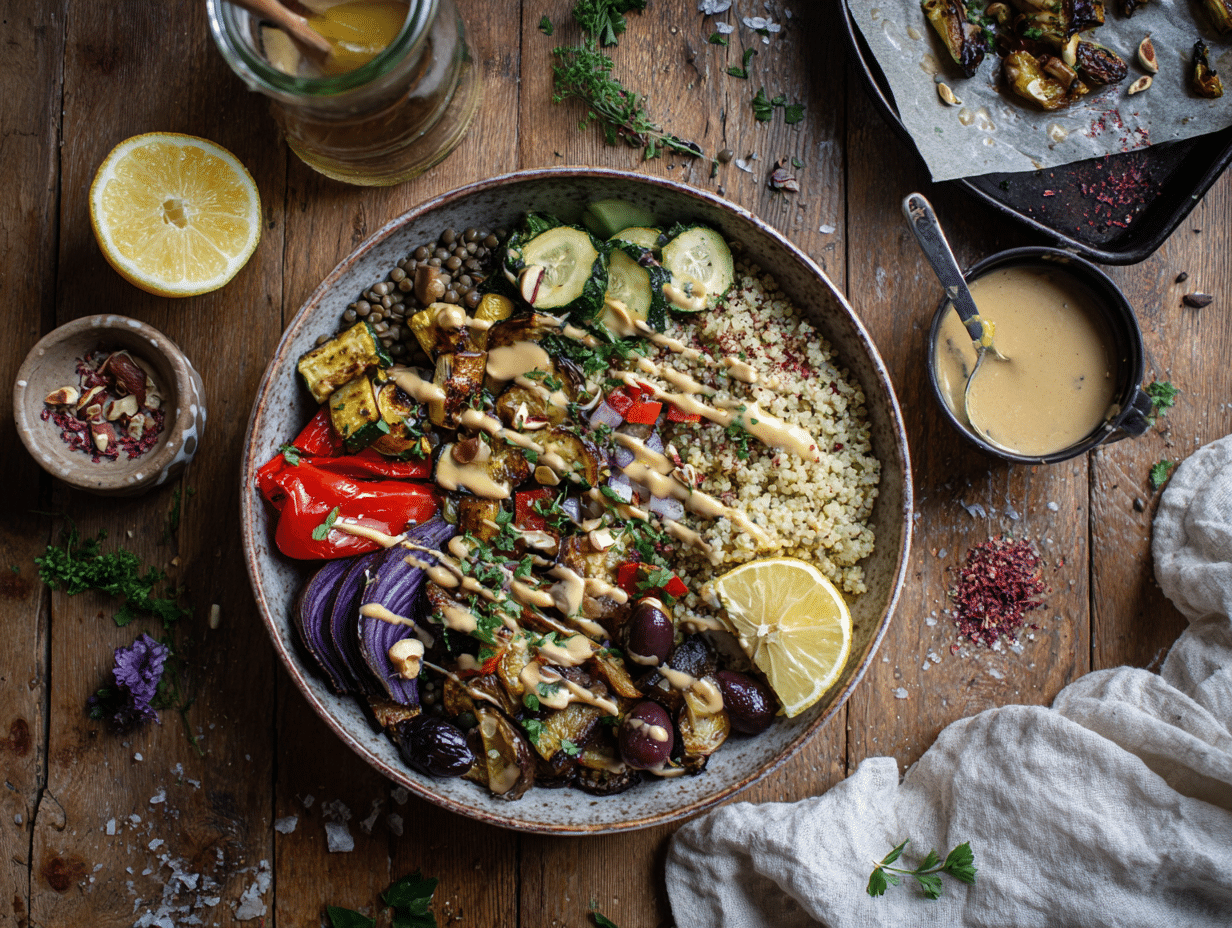
This bowl combines French green lentils, roasted vegetables, and quinoa with a tahini-lemon dressing. It comes together in about an hour using one sheet pan and one pot, and it holds up well in the fridge for several days of lunches or dinners.
Why this recipe works
Two things make this recipe reliable. First, French green lentils (lentilles du Puy) hold their shape after cooking instead of turning mushy, which means they stay distinct in the bowl rather than blending into the grains. Second, the tahini dressing is built by adding cold water gradually — tahini seizes up before it loosens, and that’s normal. Keep adding water a tablespoon at a time and it will go from thick and clumpy to smooth and pourable. Rushing that step is the main reason dressings end up gluey.
What can go wrong
- Vegetables steam instead of roast. This happens when the pan is crowded. If your sheet pan is small, split the vegetables across two pans or roast in two batches. Crowded vegetables release moisture and never get the caramelized edges you want.
- Lentils turn to mush. Start checking them at the 20-minute mark. Cooking time varies by age of the lentils — older dried lentils from the back of the pantry can cook faster or slower than expected.
- Quinoa is gummy. Rinse it well before cooking even if the package says pre-rinsed, and let it steam off the heat with the lid on for 5 minutes after cooking. Lifting the lid too early releases the steam that finishes the texture.
- Dressing is too thick to pour. Add water one tablespoon at a time until it reaches a consistency you can drizzle. Tahini brands vary significantly in thickness, so the amount of water you need will differ from batch to batch.
- Bowl tastes flat. Taste everything before assembling. Lentils and quinoa both need salt while they cook, not just at the end. Under-seasoned grains are the most common reason a finished bowl disappoints.
About the ingredients
- French green lentils: Worth seeking out at a grocery store with a bulk section or international aisle. Regular brown lentils work but will be softer — not a disaster, just a different texture.
- Tahini: Quality varies a lot. A good tahini should smell nutty, not bitter. Stir it thoroughly from the bottom of the jar before measuring — the oil separates on top and the solids sink.
- Quinoa: Any color works here. Tri-color looks nice but skip the garnish — not worth the extra dish when the bowl already has plenty going on visually.
- Roasted vegetables: The recipe’s vegetables are flexible. Whatever needs using in your fridge will likely work as long as it roasts well. Avoid anything very watery like zucchini cut too thick, which can make the pan wet.
Make-ahead notes
Store the lentils, quinoa, roasted vegetables, and tahini dressing in separate containers in the fridge — each keeps well for up to 4 days. Keep the fresh toppings like cucumber and herbs separate and add them only when you’re ready to eat, otherwise they go limp fast. The dressing thickens in the fridge; stir in a splash of water to loosen it before using. Lentils and quinoa both freeze well for up to 2 months — portion them together or separately and thaw overnight in the fridge. Roasted vegetables don’t freeze well; they turn watery on reheating, so make only what you’ll use within 4 days.

Mediterranean Lentil Power Bowl with Roasted Vegetables and Tahini–Lemon Dressing

Equipment
- rimmed baking sheet
- Parchment paper
- Chef's knife
- Cutting board
- Large mixing bowl
- 2 medium saucepans with lids
- Fine mesh strainer
- Measuring cups and spoons
- Whisk
- Microplane zester/grater
- Small skillet
- Tongs or spatula
Ingredients
For the Roasted Vegetables:
- 1 small eggplant, cut into 3/4-inch cubes about 1 lb; choose firm, glossy skin
- 1 medium zucchini, halved lengthwise and sliced 1/2-inch thick about 10 oz
- 1 large red bell pepper, cut into 1-inch pieces ripe with tight skin for sweetness
- 1 small red onion, cut into 8 wedges look for deep purple flesh for best flavor
- 1 cup cherry tomatoes, left whole use in-season, vine-ripened for best sweetness
- 2 tbsp extra-virgin olive oil for roasting vegetables; a peppery, cold-pressed variety is ideal
- 1 tsp kosher salt for vegetables
- ½ tsp freshly ground black pepper
- 1 tsp dried oregano Mediterranean or Greek oregano preferred
- ½ tsp ground cumin for vegetables
- ½ tsp smoked paprika adds gentle smokiness; optional but recommended
For the Lentils:
- 1 cup French green or brown lentils, picked over and rinsed French green (du Puy) hold shape best; choose fresh crop for faster cooking
- 3 cups low-sodium vegetable broth or water broth adds depth; choose a clean, herb-forward brand
- 1 whole bay leaf fresh-dried, not dusty; discard after cooking
- 1 small yellow onion, halved for simmering aromatics; discard after cooking
- 1 clove garlic, lightly crushed infuses broth; discard after cooking
- 1 tbsp extra-virgin olive oil to finish cooked lentils for gloss and flavor
- 1 tsp red wine vinegar or fresh lemon juice brightens flavor after cooking
- ½ tsp kosher salt to season cooked lentils to taste
For the Quinoa Base:
- ¾ cup quinoa, rinsed well white or tri-color; rinse to remove bitterness (saponins)
- 1 ½ cups low-sodium vegetable broth or water; broth yields richer flavor
- 1 pinch kosher salt for quinoa cooking liquid
For the Tahini–Lemon Dressing:
- ⅓ cup tahini, stirred well choose a smooth, pourable brand (e.g., Soom or Seed + Mill)
- 1 large lemon, zested and juiced about 1 tsp zest and 3 tbsp juice; organic preferred for zesting
- 1 clove garlic, microplaned or finely minced; raw garlic adds a punchy bite
- 2 tbsp extra-virgin olive oil whisked into the dressing for silkiness
- 1 tbsp maple syrup balances lemon and tahini bitterness; or use date syrup
- ½ tsp kosher salt for dressing; adjust to taste
- ¼ tsp ground cumin for dressing; warm, nutty aroma
- 2–4 tbsp cold water to thin to a pourable, ribboning consistency
- 2 tbsp fresh flat-leaf parsley, finely chopped stirred in at the end for freshness
- 1 tbsp fresh mint, finely chopped optional but bright and aromatic
For the Toppings & Garnish:
- ¼ cup pitted Kalamata olives, sliced look for oil-cured, not canned, for best flavor and texture
- 1 small Persian cucumber, diced small crisp and thin-skinned; no need to peel
- ¼ cup pine nuts or slivered almonds toast just until golden for a buttery crunch
- 1 tbsp fresh parsley, chopped for garnish
- 1 tsp sumac optional; tart, lemony finish
- ¼ tsp Aleppo pepper or red pepper flakes optional; gentle heat and fruitiness
- 4 wedges lemon for serving and brightening at the table
Instructions
- Heat the Oven and Prepare Your Pan: Set a rack in the center and preheat the oven to 425°F (220°C). Line a rimmed baking sheet with parchment for easy cleanup and better caramelization without sticking.
- Roast the Vegetables: In a large bowl, toss eggplant, zucchini, red bell pepper, and red onion with 2 tbsp olive oil, 1 tsp kosher salt, 1/2 tsp black pepper, 1 tsp oregano, 1/2 tsp cumin, and 1/2 tsp smoked paprika. Spread in a single layer on the prepared sheet. Roast for 20 minutes, then add the whole cherry tomatoes, gently tossing to coat in pan juices. Continue roasting 5–7 minutes more until edges are deeply golden and tomatoes just start to burst. Optional: Broil 1–2 minutes for extra char, watching closely.
- Start the Lentils (parallel to roasting): Rinse lentils in a fine-mesh strainer until the water runs clear. Combine lentils with 3 cups broth or water, bay leaf, halved onion, and crushed garlic in a medium saucepan. Bring to a boil over medium-high heat, then reduce to a gentle simmer and cook 20–25 minutes until tender but still holding shape. Drain well; discard aromatics. While still warm, season with 1/2 tsp kosher salt, 1 tbsp olive oil, and 1 tsp red wine vinegar or lemon juice. The lentils should glisten and smell savory with a bright edge.
- Cook the Quinoa (parallel): Rinse quinoa under cold water, rubbing the grains between your fingers to remove bitterness; drain well. In a second saucepan, combine quinoa with 1 1/2 cups broth and a pinch of salt. Bring to a boil, cover, reduce heat to low, and simmer 15 minutes. Remove from heat and let stand, covered, 5 minutes. Fluff with a fork—the grains should look translucent with tiny tails released.
- Make the Tahini–Lemon Dressing: In a bowl, whisk tahini, lemon zest and juice, microplaned garlic, maple syrup, 1/2 tsp salt, and 1/4 tsp cumin. Slowly stream in 2 tbsp olive oil while whisking to emulsify. Whisk in 2–4 tbsp cold water a little at a time until the dressing turns pale and flows in glossy ribbons. If it seizes at first, keep adding water gradually—it will loosen. Texture cue: It should coat a spoon but drip off in a thin sheet.
- Toast the Nuts: In a dry small skillet over medium heat, toast pine nuts or slivered almonds for 2–3 minutes, stirring, until just golden and fragrant. Immediately transfer to a plate to cool and prevent over-browning.
- Prep the Cool, Crisp Elements: Slice the Kalamata olives, dice the Persian cucumber, and chop fresh parsley (and mint, if using). These should smell bright and herby and add refreshing crunch to balance the warm components.
- Adjust the Roasted Vegetables: Pull the vegetables from the oven when they are caramelized at the edges and tender in the center. Toss once on the pan so the tomato juices glaze the veg. Season to taste with a pinch more salt if needed.
- Assemble the Bowls: Divide quinoa among 4 bowls. Spoon warm lentils over the grains, then pile on the roasted vegetables. Drizzle generously with tahini–lemon dressing. Finish with olives, cucumber, toasted nuts, a sprinkle of parsley, sumac, and a pinch of Aleppo pepper. Serve with lemon wedges for squeezing.
- Final Seasoning Like a Pro: Taste a bit of each component together. If it feels flat, add a squeeze of lemon; if it needs richness, add a thread of olive oil; if it lacks pop, add a small pinch of salt. The perfect bowl is bright on the nose, savory and nutty on the palate, with a satisfying crunch and creamy finish.
Notes
Mary’s Tips:
- Faster Roasted Veg: Preheat the pan as the oven heats; hot metal sears on contact for deeper browning.
- Lentil Texture: Salt after cooking to keep skins intact and achieve a tender-but-springy bite.
- Creamier Dressing: Blitz in a mini food processor for ultra-smooth results. No processor? A whisk works perfectly; add water gradually.
- Make it Gluten-Free: Use quinoa (as written). For a grain swap, try bulgur or farro; adjust cooking times accordingly.
- Optional Protein Boost: Roast well-dried canned chickpeas (15 oz) with 1 tbsp olive oil, 1/2 tsp cumin, 1/2 tsp smoked paprika, and 1/4 tsp salt at 425°F (220°C) for 20–25 minutes, shaking once. Add to bowls.
- Meal Prep: Keep dressing separate until serving to preserve textures. Bowls keep 4 days refrigerated; refresh with lemon and olive oil.
- Onion-Caramelizing Trick: Toss wedges with a pinch of sugar before roasting to speed browning without sweetness in the final dish.
Serving Suggestions:
- Plating: Create a visual clock—grains at 6 o’clock, lentils at 10, roasted veg at 2. Spoon dressing in a zigzag for contrast.
- Garnish: Sprinkle sumac for a ruby halo and add a tuft of chopped parsley and mint at the center. Golden nuts should glint; tomatoes lightly blistered.
- Pairings: Serve with chilled mint tea, a citrusy spritz, or a dry rosé alternative. Warm pita or grilled sourdough is a lovely side (if not gluten-free).
Culinary Context:
This bowl nods to the Levant—lentils and tahini are pantry icons from the region, while herb-laced lemon brings a coastal Mediterranean brightness. I first tasted a similar combo in a small market café in Beirut, where the tahini was whisked tableside—ever since, I chase that silky, tangy balance.Optional Advanced Instructions:
- Do-Ahead: Cook lentils and quinoa up to 3 days in advance; rewarm with a splash of broth. Roast vegetables day-of for best texture.
- Parallel Workflow: Start roasting vegetables first; immediately begin lentils, then quinoa, then whisk dressing while everything simmers/roasts. You’ll finish in about 35 minutes of cook time.
- No-Oven Method: Sear vegetables in a large skillet over medium-high heat until charred-tender; cover briefly to soften.
Timing:
- Prep Time: 25 minutes
- Cook Time: 35 minutes (vegetables roast 25 minutes; lentils simmer 20–25 minutes; quinoa cooks 15 minutes; toasting 2–3 minutes; tasks overlap)
- Total Time: 60 minutes
Nutrition
Frequently asked questions
Can I use canned lentils instead of dried?
Yes, canned lentils work but the texture will be softer. Drain and rinse them well, then skip the cooking step — just warm them briefly in a pan with a little olive oil and your seasonings before assembling the bowl.
My tahini always turns into a thick paste when I add lemon juice. What am I doing wrong?
Nothing — that’s exactly what tahini does when acid hits it. Keep adding cold water one tablespoon at a time and whisk steadily; it will loosen into a smooth sauce. Starting with room-temperature tahini helps it come together faster.
Can I swap the quinoa for something else?
Bulgur wheat is the most natural swap and cooks faster. Brown rice, farro, or couscous all work too — just adjust the liquid and cooking time according to the grain you choose.
How do I know when the roasted vegetables are done?
Look for browned edges and a slight shrinkage — the vegetables should look a little collapsed, not raw and puffy. A fork should slide in without resistance. If they look pale and soft, they need more time at higher heat.
Is this recipe gluten-free?
Yes, as written it is gluten-free. Just double-check your tahini and any spice blends you use, since some brands process on shared equipment with wheat.
Can I make this with red or brown lentils if I can’t find French green lentils?
Brown lentils are the best substitute — they hold their shape reasonably well and have a similar earthy flavor. Avoid red lentils here; they break down completely when cooked and will give you more of a thick mash than distinct lentils in the bowl.
More plant-based recipes to try
- Lebanese Vegan Grape Leaves
- Mediterranean Orzo Artichoke Salad
- Moroccan Lentil Apricot Tagine
- Smoky Spanish Chickpea Stew