
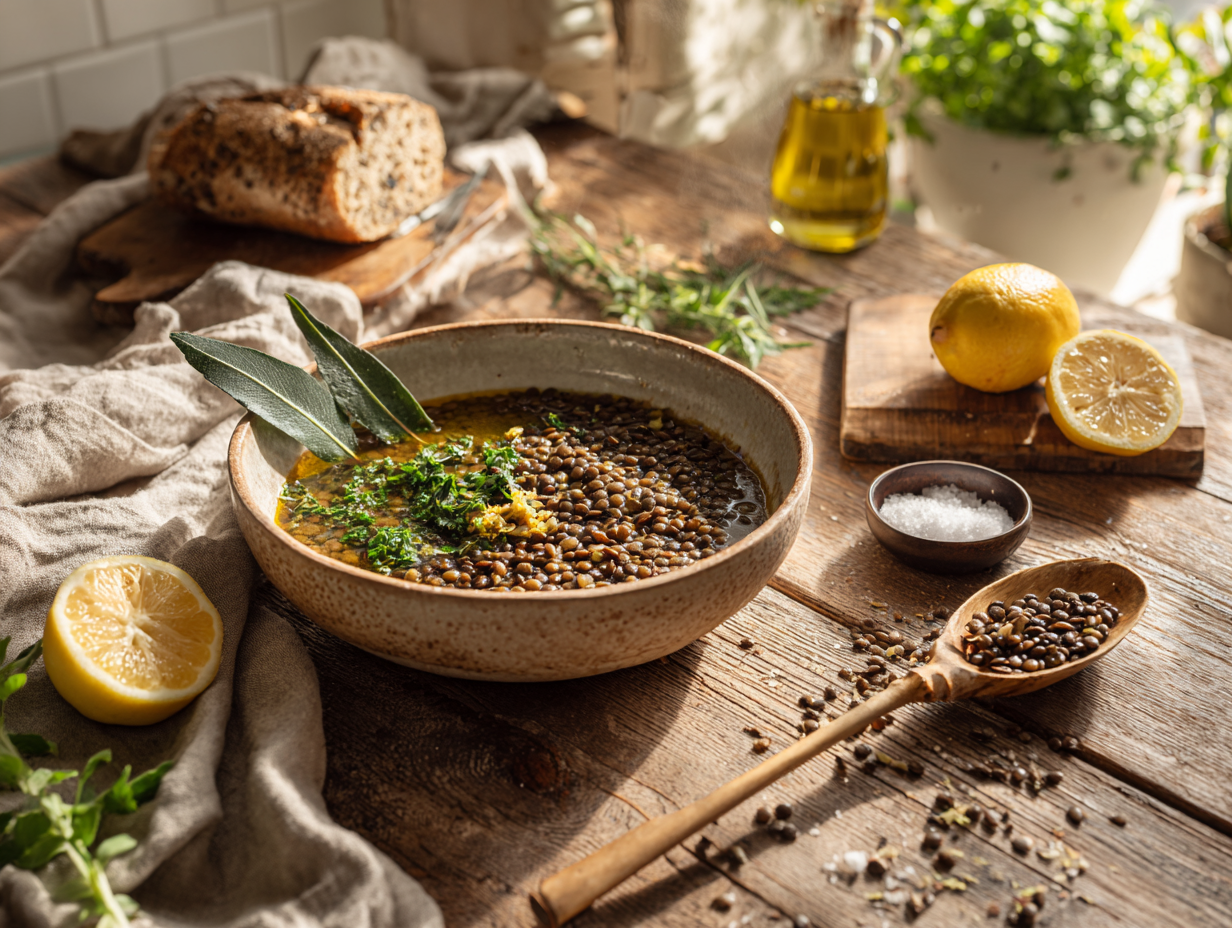
These are well-seasoned brown or French green lentils simmered with aromatics, finished with lemon and a quick cumin oil. They hold their shape, taste like an actual meal, and work as a side or a main. The honest reason to make them: they’re filling, they reheat well all week, and people who claim they don’t like lentils tend to finish the bowl.
The short version of why this works
Two things matter here. First, the aromatics — onion halves, crushed garlic, and bay leaves — simmer directly in the cooking water the whole time, not just for a minute at the start. That low-effort step builds a savory base that plain salted water can’t match. Second, the cumin oil at the end. Briefly heating whole cumin seeds in olive oil until they sizzle and pop releases their flavor in a way that stirring in ground cumin never does. Pour that fragrant oil over the finished lentils and it coats every bite. Skip the garnish — not worth the extra dish. The cumin oil is the finish that actually counts.
Storage and reheating
Cooked lentils keep in an airtight container in the fridge for up to 5 days. They thicken as they sit because the lentils absorb the residual liquid, so add a splash of water or vegetable broth when reheating on the stovetop over medium-low heat, stirring until warmed through. For the microwave, cover loosely and heat in 60-second intervals, adding liquid as needed. They also freeze well — portion into freezer bags or containers and freeze for up to 3 months. Thaw overnight in the fridge or defrost directly from frozen in a covered saucepan over low heat with a few tablespoons of water.
If something goes sideways
- Lentils are mushy: They cooked too long or at too high a simmer. Next time, start checking for doneness a few minutes early — they should be tender but still hold their shape when pressed. Brown lentils go soft faster than French green (Puy) lentils, so if texture matters most, use Puy.
- Lentils are gritty or chalky in the center: They’re undercooked. Add a bit more water, cover, and keep simmering on low. Don’t rush it with higher heat — the outsides will blow out before the centers finish.
- The cumin oil smells burnt: The oil was too hot or the seeds sat too long. Burnt cumin turns bitter fast. Discard it, wipe the pan, and start over with fresh seeds on lower heat — they only need 30 to 60 seconds once the oil is warm.
- Lentils taste flat even after seasoning: Acid is probably low. Add more lemon juice a little at a time and taste as you go. A small splash of red wine vinegar also works if you’ve run out of lemon.
- Lentils soaked up all the water before they’re done: Just add more water, about a quarter cup at a time. Older dried lentils absorb more liquid and take longer to cook — this is normal and not a sign anything went wrong.

Perfect Everyday Lentils with Lemon, Bay, and Cumin

Equipment
- Fine mesh sieve
- 4-quart saucepan with lid
- Wooden spoon
- Measuring cups and spoons
- Chef's knife
- Cutting board
- Small skillet (for optional tempered oil)
Ingredients
- 1 cup dried lentils (brown or French green) choose fresh, current-year crop; French green (du Puy) hold shape best
- 4 cups filtered water or low-sodium vegetable broth filtered water for pure flavor; broth for a richer base
- 1 small yellow onion, halved peel on optional for a golden tint
- 2 cloves garlic, lightly crushed bruise to release aroma; keep whole for subtlety
- 1 piece bay leaf prefer Turkish bay for delicate aroma
- 1 piece kombu (optional) about 2 inches; adds umami and helps tenderize
- 1 teaspoon kosher salt, divided Diamond Crystal preferred; adjust if using Morton
- 2 tablespoons extra-virgin olive oil, divided fruity, peppery oil for finishing and optional temper
- 1 teaspoon whole cumin seeds (or 1/2 teaspoon ground) use seeds for tempered oil; ground for a quick stir-in
- ¼ teaspoon freshly ground black pepper
- 1 tablespoon fresh lemon juice from about 1/2 lemon; adjust to taste
- 1 teaspoon finely grated lemon zest microplane for a fine, aromatic zest
- 2 tablespoons chopped fresh parsley or cilantro flat-leaf parsley for classic profile; cilantro for brightness
Instructions
- Sort and Rinse (5 minutes): Spread 1 cup lentils on a sheet pan and pick out any small stones or debris. Rinse thoroughly in a fine-mesh sieve under cool running water until the water runs clear. This removes dust and promotes even cooking.
- Build the Aromatic Base (2 minutes): In a 4-quart saucepan, combine rinsed lentils, 4 cups water or broth, halved onion, crushed garlic, bay leaf, and the optional kombu.
- Bring to a Gentle Simmer (about 5–6 minutes): Set over medium-high heat and bring just to a boil. Immediately reduce to maintain a gentle, steady simmer—small bubbles lazily breaking the surface. Skim any foam for a cleaner flavor. Partially cover with a lid to minimize evaporation.
- Season Mid-Cook (at 10 minutes): Sprinkle in about 1/2 teaspoon kosher salt. Early seasoning encourages even seasoning without toughening the skins. Stir, then continue simmering.
- Simmer until Tender (total 20–25 minutes): Continue cooking until the lentils are tender with creamy centers but still hold their shape. Begin checking at 20 minutes; most brown lentils are perfect around 25 minutes, French green may need a touch more. The aroma will be savory and sweet from the onion and bay, and the lentils should taste nutty, not chalky.
- Finish and Adjust (2 minutes, off heat): Remove the onion, garlic, bay, and kombu. If you prefer drier lentils, drain excess liquid; for brothy lentils, leave some cooking liquid. Stir in remaining 1/2 teaspoon salt, black pepper, 1 tablespoon olive oil, and 1 tablespoon lemon juice. Taste and adjust salt and acidity until lively and balanced.
- Optional Tempered Cumin Oil (parallel, 3 minutes): In a small skillet, warm 1 tablespoon olive oil with 1 teaspoon cumin seeds over medium-low heat until the seeds gently sizzle and turn a shade darker, 2–3 minutes. The oil should be shimmering but not smoking—about 300–325°F (150–165°C). Immediately drizzle the fragrant oil over the lentils and stir. If using ground cumin, simply stir 1/2 teaspoon into the hot lentils with the oil.
- Herb and Zest Finish (1 minute): Fold in lemon zest and chopped parsley or cilantro. Cover and rest 1–2 minutes to let flavors bloom, then serve.
Notes
Michelle’s Tips:
- Brothy vs. Dry: For salads, drain well; for a comforting bowl, keep 1/4–1/2 cup of the cooking liquid.
- Acidity Timing: Add lemon at the end to protect tenderness and preserve bright flavor.
- Salt Smart: Season in layers (mid-cook and at the end) for depth without oversalting.
- Substitutions: Use thyme sprigs instead of bay; add a pinch of smoked paprika instead of cumin; swap lemon with red wine vinegar.
- Faster Aromatics: Finely chop the onion and simmer it with the lentils for a stronger onion presence—no extra pan required.
- Keeping Warm: To hold for service, cover and keep in a 200°F (95°C) oven up to 30 minutes; stir and splash with hot water before serving.
- Storage: Refrigerate up to 5 days in an airtight container with some cooking liquid. Freeze up to 3 months. Reheat gently with a splash of water, then refresh with lemon and herbs.
Serving Suggestions:
Spoon lentils into warm bowls so they glisten. Drizzle with a few drops of olive oil, dust with black pepper, and crown with fresh herbs and lemon zest. For contrast, add a handful of peppery arugula or serve alongside crusty bread or steamed rice. Perfectly cooked lentils appear satin-sheened, with intact skins and a gentle steam carrying notes of bay, lemon, and spice.Culinary Context:
Lentils are beloved across the Mediterranean and the broader Middle East and South Asia, prized for speed, nutrition, and adaptability. This rendition nods to French technique (whole aromatics, gentle simmer) and Mediterranean finishing (good olive oil, lemon, and herbs), creating a versatile base you can take in countless directions.Optional Advanced Instructions:
- Make-Ahead: Cook up to 3 days in advance; cool quickly, refrigerate in their liquid, and reheat gently with a splash of water.
- Instant Pot: Combine ingredients (omit kombu if you prefer), use1 cup lentils : 2 1/2 cups water, cook high pressure 6–8 minutes, natural release 10 minutes, then season and finish.
- Soffritto Upgrade: For deeper flavor, sauté 1/2 cup finely diced onion, 1/4 cup diced carrot, and 1/4 cup diced celery in 1 tablespoon olive oil until sweet and golden before adding lentils and liquid.
- Texture Control: For firmer lentils (salads), start checking at 18–20 minutes; for softer (soups), extend to 30 minutes with extra water.
Nutrition
Your questions, answered
Can I use red lentils instead of brown or green?
Red lentils will not work here — they break down into a thick purée and won’t hold their shape. Stick with brown lentils or French green (Puy) lentils; both stay intact and give you the texture this recipe is built around.
Do I really need to add the salt partway through cooking instead of at the start?
Yes, it makes a real difference. Salting too early can toughen the lentil skins and leave you with a chewier texture than you want. Adding salt about halfway through lets the lentils soften properly while still seasoning them all the way to the center.
What can I serve this with to make it a full meal?
Crusty bread, warm pita, or a scoop of cooked grain like farro or rice turns this into a complete dinner. It also works well spooned over roasted vegetables or alongside a simple green salad — the lentils are substantial enough that you don’t need much else.
More plant-based recipes to try
- Mediterranean Lentil Power Bowl
- Moroccan Lentil Apricot Tagine
- Smoky Spanish Chickpea Stew
- Vegan Turkish Lentil Köfte