
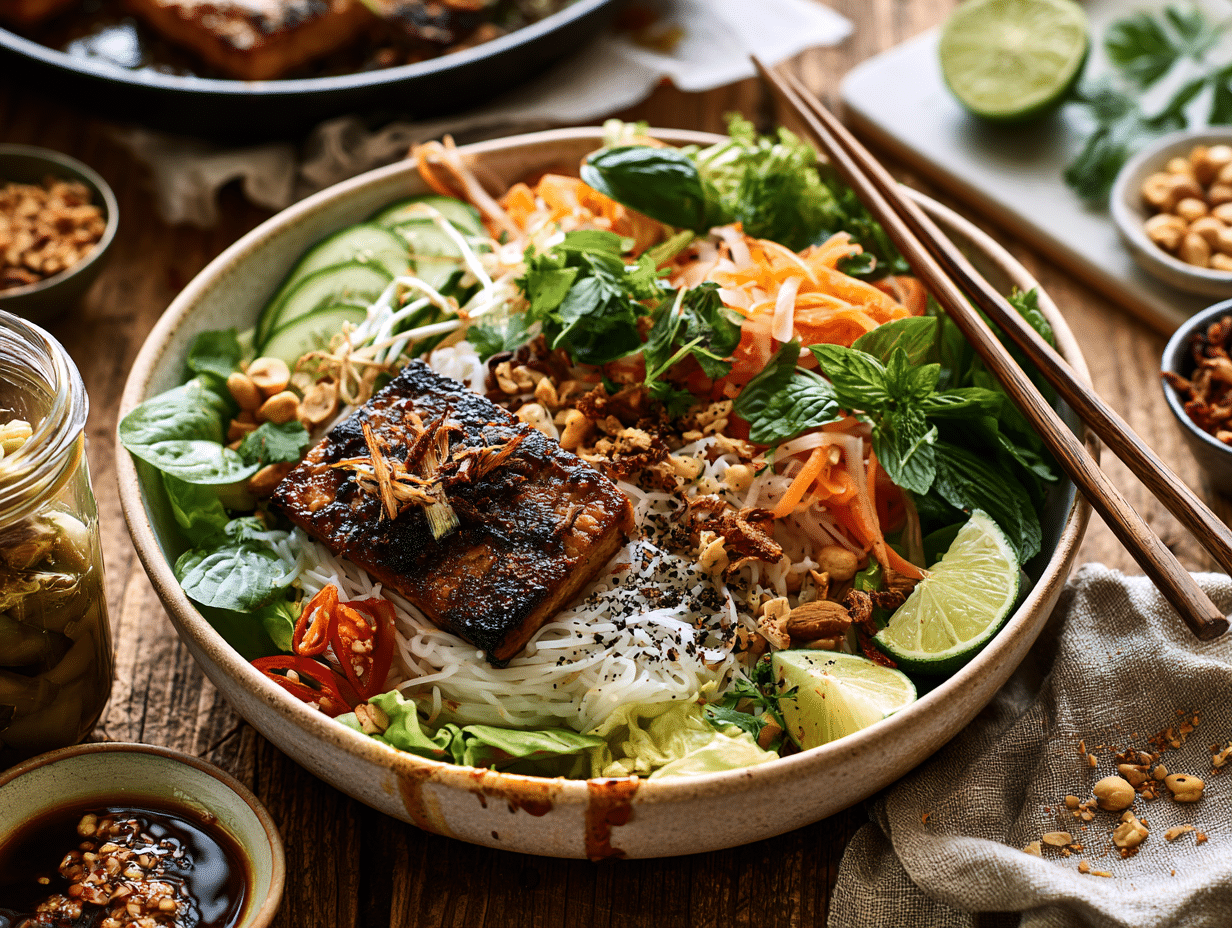
Vietnamese Rice Noodle Salad (Bún Chay): A Journey Through Vietnam’s Vibrant Culinary Heritage
The Soul of Vietnamese Street Food
In the bustling markets of Southern Vietnam, where the humid air mingles with the intoxicating aromas of fresh herbs and sizzling ingredients, Bún Chay stands as a testament to the Vietnamese genius for balance. This vegetarian rice noodle salad embodies the very essence of Vietnamese cuisine—a harmonious dance between contrasting elements that creates something far greater than the sum of its parts.
Understanding Bún Chay: More Than Just a Salad
The name itself tells a story: “bún” refers to the delicate rice vermicelli that forms the foundation of the dish, while “chay” indicates its vegetarian nature. In Vietnamese Buddhist tradition, “chay” dishes are eaten on the first and fifteenth days of the lunar month, making this salad both a culinary delight and a spiritual practice.
Unlike Western salads that often serve as mere accompaniments, Bún Chay is a complete meal—substantial yet refreshing, complex yet accessible. It represents the Vietnamese philosophy of yin and yang on a plate: hot meets cold, soft meets crunchy, sweet meets sour, creating a dynamic eating experience that engages all the senses.
The Five Elements in a Bowl
Vietnamese cuisine is deeply rooted in the concept of ngũ vị—the five fundamental flavors that must be present in a balanced dish:
- Sour (chua): From lime juice and rice vinegar
- Sweet (ngọt): Through palm sugar or maple syrup
- Salty (mặn): Via soy sauce or traditional fish sauce
- Spicy (cay): From fresh chilies or chili-garlic sauce
- Bitter (đắng): Found in the fresh herbs, particularly cilantro stems
This careful orchestration of flavors reflects the Vietnamese belief that food should nourish not just the body, but also maintain harmony within it.
Regional Variations: A Tale of Two Vietnams
While Bún Chay is enjoyed throughout Vietnam, distinct regional differences reflect local preferences and available ingredients. In the North, the salad tends to be more austere, with a lighter hand on the herbs and a preference for subtle flavors. The nước chấm is often clearer and less sweet, allowing the natural flavors of the vegetables to shine through.
In contrast, Southern Vietnamese versions—like the one that inspired this recipe—are more exuberant. The generous use of fresh herbs, the slightly sweeter dressing, and the abundance of garnishes reflect the South’s tropical abundance and its people’s love for bold, vibrant flavors.
The Art of Nước Chấm Chay
No discussion of Bún Chay would be complete without delving into its soul—the nước chấm chay. This vegetarian version of Vietnam’s ubiquitous dipping sauce is a masterclass in balance. Traditional nước chấm relies on fish sauce for its umami depth, but the vegetarian version achieves similar complexity through the careful layering of soy sauce, lime juice, and aromatics.
The key to exceptional nước chấm chay lies in achieving the perfect equilibrium—it should be bright enough to cut through the richness of fried tofu, sweet enough to complement the bitter herbs, and spicy enough to awaken the palate without overwhelming it.
Lemongrass: The Citrus Heart of Southeast Asia
The addition of lemongrass tofu elevates this traditional salad with a distinctly aromatic twist. Lemongrass (sả in Vietnamese) is more than just a flavoring—it’s a cornerstone of Vietnamese cooking that brings a unique citrusy essence without the acidity of actual citrus fruits.
When preparing lemongrass, only the tender inner core is used, as the outer layers are too fibrous. The traditional method involves bruising the lemongrass with the flat side of a cleaver before mincing, which releases the essential oils and intensifies the flavor. This technique, passed down through generations, ensures maximum fragrance in every bite.
The Ritual of Assembly
In Vietnam, the assembly of Bún Chay is almost ritualistic. Street vendors have perfected the art of building these bowls with practiced efficiency, each component placed with intention. The lettuce provides a crisp foundation, the noodles create a neutral canvas, and the herbs are scattered like confetti, each one contributing its unique note to the symphony of flavors.
This methodical construction isn’t just about aesthetics—it ensures that each bite contains a perfect cross-section of all the elements, delivering the full intended experience with every forkful (or chopstick-full).
Cultural Significance: More Than Sustenance
In Vietnamese culture, meals are communal affairs that strengthen social bonds. Bún Chay, with its interactive nature—diners often customize their bowls with additional herbs, peanuts, and sauce—embodies this spirit of shared dining. It’s common to see families gathered around a table laden with platters of herbs and vegetables, each person creating their perfect bowl.
The dish also reflects Vietnam’s agricultural heritage. The abundance of fresh herbs and vegetables celebrates the fertility of the Mekong Delta, while the rice noodles pay homage to the country’s status as one of the world’s largest rice producers.
Modern Adaptations and Global Appeal
As Vietnamese cuisine has spread globally, Bún Chay has found new audiences among health-conscious diners and vegetarians seeking flavorful, satisfying meals. The dish’s naturally gluten-free profile (when made with tamari instead of soy sauce) and its emphasis on fresh, raw vegetables align perfectly with contemporary dietary trends.
Yet even as it adapts to new contexts and dietary preferences, the essence of Bún Chay remains unchanged—it’s still about balance, freshness, and the celebration of contrasting textures and flavors that make Vietnamese cuisine so distinctive.
The Philosophy of Freshness
Perhaps no aspect of Vietnamese cooking is more important than freshness, and Bún Chay exemplifies this principle. The herbs are added at the last moment to preserve their essential oils, the noodles are served at room temperature to maintain their texture, and the hot tofu provides a temperature contrast that enlivens the entire dish.
This commitment to freshness extends beyond mere flavor—it reflects a deeper philosophy about the connection between food and vitality. In Vietnamese traditional medicine, fresh herbs are considered cooling foods that help balance the body’s internal temperature, making Bún Chay particularly appealing during the hot, humid summers of Southern Vietnam.
A Living Tradition
As Vietnam continues to modernize rapidly, dishes like Bún Chay serve as delicious links to the past while remaining thoroughly relevant to contemporary life. They remind us that the best recipes aren’t just instructions for combining ingredients—they’re cultural artifacts that tell stories about people, places, and traditions.
Whether enjoyed from a street vendor’s cart in Saigon or prepared in a home kitchen thousands of miles away, Bún Chay continues to offer what it has always promised: a moment of refreshing balance in a complex world, a celebration of nature’s bounty, and a delicious reminder that sometimes the simplest ingredients, thoughtfully combined, create the most memorable meals.

Vietnamese Rice Noodle Salad (Bún Chay) with Lemongrass Tofu

Equipment
- Chef’s knife
- Cutting board
- Mixing bowls
- Small saucepan or kettle
- Colander or fine-mesh strainer
- Nonstick skillet or wok
- Tongs or chopsticks
- Paper towels or clean kitchen towel
- Citrus juicer (optional)
Ingredients
For the quick pickles (đồ chua)
- 1 cup carrot, julienned (about 1 medium) Choose firm, sweet carrots for best crunch
- 1 cup daikon radish, julienned Look for fresh, crisp daikon; peel if skin is thick
- ½ cup unseasoned rice vinegar Unseasoned keeps you in control of salt and sugar balance
- ½ cup warm water Helps dissolve sugar quickly for a clear brine
- 2 tbsp organic cane sugar Adjust to taste for a balanced sweet-sour profile
- 1 tsp kosher salt Fine sea salt works too; start with a scant teaspoon
For the lemongrass tofu
- 14 oz extra-firm tofu Non-GMO; press for the best sear and texture
- 2 tbsp finely minced lemongrass About 1 thick stalk, tender inner core only; or use 1 1/2 tbsp lemongrass paste
- 2 tsp garlic, minced About 2 cloves; grate for a smoother marinade cling
- 2 tbsp shallot, minced 1 small shallot; sweeter and more delicate than onion
- 2 tbsp low-sodium soy sauce or tamari Use tamari for gluten-free
- 1 tbsp maple syrup Adds gentle sweetness and helps caramelization
- 1 tsp lime zest Optional, for citrus lift and aroma
- 1 tbsp neutral oil Avocado, canola, or grapeseed; for marinade
For the vegan nước chấm (dressing)
- ¼ cup fresh lime juice Juice just before mixing for brightness
- 3 tbsp low-sodium soy sauce or tamari Tamari for gluten-free; adjust to taste for salt balance
- 2 tbsp unseasoned rice vinegar Adds clean acidity alongside lime juice
- 3 tbsp warm water Loosens the dressing for even distribution
- 1 ½ tbsp maple syrup or agave Adjust to achieve the classic sweet-sour balance
- 1 tsp chili-garlic sauce or 1 small red chili, thinly sliced Add more or less to taste; remove seeds for milder heat
- 1 tsp garlic, finely grated 1 small clove; microplane for a silky texture
For the noodles, salad base, and garnish
- 8 oz dry rice vermicelli noodles (Bún) Look for thin Vietnamese-style rice vermicelli; Three Ladies brand is reliable
- 4 cups shredded romaine or green leaf lettuce Rinse and spin very dry for the crispest texture
- 1 cup cucumber, thinly sliced Persian or English cucumbers have fewer seeds and stay crisp
- 1 cup bean sprouts Rinse in cold water to keep snappy; optional quick blanch if preferred
- ½ cup fresh mint leaves Tear just before serving to prevent bruising
- ½ cup Thai basil leaves Adds anise notes; substitute sweet basil if needed
- ½ cup cilantro leaves and tender stems Tender stems add extra fragrance and crunch
- 2 scallions, thinly sliced Use both white and green parts for depth and freshness
- ⅓ cup roasted peanuts, lightly crushed Dry-roast briefly for extra aroma if unsalted
- ¼ cup crispy fried shallots Optional but highly recommended; store-bought is fine
- 1 lime, cut into wedges Serve alongside for last-minute brightness
For cooking
- 2 tbsp neutral oil For searing tofu; avocado, canola, or grapeseed
Instructions
- Quick-pickle the carrot and daikon (10 minutes rest). Whisk together 1/2 cup warm water, 1/2 cup rice vinegar, 2 tbsp sugar, and 1 tsp kosher salt until dissolved. Add the julienned carrot and daikon, press to submerge, and let sit for 10 minutes. The brine should taste bright-sour with gentle sweetness; veggies will stay crisp.
- Press and marinate the tofu (8 minutes press + 7 minutes marinate). Wrap the 14 oz tofu in a clean towel and place a light weight on top for 8 minutes to quickly expel surface moisture. Meanwhile, mix 2 tbsp minced lemongrass, 2 tsp garlic, 2 tbsp shallot, 2 tbsp soy sauce or tamari, 1 tbsp maple syrup, 1 tsp lime zest (optional), and 1 tbsp neutral oil. Pat tofu dry, cut into 1/2-inch slabs or cubes, and toss gently in the marinade. Rest for 7 minutes; the tofu should smell citrusy and aromatic.
- Make the vegan nước chấm (5 minutes). In a small bowl, whisk 1/4 cup lime juice, 3 tbsp soy sauce or tamari, 2 tbsp rice vinegar, 3 tbsp warm water, 1 1/2 tbsp maple syrup, 1 tsp chili-garlic sauce (or sliced chili), and 1 tsp grated garlic until translucent and glossy. Taste for a balanced sweet-sour-salty-heat profile and adjust as desired.
- Cook and chill the rice vermicelli (about 4 minutes). Bring a pot of water to a rolling boil (212°F / 100°C). Add 8 oz rice vermicelli and cook per package, usually 3–4 minutes, until just tender and bouncy. Drain immediately and rinse under very cold water until cool; shake off excess water. Toss with a few drops of neutral oil to prevent sticking and set aside.
- Sear the lemongrass tofu (about 11 minutes). Heat 2 tbsp neutral oil in a nonstick skillet or wok over medium-high heat until the oil shimmers (pan surface will be very hot; if oven-baking, preheat to 425°F / 220°C). Lay tofu in a single layer and cook 3–4 minutes per side until deep golden and lightly crisp. Alternative: Deep-fry at 350°F / 175°C for 3–4 minutes, or oven-bake for 18–20 minutes, flipping halfway.
- Assemble and plate (about 5 minutes). In wide bowls, create a bed with 4 cups shredded lettuce. Add a nest of chilled noodles, then arrange cucumber, bean sprouts, and a generous handful of mixed herbs (mint, Thai basil, cilantro). Spoon over the vegan nước chấm to lightly gloss the noodles. Top with hot lemongrass tofu, a tangle of pickled carrot and daikon (drained), crushed peanuts, fried shallots, and lime wedges. Look for a mosaic of greens, ivory noodles, golden tofu, and ruby chili—this color story signals perfect balance.
Notes
Michelle’s Tips
- Maximize herb fragrance: Tear herbs by hand just before serving to release essential oils without bruising.
- Quick-press tofu hack: Microwave tofu for 30 seconds, then press for faster water release without crumbling.
- Sharper lemongrass: Bruise minced lemongrass with the side of your knife or a mortar to unlock citrusy oils. If you don’t have a mortar and pestle, pulse aromatics briefly in a food processor; texture will be slightly finer.
- Gluten-free: Use tamari and ensure fried shallots/peanuts are GF-certified.
- Mild heat: Remove chili seeds and ribs, or replace with a few drops of chili oil at the table.
- Crunch insurance: Rinse noodles very well in cold water; this halts cooking and preserves their bounce.
- Alternative tofu methods: Air-fry at 400°F / 205°C for 12–14 minutes, shaking once, for extra-crisp edges.
Serving Suggestions
- Plating: Use wide, shallow bowls. Twirl noodles into a compact nest with chopsticks, then tuck vegetables and herbs around for contrast. Lay tofu at 10 and 2 o’clock so it crowns the bowl.
- Garnish: A final squeeze of lime, a sprinkle of crushed peanuts, and a few mint tips add sparkle. For aroma, finish with a whisper of freshly cracked black pepper.
- Pairings: Serve with iced jasmine tea, a crisp pilsner, or a lime soda. A side of torn lettuce for wrapping bites is wonderfully interactive.
Culinary Context
Bún Chay is a beloved Vietnamese staple, especially in the South, where herbs are plentiful and salads are meals unto themselves. Traditionally assembled to order, each bowl balances the elemental Vietnamese flavor compass—sour (lime, vinegar), salty (soy/tamari), sweet (maple), spicy (chili), and bitter (herbs). I fell in love with its market-stall energy—the way a vendor’s practiced hands build layers of texture and brightness in seconds.Optional Advanced Instructions
- Make-ahead: Quick pickles keep 1 week in the fridge; dressing keeps 5 days. Press and marinate tofu up to 24 hours ahead for deeper flavor.
- Parallel cooking: While tofu marinates, boil water and prep herbs. Chill noodles while you sear tofu to serve hot-on-cold for a dynamic contrast.
- Beginner alternative: If searing feels tricky, oven-bake the tofu at 425°F / 220°C for 18–20 minutes; it’s forgiving and evenly browns.