
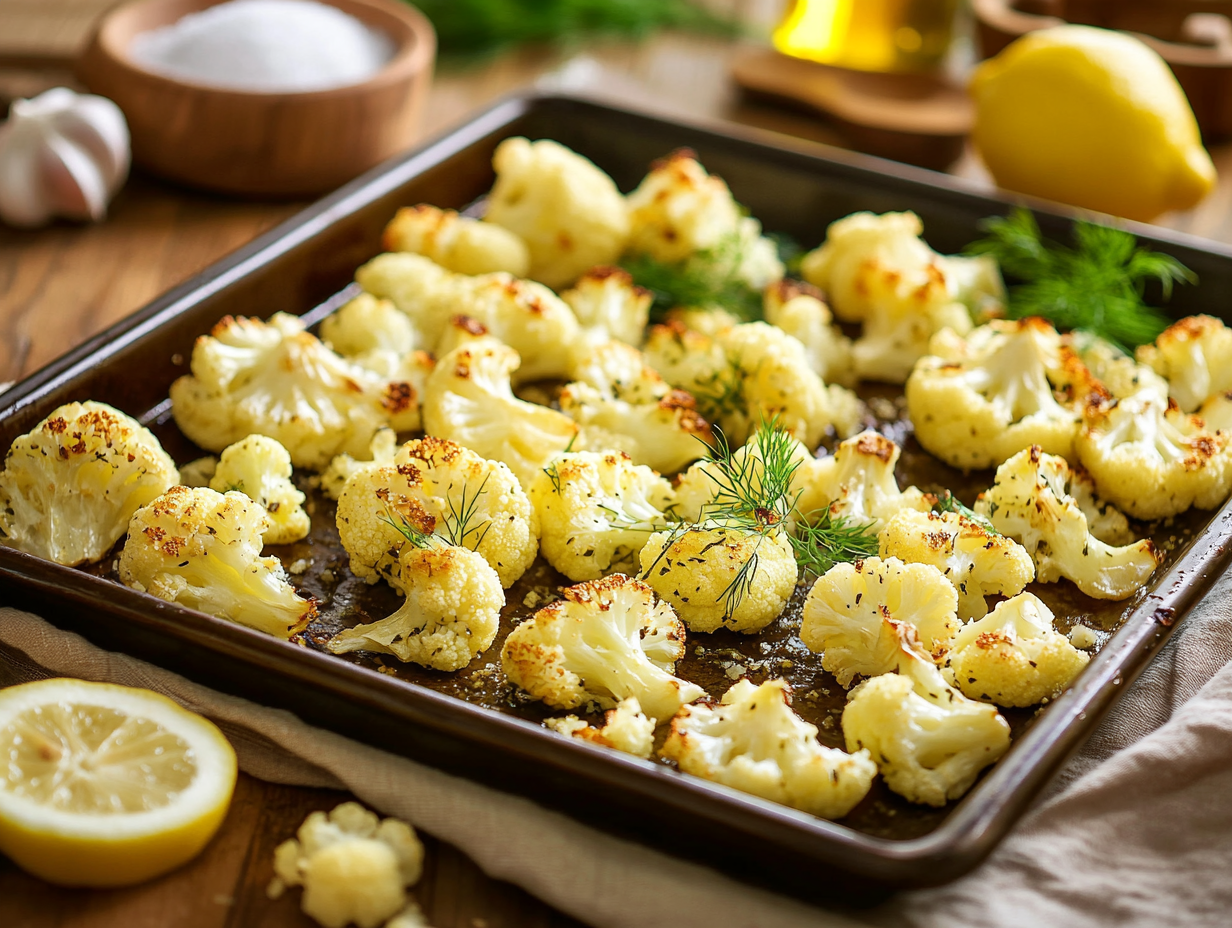
This is roasted cauliflower tossed with olive oil, lemon juice and zest, garlic, and fresh dill, then cooked at high heat until the edges brown and the centers go tender. It comes together on one sheet pan with almost no prep, and it works as a side dish or a light main over grains.
Smart swaps
- Fresh dill: Dried dill works in a pinch — use about one-third the amount. The flavor is less bright but still good.
- Extra virgin olive oil: Any neutral high-heat oil works, but olive oil gives noticeably better flavor here. Don’t substitute.
- Lemon zest: If you only have bottled lemon juice, skip the zest step — bottled juice has no useful oils to extract. Use a fresh lemon if you can.
- Toasted pine nuts (optional garnish): Skip the garnish — not worth the extra dish. The cauliflower stands on its own.
What makes this version work
Two things matter most. First, using both lemon juice and zest together: the juice seasons and adds acidity, while the zest carries fragrant oils that survive the oven heat and give the finished dish a rounded lemon flavor rather than a sharp one. Second, adding a portion of the fresh dill after roasting rather than only before — dill loses most of its character under high heat, so the post-roast addition is what you actually taste. Everything else is straightforward.
Mistakes to avoid
- Skipping the dry on the florets: If the cauliflower is wet from washing when it goes onto the pan, it steams before it can brown. Pat the florets dry with a clean towel first.
- Adding lemon juice too early in the wrong way: Pooled juice on the pan can cause the florets to steam in spots. Toss the cauliflower in the dressing in a bowl, then spread it out — don’t pour juice directly onto the sheet pan.
- Using a dark or nonstick pan: A heavy light-colored sheet pan distributes heat more evenly and lets you see browning without burning. Dark pans can over-brown the bottoms before the tops catch up.
- Pulling it too early: Pale golden isn’t done. Wait for deep brown edges on at least some of the florets — that’s where the flavor is. Taste before you take it out.
- Storing with the fresh dill already mixed in: If you’re making this ahead, keep the finishing dill separate and add it just before serving. Dill wilts and turns bitter once it sits with warm, dressed vegetables.
Keeping and reheating
Leftovers keep in an airtight container in the fridge for up to 4 days. To reheat, spread the florets back on a sheet pan and put them in a 400°F oven for 8 to 10 minutes — this brings back some of the crispness that a microwave will not. The microwave is fine if you don’t mind softer texture; 60 to 90 seconds on medium power is enough. This dish does not freeze well; the texture turns mushy after thawing.

Lemon Dill Roasted Cauliflower

Equipment
- Baking sheet
- Large mixing bowl
- Knife
- Cutting board
- Parchment paper
Ingredients
- 1 head cauliflower medium-sized, fresh and firm, cut into bite-sized florets
- 2 tablespoons extra virgin olive oil use a high-quality Mediterranean blend for best flavor
- 1 tablespoon fresh lemon juice from about 1/2 a lemon
- 1 teaspoon lemon zest zest only the yellow skin to avoid bitterness
- 2 cloves garlic minced finely
- 1 tablespoon fresh dill chopped; reserve a little for garnish
- ½ teaspoon sea salt to taste
- ¼ teaspoon freshly ground black pepper
Instructions
- Preheat your oven to 400°F (200°C). Line a large baking sheet with parchment paper.
- In a large mixing bowl, toss the cauliflower florets with olive oil, lemon juice, lemon zest, and minced garlic. Mix until evenly coated.
- Add fresh dill, sea salt, and black pepper. Gently toss again to distribute the herbs and seasoning well.
- Spread the seasoned cauliflower florets in a single layer on the prepared baking sheet, ensuring they are not crowding. Crowding causes steaming rather than roasting.
- Roast in preheated oven for 35 minutes, turning the florets halfway through. They should be golden brown on the edges and tender inside.
- Remove from the oven and garnish with additional fresh dill before serving.
Notes
- For a twist, add a pinch of smoked paprika before roasting for extra depth.
- If fresh dill is unavailable, substitute with 1 teaspoon of dried dill, but use it sparingly.
- Garnish with toasted pine nuts or tahini drizzle for a more substantial main course.
Nutrition
Frequently asked questions
Can I use frozen cauliflower instead of fresh?
You can, but the results will be noticeably softer. Frozen cauliflower holds more water, so thaw it completely and press it dry with a towel before roasting, and expect less crisping at the edges.
How do I cut the cauliflower so it roasts evenly?
Cut florets to roughly the same size — about 1.5 to 2 inches across. Pieces that are too large stay raw in the center while the outside browns; pieces that are too small can burn before the inside cooks through.
Can I make this ahead for a dinner party?
Yes, roast it up to a day ahead and reheat on a sheet pan at 400°F for 8 to 10 minutes before serving. Hold the fresh dill and any lemon zest garnish until just before you bring it to the table.
What can I serve this with to make it a full meal?
It works well over couscous, quinoa, or alongside a chickpea dish. For a fuller plate, try it next to a Mediterranean lentil bowl or with warm flatbread and hummus.
My cauliflower came out soggy. What went wrong?
The most common cause is overcrowding the pan — florets touching each other trap steam and prevent browning. Use two sheet pans if needed, and make sure the cauliflower is dry before it goes in the oven.
Can I use lemon juice from a bottle?
It will work for the juice component, but skip trying to zest a bottled lemon — there’s nothing to zest. If you go that route, the lemon flavor will be sharper and less complex, so use a little less than the recipe calls for and taste as you go.
If you liked this one
- Mediterranean Lentil Power Bowl
- Vegan Greek Gyro Bowl
- Mediterranean Orzo Artichoke Salad
- Baked Ratatouille with Herb Oil