
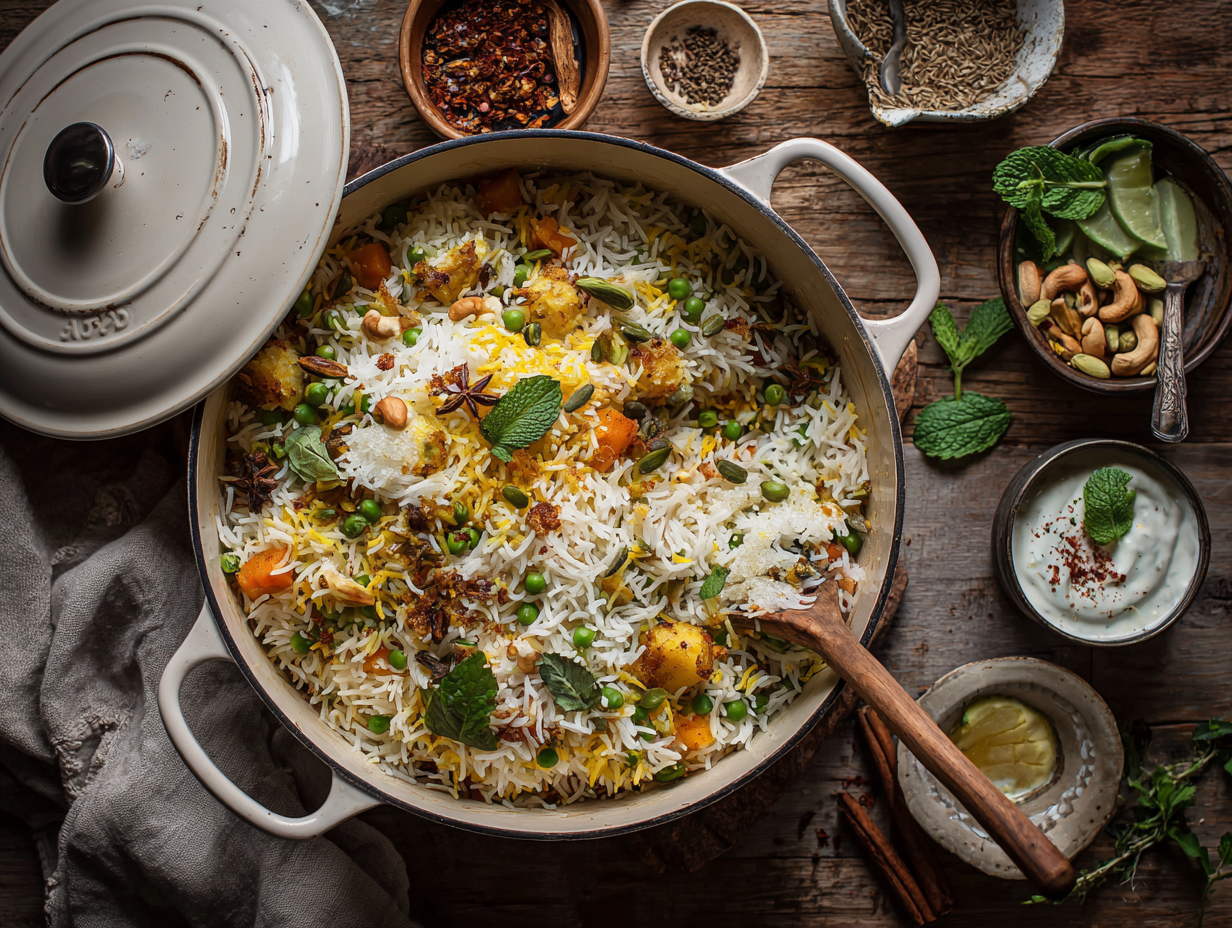
This is a layered rice dish built around the dum method — sealed steam cooking that gives you long, separate grains and vegetables that actually taste like something. It takes more steps than a weeknight stir-fry, but most of them are short, and a lot of the work happens while the pot sits on low heat doing its thing. If you want a one-pot dinner that feels genuinely special without ordering takeout, this is a solid choice.
The short version of why this works
Two things make or break this recipe. First, parboiling the rice to exactly 70–80% done before layering — if you skip this or overcook it at this stage, the final dum cook will turn everything to mush. Pull the rice while it still has a firm, chalky center. Second, the seal. Covering the pot tightly with foil before the lid traps steam inside so the rice finishes cooking in spiced vapor rather than boiling water. That’s what gives each grain its flavor and keeps it from clumping. A heavy-bottomed pot matters here — thin pans create hot spots that scorch the bottom layer before the top is done.
Shopping notes
- Aged basmati rice: Look for bags labeled “aged” or “extra-long grain” at South Asian grocery stores. Aged rice has lower moisture content and holds its shape through the two-stage cooking. Standard supermarket basmati works but is more prone to going soft.
- Coconut yogurt: Use plain, unsweetened, full-fat coconut yogurt. Thin or sweetened versions will make the masala watery and throw off the flavor balance. Soy-based plain yogurt is a reliable backup.
- Saffron: A small pinch goes a long way. If the price is a barrier, skip it — the dish is still good. Don’t substitute turmeric expecting the same result; it changes the flavor, not just the color.
- Vegan butter: Any neutral-tasting block-style vegan butter works. Avoid spreads with high water content, which can make the rice greasy.
- Birista (fried onions): Store-bought crispy fried onions (check the label — most are vegan) save 20 minutes and work just as well as homemade here. Skip making them from scratch on a weeknight — not worth the extra time or splatter.
Common problems and fixes
- Rice is mushy throughout: The parboil ran too long. Next time, taste the rice at 5 minutes — it should be cooked on the outside but hard in the middle. Drain immediately and spread on a tray to stop carryover cooking.
- Bottom layer is burnt but top is undercooked: Your heat was too high during the dum stage. Use the lowest burner setting your stove has, and place a flat griddle or tawa under the pot to diffuse heat. The dum stage should be a gentle simmer, not a boil.
- Vegetables are waterlogged and falling apart: Dense vegetables like carrots and potatoes need less time than you think when they’re going into a sealed pot. Cut them slightly larger than you normally would, and don’t pre-cook them all the way through in the masala step.
- The foil seal leaked and the rice dried out: Use two layers of foil and crimp the edges firmly against the pot rim before adding the lid. If you notice steam escaping during cooking, press the foil down again and add a few tablespoons of warm water around the edge of the rice.
- Spices taste raw or sharp: Whole spices need direct contact with hot oil at the start to bloom properly. If the oil wasn’t hot enough when you added them, you’ll get a raw, harsh flavor. Toast them in the oil until fragrant — about 30 seconds — before adding anything else.
Keeping and reheating
Leftover biryani keeps well in an airtight container in the fridge for up to 4 days. The flavors actually improve overnight as the spices settle in. To reheat, add a tablespoon or two of water per portion, cover tightly with a lid or plate, and microwave on medium power for 2–3 minutes, stirring once halfway through. Reheating on the stovetop over low heat with a splash of water also works well — just keep the lid on and stir gently to avoid breaking up the rice. For freezing, portion it into individual servings before freezing; it keeps for up to 2 months. Thaw overnight in the fridge before reheating the same way.

Aromatic Vegan Vegetable Biryani (Dum Style)

Equipment
- Heavy-bottomed Dutch oven (5–6 qt) with tight-fitting lid
- Medium pot (4–5 qt) for boiling rice
- Large skillet or sauté pan
- Fine-mesh strainer or colander
- Measuring cups and spoons
- Small heatproof bowl
- Mortar and pestle or spice grinder (optional)
- Aluminum foil and clean kitchen towel
Ingredients
For the Rice & Saffron Prep:
- 2 cups aged basmati rice preferably extra-long grain; rinse until water runs clear
- 8 cups water for parboiling the rice
- 1.5 tbsp Kosher salt for rice water; adjust if using fine salt
- 2 pieces bay leaves for rice water infusion
- 4 pieces green cardamom pods lightly cracked
- 6 pieces cloves
- 1 piece cinnamon stick about 2 inches
- 1 tsp cumin seeds for rice water infusion
- ¼ tsp saffron threads quality Iranian or Spanish saffron recommended
- ⅓ cup warm unsweetened almond milk for blooming saffron; warm to about 120°F/50°C
For the Fried Onions (Birista):
- 4 tbsp neutral oil avocado, sunflower, or grapeseed
- 2 large yellow onions, very thinly sliced mandoline-thin for best crispness
For the Masala & Vegetables:
- 2 tbsp neutral oil for the masala
- 1 tsp cumin seeds for tempering
- ½ tsp black mustard seeds optional but aromatic
- 1 piece bay leaf for masala
- 3 pieces green cardamom pods lightly cracked
- 4 pieces cloves
- 1 piece cinnamon stick about 1.5 inches
- 1 piece star anise optional
- 1.5 cups yellow onions, sliced for the masala base
- 2 tbsp ginger-garlic paste equal parts fresh ginger and garlic, ground
- 2 pieces Thai green chiles, slit adjust to heat preference
- 1 cup Roma tomatoes, diced about 2 medium tomatoes
- 2 tsp ground coriander
- 1 tsp ground cumin
- 1 tsp Kashmiri red chili powder mild, vibrant color
- ½ tsp ground turmeric
- 1 tsp garam masala preferably homemade or a high-quality brand
- 1 tsp fine sea salt for the masala; adjust to taste
- 1 cup cauliflower florets, small bite-sized
- ¾ cup carrots, diced
- ¾ cup green beans, chopped
- ¾ cup green peas fresh or frozen
- ½ cup unsweetened coconut yogurt thick style; acts like dairy yogurt
- ½ cup fresh mint leaves, torn loosely packed
- ½ cup fresh cilantro, chopped tender stems included
- 1 tbsp fresh lemon juice
For Layering & Finish:
- 2 tbsp vegan butter for dotting the top layer
- 2 tbsp golden raisins optional but classic
- 2 tbsp raw cashews halves or pieces
- 1 tsp rose water or kewra water optional aromatic flourish
Instructions
- Rinse and Soak the Rice: Place 2 cups basmati rice in a bowl, rinse under cold water, gently rubbing the grains until the water runs almost clear (2–3 rinses). Cover with fresh water and soak for 20 minutes. This hydrates the core so grains cook long and separate, not sticky.
- Bloom the Saffron: Warm 1/3 cup almond milk to about 120°F/50°C (just warm to the touch, not hot). Add 1/4 tsp saffron and let steep at least 10 minutes; the liquid should turn a deep golden-orange and smell floral.
- Make the Birista (fried onions) — about 10 minutes: In a large skillet over medium heat, heat 4 tbsp neutral oil until shimmering. Add 2 large thinly sliced onions and a pinch of salt; cook, stirring often, until deep golden with crisp edges, about 10 minutes. Reduce heat if browning too quickly. Scoop to a paper towel–lined plate; they will crisp further as they cool. Reserve the flavorful onion oil in the pan.
- Parboil the Rice — about 6 minutes: Bring 8 cups water to a rolling boil (212°F/100°C) in a medium pot. Add 1.5 tbsp kosher salt, 2 bay leaves, 4 green cardamom, 6 cloves, 1 cinnamon stick, and 1 tsp cumin seeds. Drain the soaked rice and add it in. Boil until 70% cooked, about 6 minutes; grains should be long with a firm, chalky center. Drain through a fine-mesh strainer; gently remove whole spices if you spot them.
- Start the Masala — about 5 minutes: In a heavy Dutch oven over medium heat, add 2 tbsp neutral oil. When hot, add 1 tsp cumin seeds, 1/2 tsp black mustard seeds (optional), 1 bay leaf, 3 cardamom, 4 cloves, 1 small cinnamon stick, and 1 star anise (optional). Temper until the spices sizzle and smell nutty, 45–60 seconds. Add 1.5 cups sliced onions; sauté until soft and lightly golden, 3–4 minutes.
- Build Flavor — about 7 minutes: Stir in 2 tbsp ginger-garlic paste and 2 slit green chiles; cook until the raw edge disappears, 1–2 minutes. Add 1 cup diced tomatoes, 2 tsp ground coriander, 1 tsp ground cumin, 1 tsp Kashmiri chili, 1/2 tsp turmeric, and 1 tsp garam masala. Cook, stirring, until the tomatoes break down and the oil begins to separate from the paste, 4–5 minutes. If sticking, splash in 1–2 tbsp water to deglaze.
- Add Vegetables and Yogurt — about 5 minutes: Add 1 cup cauliflower, 3/4 cup carrots, 3/4 cup green beans, 3/4 cup peas, and 1 tsp fine sea salt. Sauté 2 minutes to coat in spices. Stir in 1/2 cup coconut yogurt; simmer gently 2–3 minutes until glossy and the vegetables are just beginning to soften. Turn heat to low.
- Layer the Biryani — about 7 minutes: Scatter half the mint and half the cilantro over the masala. Top with all of the drained rice in an even layer; do not pack down. Spoon the saffron-almond milk evenly over the rice. Dot with 2 tbsp vegan butter. Sprinkle the birista (fried onions) generously over the top, along with 2 tbsp raisins and 2 tbsp cashews. Drizzle 1 tsp rose or kewra water and 1 tbsp lemon juice. Visual cue: you should see distinct layers and streaks of saffron gold across the rice.
- Dum (steam) — 20 minutes: Seal the pot with a sheet of foil, then cover with the lid. Place over the lowest flame and cook for 20 minutes to trap steam. Alternatively, bake at 350°F/180°C for 20–25 minutes. You should catch a heady aroma of saffron and sweet spices when you gently lift the lid.
- Rest, Fluff, and Finish — about 5 minutes: Turn off the heat and rest 5 minutes. Uncover, then use a wide spoon or fork to gently lift and fluff, preserving long grains. Garnish with the remaining mint and cilantro. Serve immediately.
Notes
Michelle’s Tips:
- Rice Perfection: Aged basmati releases less starch and elongates beautifully. Rinse thoroughly and do not skip the soak.
- Birista Shortcut: Air-fry onions at 300°F/150°C, tossing every 5 minutes until golden, to reduce oil; or use high-quality store-bought fried onions.
- Heat Control: If your stove runs hot, place a heat diffuser or an extra skillet under the biryani pot during dum to prevent scorching.
- Substitutions: Coconut yogurt can be swapped with cashew cream (1/2 cup cashews blended with 1/2 cup warm water). For milder heat, replace Thai chiles with 1 jalapeño, seeded and sliced.
- Nuts ‘N’ Raisins: For deeper flavor, toast cashews and raisins in 1 tsp oil for 1–2 minutes until golden before layering.
- Spice Balance: Kashmiri chili is vivid yet mild; if using cayenne, start with 1/2 tsp.
Serving Suggestions:
- Plate in a wide bowl to showcase the long grains; lift from the side so the masala and rice ribbon naturally.
- Garnish with a tuft of fried onions, mint sprigs, and a pinch of saffron strands. Serve with a cool cucumber–mint raita (vegan yogurt), lemon wedges, and a simple kachumber salad.
- Pair with a crisp lager, lightly chilled Riesling, or spiced chai. Perfect doneness cues: separate grains, glossy finish, saffron’s floral aroma, and vegetables tender but not mushy.
Culinary Context:
Biryani traveled across the Indian subcontinent via Persian influences, evolving into distinct regional styles. This version nods to Hyderabadi dum biryani—layered and sealed—translated thoughtfully into a vegan format without losing its royal character. I learned to judge doneness by aroma first: when saffron, cardamom, and fried onions bloom together, it’s time to open the pot.Optional Advanced Instructions:
- Make-Ahead: Fry onions and bloom saffron up to 2 days ahead (refrigerate onions; keep saffron covered at room temp). Parboil and cool rice up to 4 hours ahead; spread on a tray to prevent clumping.
- Beginner Alternatives: Instead of whole spices, use a good biryani masala blend (2–3 tsp) added with the ground spices. If you don’t have a mortar and pestle, a spice grinder or even the back of a pan works to lightly crack cardamom.
Nutrition
Your questions, answered
Can I use regular long-grain rice instead of basmati?
You can, but the texture will be noticeably different. Basmati elongates as it cooks and stays separate; regular long-grain rice tends to clump and go softer under the dum steam. If basmati isn’t available, jasmine rice is a closer substitute than standard long-grain.
Do I really need to soak the rice first?
Yes — soaking for 30 minutes shortens the parboil time and helps the grains cook evenly without splitting. If you’re short on time, even 15 minutes helps. Skipping it entirely means the outside of each grain overcooks before the center is done.
Can I make this in an Instant Pot or pressure cooker?
You can, but you won’t get the same layered texture. Pressure cooking merges everything together rather than keeping the rice and masala in distinct layers. Use the sauté function for the masala, then pressure cook on low for 6 minutes with a quick release — expect a more mixed, pilaf-style result.
What vegetables work best if I want to swap or add to what the recipe lists?
Stick to vegetables that hold their shape under heat — cauliflower, green beans, peas, bell peppers, and firm tofu all work well. Avoid anything with very high water content like zucchini or tomatoes added in large amounts, as they release liquid that can make the rice wet.
How do I know when the dum stage is actually done without lifting the lid?
Cook for the full time in the recipe and trust the process — lifting the lid releases the steam you’ve been building. One reliable sign it’s ready: the aroma coming from the pot shifts from sharp and spiced to something more mellow and rounded, and you’ll hear the sizzle from the bottom quiet down significantly.
If you liked this one
- Crispy Indian Chickpea Waffles
- Vegan Malaysian Laksa Soup
- Vegan Indonesian Rice Bowl
- Moroccan Lentil Apricot Tagine