
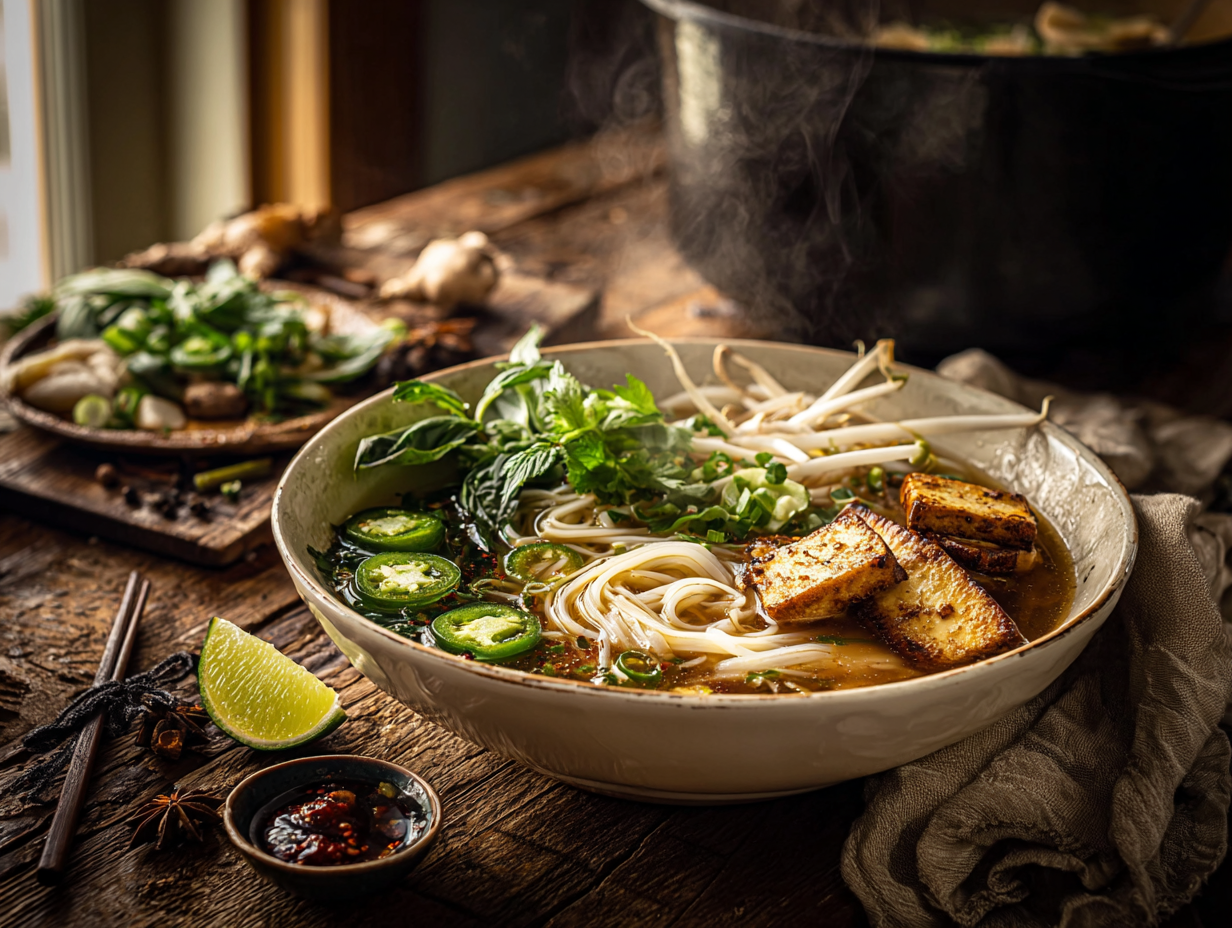
This is a clear, spiced broth loaded with rice noodles, tofu, mushrooms, and fresh herbs — built without any animal products. The broth gets its depth from charred aromatics, whole spices, dried mushrooms, and kombu, so it tastes like it took all day even when it didn’t. If you want a bowl of soup that actually satisfies, this is a reliable one to have in your rotation.
Why this recipe works
Two things carry this broth. First, charring the onion and ginger directly under a broiler or over a gas flame — not just sautéing them — pulls out a smoky sweetness that you cannot fake with extra seasoning. Second, the combination of dried shiitake mushrooms and kombu does the heavy lifting on umami. Shiitakes release glutamates as they steep; kombu adds a separate layer of savory depth through its own natural compounds. Together they replace what beef bones would otherwise provide. Neither ingredient is expensive, and both keep indefinitely in a pantry, so this broth is genuinely achievable on a tight grocery week.
Common problems and fixes
- Broth tastes thin or flat: Add more tamari a teaspoon at a time, then taste. If it still lacks depth, drop in a few extra dried shiitake pieces and simmer another 10 minutes before straining. A pinch of white pepper also sharpens the overall flavor noticeably.
- Broth is cloudy: This usually means the heat was too high during simmering. A rolling boil breaks down the mushrooms and muddies the liquid. Keep it at a bare simmer — just a few lazy bubbles — and strain through a fine-mesh sieve lined with a paper towel or cheesecloth.
- Spices taste sharp or medicinal: Too many cloves is usually the culprit. If you’re scaling up, keep cloves to 2-3 regardless of batch size. You can also strain the broth earlier if the spice flavor is getting aggressive — 30 minutes of steeping is often enough.
- Noodles clump in the bowl: Rice noodles continue absorbing liquid after cooking. If you’re serving in batches or prepping ahead, rinse the cooked noodles under cold water, toss with a tiny bit of neutral oil, and store them separately. Add them to the bowl dry and pour the hot broth over — they’ll loosen immediately.
- Can’t find kombu: Skip it and double the dried shiitakes instead. The broth won’t have quite the same mineral note, but it will still be deeply savory. A sheet of nori stirred in at the end and then removed is a reasonable pantry substitute.
Leftovers and meal prep
Store the broth and noodles separately — this is the single most important thing for leftovers. Broth keeps in the fridge for up to 5 days and freezes well for 3 months; pour it into quart containers or ice cube trays so you can thaw only what you need. Cooked noodles stored in broth turn mushy within a few hours, so keep them in a sealed container with a splash of oil and use within 2 days. Tofu can go into the broth container or stored separately — either works. To reheat, bring the broth to a simmer on the stovetop rather than microwaving it; the microwave tends to flatten the spice notes. Fresh herb garnishes should always be added at serving time, not stored with the soup — skip pre-garnishing if you’re packing this for lunch, not worth the soggy result.

Deep-Umami Vegan Pho (Phở Chay)

Equipment
- 8-quart stockpot
- Sheet pan or broiler-safe rack
- Cast-iron or stainless skillet
- Fine mesh strainer
- Cheesecloth or tea infuser (for spices, optional)
- Tongs
- Chef's knife
- Cutting board
- Ladle
- Measuring cups and spoons
Ingredients
For the Broth Base:
- 2 large yellow onions, halved (skins left on) choose firm, heavy onions; skins aid color when charred
- 1 piece fresh ginger (about 4 inches), split lengthwise look for smooth, taut skin for maximum aroma
- 1 lb mixed mushrooms (cremini and shiitake), roughly chopped stems included for extra umami; organic if possible
- 2 medium carrots, cut into large chunks sweet, fresh carrots deepen broth balance
- 1 small daikon radish, thick slices (optional) adds clean sweetness and body
- 1 piece kombu (about 4 x 4 inches) do not boil too long to avoid bitterness
- 10 cups water filtered if available, for a cleaner finish
For the Spice Bouquet:
- 4 pieces star anise fragrant backbone of pho
- 1 stick cinnamon (about 3 inches) Saigon cinnamon preferred for intensity
- 6 pieces cloves adds warm sweetness—don’t overdo
- 1 tbsp coriander seeds toast until nutty and aromatic
- 1 tsp fennel seeds for subtle sweetness and lift
- 2 pods green cardamom (optional) light citrusy perfume
- 1 tsp black peppercorns (optional) adds a gentle peppery warmth
For the Seasoning & Balance:
- 3 tbsp low-sodium tamari or soy sauce use tamari for gluten-free
- 1 tbsp coconut sugar or rock sugar balances spice and aromatics
- 1 tsp kosher salt, plus more to taste adjust at the end for clarity and balance
- 1 tbsp rice vinegar (optional) a bright finishing note if desired
For the Noodles & Proteins:
- 12 oz dried flat rice noodles (banh pho, size M) choose reputable Vietnamese brands for best texture
- 14 oz extra-firm tofu, pressed and sliced look for non-GMO; press 10–15 minutes
- 1 tbsp neutral oil (avocado or grapeseed) for searing tofu
For the Fresh Toppings & Garnishes:
- 2 cups bean sprouts, rinsed crisp and fresh
- 1 cup Thai basil leaves the signature herbal lift
- 1 cup cilantro leaves with tender stems adds verdant freshness
- 4 pieces scallions, thinly sliced both whites and greens
- 1-2 pieces jalapeños, thinly sliced adjust heat to taste
- 1 medium lime, cut into wedges for squeezing at the table
- ¼ cup vegan hoisin sauce confirm ingredients for vegan-friendly brand
- 2-3 tbsp Sriracha or chili sauce serve on the side
Instructions
- Char the Aromatics: Position an oven rack about 6 inches from the broiler and preheat the broiler to High (about 500°F / 260°C). Place the halved onions (cut side up) and split ginger on a sheet pan and broil until well charred in spots, 8–10 minutes, turning once. You should see blistered skins and smell sweet, smoky aromas.Alternative: Char directly over a gas flame with tongs until blackened.
- Toast the Spices: In a dry skillet over medium heat (about 350°F / 175°C), toast star anise, cinnamon, cloves, coriander, fennel, cardamom, and peppercorns for 2–3 minutes until fragrant and slightly darkened; shake the pan often to prevent scorching. Transfer to a cheesecloth sachet or tea infuser if you prefer easy removal.
- Build the Broth: In an 8-quart stockpot, combine water, mushrooms, carrots, daikon (optional), kombu, charred onions and ginger, and the toasted spices. Bring to a gentle boil over high heat, then immediately reduce to a bare simmer (about 190°F / 88°C). After 20 minutes, remove and discard the kombu to avoid bitterness. Stir in tamari, coconut sugar, and 1 teaspoon salt, and continue simmering gently for 40 minutes more (total simmer ~60 minutes), skimming any foam. You should end up with a clear, aromatic broth with a glossy surface.
- Strain and Keep Hot: Strain the broth through a fine-mesh strainer (or strainer lined with cheesecloth) into a clean pot. Discard solids. Keep the broth at a gentle simmer for serving.
- Sear the Tofu: Heat 1 tablespoon neutral oil in a skillet over medium-high heat (surface ~375–400°F / 190–205°C). Sear tofu slices 2–3 minutes per side until golden and lightly crisp.Alternative: Bake on a lined sheet at 425°F / 220°C for 20 minutes, flipping halfway.
- Prepare the Noodles: Soak rice noodles in warm water for 20–30 minutes until pliable. Bring a separate pot of water to a boil and cook the soaked noodles for 30–60 seconds until just tender but springy. Drain and briefly rinse to stop cooking. Portion noodles into 4 warmed bowls.
- Final Seasoning: Taste the broth and adjust—add a splash more tamari for salt/umami, a pinch of sugar for roundness, or rice vinegar for brightness. Bring back to a brief simmer to meld, then keep hot.
- Assemble: Arrange tofu over the noodles. Ladle about 2 cups of boiling-hot broth into each bowl. Top with scallions, cilantro, Thai basil, bean sprouts, and jalapeños. Serve with lime wedges, hoisin, and Sriracha on the side so diners can balance the bowl to taste. A perfect bowl will glisten with aromatic steam, herbs standing vibrant and perky, and noodles silky yet bouncy.
Notes
Michelle’s Tips:
- Deeper Umami: Add a handful of dried shiitakes to the pot; remove before straining. A small piece of charred apple or parsnip adds delicate sweetness.
- Speed the Char: If short on time, halve onions and sear cut-side down in a hot dry skillet until deeply browned; then add ginger slices and sear.
- Crystal-Clear Broth: Avoid vigorous boiling after the initial heat-up; a gentle simmer keeps the broth clear.
- Tofu Texture: For a chewier bite, freeze the tofu overnight, thaw, press, then sear.
- Gluten-Free: Use tamari or coconut aminos; verify hoisin brand is gluten-free.
- Salt Smart: Season the hot strained broth at the end—heat amplifies saltiness, so taste just off a simmer.
- For the cleanest flavor, avoid over-reducing the broth. Keep it at a gentle simmer and adjust seasoning at the end.
- Reserve a few seared mushroom slices as an additional topping if you like.
Serving Suggestions:
Warm wide bowls, mound noodles neatly, then fan tofu slices on one side. Ladle broth so it just covers the noodles and shimmers. Crown with a loose bouquet of Thai basil and cilantro, nestle bean sprouts for crunch, then dot with jalapeños. Finish with a bright lime wedge on the rim. Pair with iced jasmine tea or a crisp sparkling water with lime. A perfect bowl smells of warm spice, roasted ginger, and fresh herbs.Culinary Context:
Pho traces its roots to northern Vietnam before blossoming into countless regional expressions. Phở chay—vegetarian/vegan pho—has long been embraced in Buddhist kitchens, celebrating clarity and balance without animal products. This version leans on traditional char and spice, with mushrooms and kombu providing respectful depth in place of beef bones.Optional Advanced Instructions:
- Make-Ahead: The broth improves overnight; chill, then reheat to a lively simmer before serving. Skim any gelled fat-like mushroom solids for an even cleaner sip.
- Pressure Cooker: Combine broth ingredients (remove kombu after 10 minutes using sauté mode), then cook at High Pressure for 30 minutes; natural release 15 minutes. Strain and season to finish.
- Spice Sachet: Tie spices in cheesecloth for easy removal and a pristine pour.
- Batching: Double the broth and freeze in quart containers for lightning-fast future bowls.
Timing:
- Prep Time: 30 minutes (0 hours 30 minutes)
- Cook Time: 70 minutes (1 hour 10 minutes)
- Total Time: 100 minutes (1 hour 40 minutes)
Course and Cuisine:
Course: Lunch, Dinner, Main Course Cuisine: Vietnamese Origin: VietnamNutrition
Common questions
Can I use regular soy sauce instead of tamari?
Yes, regular soy sauce works fine here. The main difference is that tamari is usually gluten-free and slightly less salty, so if you swap in soy sauce, start with a little less and adjust to taste.
I don’t have star anise — can I still make this?
You can, though star anise is the most distinctive spice in pho’s flavor profile. A small amount of Chinese five-spice powder (about a quarter teaspoon) contains star anise and can fill the gap in a pinch — just don’t add more than that or it will overpower everything else.
What can I use instead of firm tofu?
Pan-fried tempeh slices or canned chickpeas both work well as protein swaps. Tempeh holds up better in hot broth; chickpeas are the quickest option if you’re working with what’s already in the pantry.
More plant-based recipes to try
- Vegan Vietnamese Sizzling Crepes
- Vegan Malaysian Laksa Soup
- Vegan Thai Drunken Noodles
- Sesame Ginger Soba Salad