
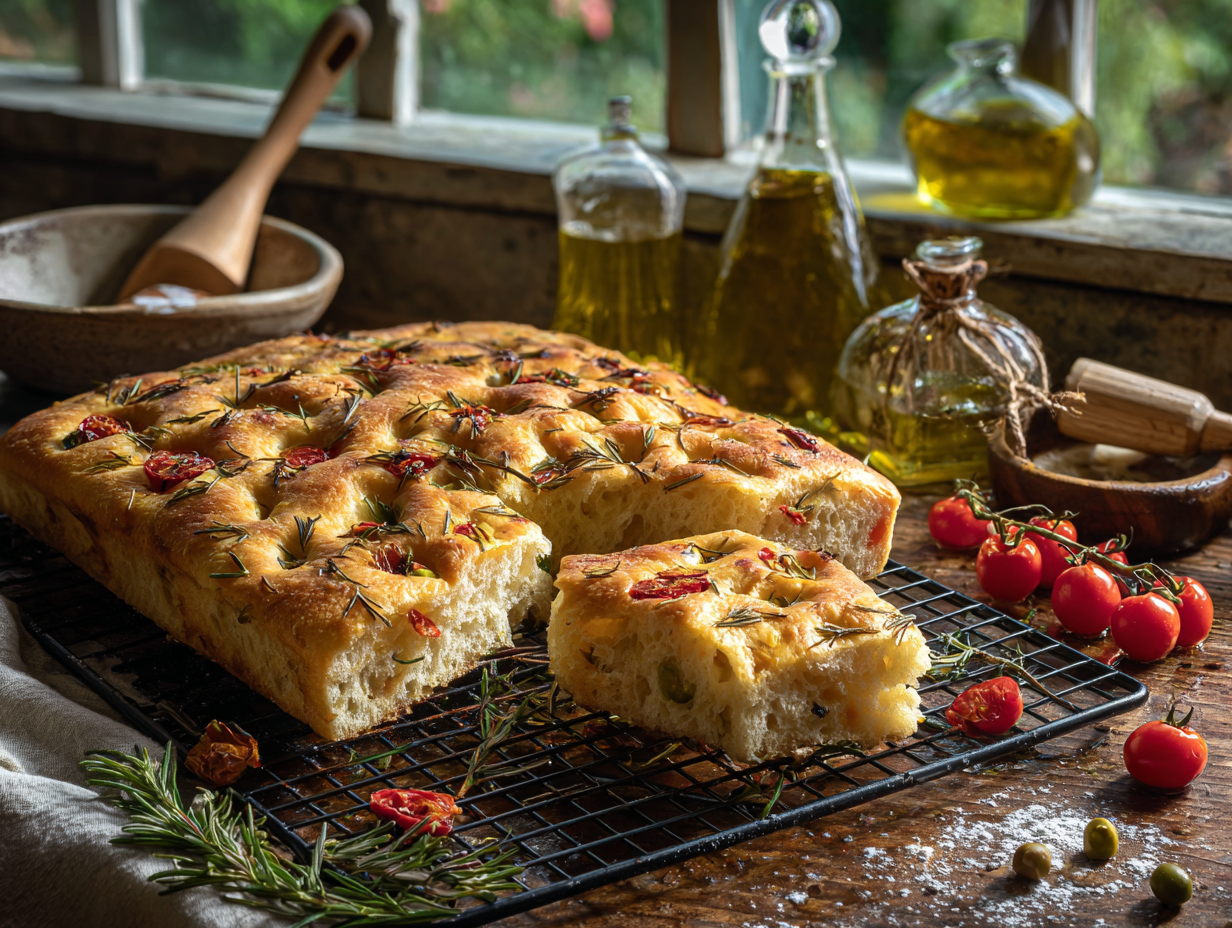
Focaccia is a thick, olive-oil-rich Italian flatbread with a crispy bottom, a soft and airy interior, and a dimpled top that holds pools of oil and salt. It has always been naturally vegan — no substitutions needed. Make it when you want something impressive that mostly takes care of itself while the dough rests.
The technique that matters
The two things that separate good focaccia from dense, disappointing focaccia are patience with the rise and not skimping on the olive oil in the pan. The dough needs enough time to develop bubbles — those bubbles are what give you that open, airy crumb. Rushing the rise, even by 20 minutes, produces a noticeably tighter texture. As for the oil: it should coat the entire bottom of the pan generously before the dough goes in. That oil isn’t just flavor — it fries the bottom crust as it bakes, which is exactly what makes focaccia worth making at home. Use a good extra-virgin olive oil here, because it’s doing most of the work.
Substitutions that actually work
- Fresh rosemary vs. dried: Fresh is strongly preferred — dried rosemary can turn sharp and slightly bitter at high oven heat. If fresh isn’t available, use half the amount of dried and press it into the dough rather than scattering it on top.
- All-purpose vs. bread flour: Bread flour gives a chewier crumb with more structure. All-purpose works and produces a slightly softer result — both are fine for beginners.
- Flaky sea salt: Don’t swap this for table salt on top. Table salt dissolves too quickly and disappears into the dough. Flaky salt stays on the surface and gives you that distinct salty crunch.
- Other toppings: Thinly sliced olives, cherry tomatoes halved and pressed cut-side down, or caramelized onions all work well — add them right before baking, not before the final rise.
Storage and reheating
Focaccia is best the day it’s baked. Store leftovers at room temperature, wrapped in a clean kitchen towel or loosely in foil, for up to 2 days — the fridge makes it go stale faster, so avoid it. To reheat, place slices directly on the oven rack or a baking sheet at 375°F for 5 to 8 minutes; this brings the crust back to life in a way a microwave simply won’t. For longer storage, freeze fully cooled slices in a zip-lock bag for up to 1 month. Reheat from frozen at 375°F for about 12 minutes — skip thawing first, it gets soggy.
Mistakes to avoid
- Using cold water to activate the yeast: The water should be warm — around 100–110°F. Too cold and the yeast won’t activate; too hot and you’ll kill it. If you don’t have a thermometer, it should feel like warm bathwater on your wrist.
- Deflating the dough when transferring it to the pan: Tip the dough in gently and use oiled fingers to coax it toward the edges. Don’t press hard or stretch aggressively — you’ll push out the gas bubbles you just spent an hour building.
- Dimpling too early or too late: Dimple the dough right before it goes into the oven, after the final rest in the pan. Dimpling too early lets the holes close up; skipping them entirely causes the surface to bubble and puff unevenly.
- Pulling it out too soon: The top should be deep golden, not just lightly golden. Pale focaccia is undercooked underneath even when the top looks set. Go for color — it won’t burn if your oven is at the right temperature.
- Adding toppings before the final pan rest: Heavy toppings placed on the dough before the last rise will weigh it down and prevent it from puffing properly. Add them after the rest, just before baking.

Ligurian-Style Vegan Rosemary Focaccia

Equipment
- Large mixing bowl
- 9x13-inch metal rimmed baking pan (or quarter-sheet pan)
- Measuring cups and spoons
- Whisk
- Silicone spatula or wooden spoon
- Bench scraper (optional)
- Pastry brush (optional)
- Kitchen thermometer for water (optional)
- Stand mixer with dough hook (optional alternative)
- Clean kitchen towel or plastic wrap
- Cooling rack
Ingredients
For the Dough:
- 1 ½ cups warm water (95°F/35°C) use filtered water for best yeast activity
- 2 teaspoons organic cane sugar feeds the yeast and aids browning; any fine sugar works
- 2 ¼ teaspoons instant yeast one standard packet; Red Star or SAF recommended
- 2 tablespoons extra-virgin olive oil fruity Ligurian-style or robust Tuscan oil shines
- 4 cups unbleached all-purpose flour spoon-and-level; King Arthur or Central Milling preferred
- 2 teaspoons fine sea salt fine texture disperses evenly in the dough
For the Pan & Prep:
- 1 teaspoon extra-virgin olive oil, for greasing bowl prevents sticking during bulk fermentation
- 3 tablespoons extra-virgin olive oil, for the pan ensures a crisp, fried-undercrust
For the Toppings:
- 2 tablespoons fresh rosemary leaves, chopped tender tips are most aromatic
- 3 cloves garlic, thinly sliced paper-thin slices toast gently without burning
- 1 cup ripe cherry tomatoes, halved choose firm, sweet, in-season tomatoes
- ½ cup pitted olives (optional) Castelvetrano or Taggiasca for classic flavor
- 1 teaspoon flaky sea salt for finishing crunch; adjust to taste
For the Olive Oil Brine & Finish:
- 3 tablespoons warm water (for brine) helps disperse salt and oil across the surface
- 1 tablespoon extra-virgin olive oil (for brine) emulsifies with water for even browning
- ½ teaspoon fine sea salt (for brine) seasoning for the crust
- 1 tablespoon extra-virgin olive oil, for finishing final aromatic sheen
Instructions
- Bloom the Yeast (10 minutes): In a large bowl, whisk together 1 1/2 cups warm water at 95°F/35°C and 2 teaspoons sugar. Sprinkle in 2 1/4 teaspoons instant yeast and whisk again. Let stand until a light foam forms on the surface, about 10 minutes. Sensory cue: it should smell bready and look creamy-foamy. If it doesn’t foam, replace your yeast.
- Mix the Dough (3 minutes), then Autolyse (15 minutes): Whisk in 2 tablespoons olive oil. Add 4 cups flour and 2 teaspoons fine sea salt. Stir with a spatula until no dry pockets remain and the dough looks shaggy, 2–3 minutes. Cover and rest 15 minutes (autolyse) to hydrate flour; the dough will smooth out slightly.
- Knead until Elastic (5 minutes): With lightly oiled hands, knead in the bowl using stretch-and-folds: grab an edge, stretch it up, fold over the center; rotate the bowl and repeat for 5 minutes until the dough becomes smoother and tacky but not tearing. Alternative: stand mixer with a dough hook on low speed for 3–4 minutes. Sensory cue: the dough should pull into long strands and feel bouncy.
- First Rise (60 minutes at warm room temp): Lightly grease a clean bowl with 1 teaspoon olive oil. Transfer dough, cover with a towel or plastic wrap, and let rise until roughly doubled, about 60 minutes at 75°F/24°C. Optional strength-building: after 30 minutes, perform 1 set of gentle coil folds (lift dough in the center and tuck ends under) to encourage an open crumb.
- Prepare the Pan and Transfer (20-minute relax): Pour 3 tablespoons olive oil into a 9x13-inch metal pan, tilting to fully coat. Gently turn the dough into the pan and flip once to oil both sides. Let the dough relax, uncovered, 20 minutes so it stretches easily without springing back.
- Make the Brine (2 minutes): In a small bowl, whisk 3 tablespoons warm water, 1 tablespoon olive oil, and 1/2 teaspoon fine sea salt until slightly emulsified and cloudy.
- Dimple, Brine, and Top: With well-oiled fingertips, press the dough outward to the corners, then dimple deeply—your fingertips should touch the pan without tearing the dough. Drizzle the brine evenly over the surface so it pools in the dimples. Scatter 2 tablespoons chopped rosemary, 3 thinly sliced garlic cloves, 1 cup halved cherry tomatoes, and 1/2 cup olives (optional). Finish with 1 teaspoon flaky salt.
- Final Proof (35 minutes) and Preheat: Let the topped dough proof at room temperature until puffed and slightly jiggly, about 35 minutes. About 20 minutes into this proof, preheat the oven to 450°F/232°C so it’s fully hot when you bake. Visual cue: the dough should look aerated with visible bubbles beneath the surface.
- Bake (24 minutes at 450°F/232°C): Bake on the center rack for 24 minutes, rotating the pan halfway at 12 minutes. The focaccia is done when the edges are deep golden and the top is burnished with tiny crisp ridges. Aroma cue: toasted wheat and warm olive oil.
- Finish and Cool: Set the pan on a cooling rack. Brush or drizzle 1 tablespoon olive oil over the hot surface for a glossy finish. Loosen edges with a thin spatula and lift the bread onto the rack after 5–10 minutes to keep the bottom crisp. Cool slightly before slicing into 12 squares.
Notes
Michelle’s Tips:
- Flour Choice: For more chew and bigger bubbles, swap 1 cup of all-purpose for bread flour. For a softer crumb, keep all all-purpose.
- Hydration Management: If your dough feels overly stiff, wet your hands and perform a few extra stretch-and-folds. If too sticky to handle, lightly oil your fingers instead of adding flour.
- Make it Garlic-Forward: Toss the sliced garlic with a teaspoon of olive oil to prevent scorching.
- Gluten-Free Adaptation: Use a reputable 1:1 gluten-free flour blend and increase water by 2–4 tablespoons to achieve a tacky dough. Expect a slightly denser crumb.
- Flavor Boosters: Add 2 tablespoons aquafaba (chickpea liquid) to the dough for extra tenderness, or 1/4 cup finely mashed cooked potato for a plush interior.
- Don’t Skip the Brine: That water–oil–salt mix promotes even blistering, bronzing, and savory depth.
- Pan Matters: A metal pan yields the crispiest underside; glass runs hotter at the edges—monitor browning.
Serving Suggestions:
- Plating: Cut into generous squares and stack slightly offset for height. Drizzle with a thread of olive oil and scatter a few fresh rosemary needles for color.
- Pairings: Serve with a shallow dish of peppery olive oil and a whisper of balsamic, a bowl of briny olives, or alongside minestrone, grilled vegetables, or a bright tomato salad.
- Visual Cues: Perfect focaccia shows a golden, craggy top; olive-oil sheen; and an open, irregular crumb that springs back when pressed.
Culinary Context:
Focaccia hails from Liguria in northwestern Italy, where olive oil is the region’s heartbeat. This rendition honors that heritage while staying fully plant-based, leaning on technique and quality oil for richness and depth. I first fell in love with it in a tiny Genoese bakery, where the baker brushed on more oil the moment it left the oven—an irresistible finishing touch I’ve kept ever since.Optional Advanced Instructions:
- Overnight Cold Ferment: After the first 60-minute rise, refrigerate the covered dough 12–24 hours. The next day, bring to room temperature for 45–60 minutes, then proceed with pan transfer, brine, and bake. Expect deeper flavor and a lacier crumb.
- Make-Ahead Toppings: Slice garlic and chop rosemary up to 8 hours in advance; keep covered and chilled. Halve tomatoes right before baking to retain juices.
- No-Stand-Mixer Method: Use brief kneading plus 2–3 sets of stretch-and-folds spaced 10 minutes apart for excellent structure without overworking.
Nutrition
FAQ
Can I make focaccia dough the night before?
Yes — an overnight cold rise in the fridge actually improves the flavor. Mix the dough, let it rise at room temperature for 1 hour, then cover and refrigerate overnight. Take it out about 1 hour before you plan to bake so it can come back to room temperature before you transfer it to the pan.
My dough isn’t rising — what went wrong?
The most likely cause is yeast that didn’t activate, usually because the water was too cold, too hot, or the yeast was old. Check that your yeast foams within 10 minutes of mixing with warm water — if it doesn’t, start over with fresh yeast before adding flour.
How do I know when the focaccia is fully baked?
The top should be a deep, even golden brown and the edges should have pulled slightly away from the pan. Lift a corner with a spatula — the bottom should be golden and firm, not pale or soft. If the top looks done but the bottom is still light, give it 3 to 5 more minutes.
More plant-based recipes to try
- Mediterranean Lentil Power Bowl
- Smoky Spanish Chickpea Stew
- Baked Ratatouille with Herb Oil
- Vegan Polenta Mushroom Bliss