
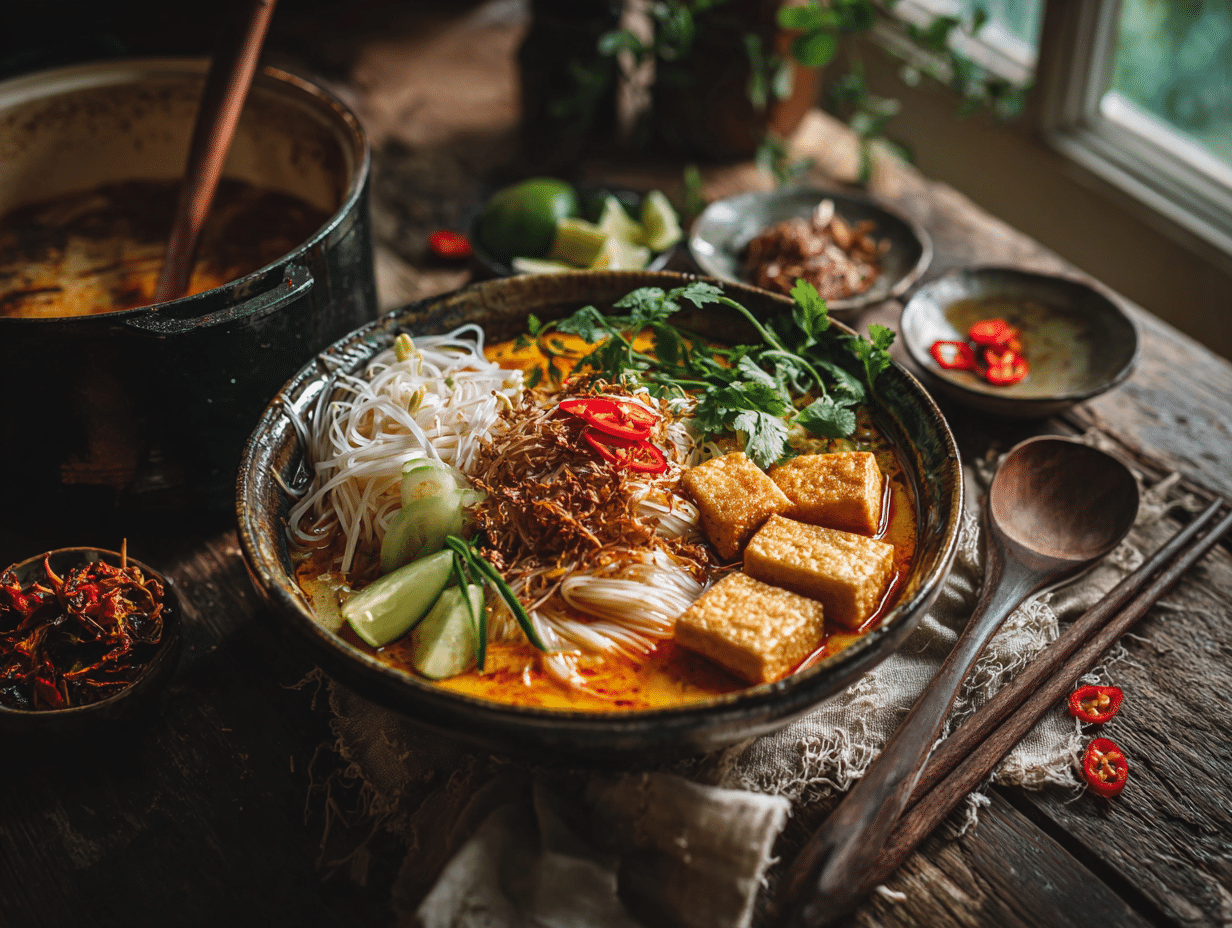
This is a coconut curry noodle soup built on a blended spice paste of lemongrass, galangal, shallots, and chilies, finished with coconut milk and loaded with king oyster mushrooms, pressed tofu, and rice noodles. It takes about an hour start to finish and lands as a genuinely filling, protein-complete meal. The nori-and-miso trick does real work here — you won’t miss the shrimp paste.
The technique that matters
Frying the spice paste in oil until the oil visibly separates from the solids is the step that makes or breaks this soup. It usually takes 8–12 minutes over medium heat with regular stirring. If you pull the paste too early, the broth tastes raw and flat. You’re looking for the paste to darken slightly, smell deeply fragrant rather than sharp, and for little pools of orange oil to appear around the edges. The second thing worth doing carefully is pressing your tofu hard — at least 20 minutes under a heavy pan — before it goes in. Wet tofu won’t brown and won’t hold up in the broth.
Ingredient notes
- Galangal: Sold fresh or frozen at most Asian grocery stores. It looks like ginger but tastes pinier and more citrusy. Dried galangal powder is a weak substitute — use fresh ginger plus a small strip of lime zest if you’re stuck.
- Lemongrass: Peel off the tough outer layers and use only the pale bottom third. Frozen lemongrass works fine here since it’s going into a blended paste.
- Nori sheets: Standard sushi nori. Toast them briefly in a dry pan before blending — 30 seconds per side — to get the most out of them.
- White miso: Shiro miso. Don’t swap in red or brown miso; the flavor is too strong and will muddy the broth.
- King oyster mushrooms: These hold their texture in hot broth better than most mushrooms. Regular oyster mushrooms work but will soften faster, so add them later.
- Pressed tofu: Extra-firm tofu pressed and pan-fried gives you the best protein hit and texture. Silken tofu will fall apart — skip it here.
Leftovers and meal prep
Store the broth and noodles separately — noodles left in broth overnight turn to mush. The broth keeps in the fridge for up to 4 days and freezes well for up to 3 months; freeze it before adding coconut milk if you want the cleanest texture on reheating, then stir in fresh coconut milk when you warm it. The spice paste alone freezes beautifully in an ice cube tray; pop out a few cubes on a weeknight and you’re most of the way to dinner. Reheat the broth gently over medium-low — a hard boil will break the coconut milk and make it grainy. Cook fresh noodles to order each time.
What can go wrong
- Broth tastes thin and one-dimensional: The paste wasn’t fried long enough. You can partially rescue it by simmering the finished broth uncovered for an extra 10 minutes to concentrate it, then adding a splash more coconut milk at the end.
- Coconut milk has curdled into grainy flecks: The heat was too high after the coconut milk went in. Keep it at a gentle simmer from that point on. It’s still safe to eat but the texture suffers — blending the broth briefly can smooth it out.
- Tofu is soggy and falling apart: It wasn’t pressed long enough or wasn’t dried before hitting the pan. Pat it with paper towels right before frying and make sure the pan is properly hot before the tofu goes in.
- Soup is aggressively spicy and you can’t dial it back: Stir in a little more coconut milk and a squeeze of lime — both cut heat without wrecking the broth. Adding more noodles to the bowl also helps distribute the heat.
- Paste won’t blend smoothly: Add the liquid ingredients (miso, a tablespoon of water or coconut milk) to the blender first, then the harder aromatics. A high-speed blender handles this easily; a standard blender may need a few scrape-downs.

Vegan Laksa Soup (Malaysian Curry Noodle Soup)

Equipment
- Dutch oven or deep saucepan
- Blender or food processor
- Mortar and pestle (optional)
- Fine mesh strainer (optional)
- Chef's knife
- Cutting board
- Measuring cups and spoons
- Ladle
- Tongs or chopsticks
Ingredients
For the Laksa Paste:
- 1 cup hot water, for soaking chilies use just-boiled water to soften dried chilies quickly
- 8 pieces dried red chilies, seeded adjust to your heat preference; soak until pliable
- 1 cup shallots, roughly chopped choose fresh, firm shallots for sweetness
- 6 cloves garlic fresh cloves for a clean aroma
- 2 stalks lemongrass, tender inner part only bruise lightly; remove tough outer layers
- 2 tbsp fresh ginger or galangal, sliced galangal is traditional; ginger is a fine substitute
- ¼ cup macadamia nuts or raw cashews acts as a candlenut substitute for body and gloss
- 1 tsp ground turmeric for color and earthiness
- 1 tsp ground coriander blooming it in oil releases citrusy notes
- ½ tsp ground cumin adds warmth and depth
- ¼ tsp ground white pepper traditional peppery lift
- 1 tsp lime zest or 2 kaffir lime leaves (torn) zest for brightness; kaffir leaves for floral citrus
- ½ sheet nori, toasted and crumbled vegan stand-in for belacan’s oceanic depth
- 1 tbsp white miso paste adds savory umami without overpowering
- 3 tbsp neutral oil (grapeseed or canola), divided use 1 tbsp to blend paste and 2 tbsp for frying
For the Broth & Noodles:
- 8 oz king oyster mushrooms, thinly sliced meaty texture that absorbs broth beautifully
- 14 oz firm tofu, pressed and 3/4-inch cubes press 20 minutes for best texture
- 4 cups low-sodium vegetable broth a clean, unsalted base lets the paste shine
- 2 cups full-fat coconut milk look for additive-free brands like Aroy-D for silky body
- ½ cup coconut cream optional but luxurious
- 2 tbsp soy sauce or tamari adds salinity and umami
- 2 tsp coconut sugar or brown sugar balances heat and acidity
- ½ tsp fine sea salt, to taste adjust depending on broth and soy sauce
- 2 cups fried tofu puffs optional; they soak up curry like sponges
- 2 tbsp fresh lime juice added off heat to preserve brightness
- 8 oz rice vermicelli noodles (or thick laksa rice noodles) cook separately according to package
For the Toppings & Garnishes:
- 2 cups bean sprouts rinse well for crisp freshness
- ½ cup fresh cilantro leaves pick tender leaves for delicate texture
- ½ cup Thai basil leaves adds aniseed perfume
- ½ cup scallions, thinly sliced for sharp freshness and color
- 1 cup cucumber, julienned cooling crunch contrasts the hot broth
- 1 piece red chili, thinly sliced bird’s eye for heat, Fresnos for milder
- 4 wedges lime serve at the table for extra zing
- ¼ cup fried shallots adds savory crunch
- 2 tbsp sambal oelek or chili crisp for heat at the table; check vegan labeling
Instructions
- Soak Chilies & Prep Aromatics (15 minutes): Place the dried chilies in a bowl and cover with the hot water. Soak until soft and pliable, about 15 minutes. Meanwhile, roughly chop the shallots, garlic, lemongrass (tender inner part), and ginger/galangal. Drain chilies, reserving a few tablespoons of the soaking liquid.
- Make the Laksa Paste (5–7 minutes): In a blender or food processor, combine drained chilies, shallots, garlic, lemongrass, ginger/galangal, nuts, turmeric, coriander, cumin, white pepper, lime zest/kaffir leaves, nori, and miso. Add 1 tbsp neutral oil and 2–3 tbsp chili soaking liquid. Blend to a thick, smooth paste, scraping down the sides as needed. Alternative: Use a mortar and pestle for a more rustic, aromatic paste—the friction coaxes out essential oils, though it takes longer.
- Fry the Paste (5–7 minutes): Heat the remaining 2 tbsp oil in a Dutch oven over medium heat. Add the paste and cook, stirring frequently, until it deepens in color, smells intensely aromatic, and the oil begins to separate from the paste—about 5–7 minutes. This blooming step unlocks the spices’ full flavor.
- Aromatics Meet Protein (3 minutes): Add the sliced king oyster mushrooms and cubed pressed tofu. Stir-fry with the paste until the mushrooms begin to soften and everything is coated, about 3 minutes.
- Build the Broth (10 minutes): Pour in the vegetable broth and bring to a gentle simmer at about 190°F / 88°C. Simmer for 10 minutes to meld flavors, stirring occasionally and skimming any froth for a clean finish.
- Enrich with Coconut (5 minutes): Reduce heat to low and stir in the coconut milk and coconut cream. Keep the soup just under a simmer at roughly 180°F / 82°C for 5 minutes—avoid a rolling boil to prevent curdling or splitting.
- Season & Finish (2–3 minutes): Stir in soy sauce, coconut sugar, and salt to taste. Add tofu puffs (if using) and warm for 2 minutes so they absorb the curry. Turn off the heat and stir in lime juice for fresh brightness.
- Cook the Noodles (3–5 minutes): While the broth simmers, cook rice vermicelli according to package directions—typically 3–5 minutes in boiling water, or pour-over soak until tender. Drain and rinse briefly under cool water to stop cooking and prevent sticking. Tip: For thick laksa rice noodles, extend cooking per package until bouncy-tender.
- Assemble & Serve: Divide noodles among 4 warm bowls. Ladle the steaming laksa broth with mushrooms and tofu over the noodles. Pile on bean sprouts, cilantro, Thai basil, scallions, cucumber, and red chili. Crown with fried shallots and serve with lime wedges and sambal on the side.
Notes
Mary’s Tips:
- Paste Depth: Don’t rush frying the paste. Cook until the oil visibly separates—this is when the aromatics have released their full flavor.
- Belacan-Leaning Umami, Vegan-Style: Toasted nori + white miso together mimic the oceanic depth of shrimp paste without compromising ethics.
- Creaminess Control: Coconut cream is optional; for a lighter bowl, use only coconut milk and add an extra 1/2 cup broth.
- Heat Management: For a milder laksa, reduce dried chilies to 4–6; for fiery heat, keep the chili seeds or add sambal at the end.
- Noodle Choices: Rice vermicelli offers a delicate slurp; thick laksa noodles give a chewier, heartier bite.
- Substitutions: Galangal can be replaced with ginger; macadamias/cashews stand in for candlenuts; tamari replaces soy for gluten-free.
- Faster Aromatics: Thinly slicing shallots and lemongrass helps the blender break them down quicker; add a splash more soaking liquid if needed.
- Salt Balance: Adjust salt only after adding soy sauce; broths vary widely in salinity.
Nutrition
Your questions, answered
Can I make this without a high-speed blender?
Yes, a standard blender works — just chop the lemongrass and galangal as finely as you can before blending, and add a tablespoon or two of water to help it move. You may end up with a slightly coarser paste, which is fine; it will still fry down and flavor the broth well.
Is this enough protein for a full meal?
With both pressed tofu and king oyster mushrooms in the bowl, each serving lands around 20–25 grams of protein depending on portion size. If you want more, add a handful of shelled edamame directly to the broth for the last two minutes of cooking — no extra prep needed.
Can I use canned coconut cream instead of coconut milk?
You can, but dilute it — one part coconut cream to one part water gets you close to full-fat coconut milk. Undiluted coconut cream makes the broth very thick and can overpower the spice paste. Skip the garnish of extra coconut cream drizzled on top if you go this route; it’s not worth the extra dish.
If you liked this one
- Indonesian Gado-Gado Peanut Salad
- Vegan Indonesian Rice Bowl
- Vegan Thai Drunken Noodles
- Vegan Japanese Katsu Curry